The problem is that most plans on file are generic. They were downloaded, lightly edited, and never matched to the actual tasks, equipment, hazards, or facilities employees work in every day. A Cal/OSHA inspection follow-up found employers saw a 9.4% drop in injury claims and 26% average savings in workers' compensation costs in the four years after an inspection, according to OSHA's business case data. That gap between paper compliance and real prevention is exactly what this guide addresses.
We'll cover what belongs in a safety plan, how to build and roll one out, which OSHA programs commonly apply, and how to keep the plan current as your operation changes.
Key Takeaways
- Build the plan around your actual hazards, workforce, and operations, not a template.
- A plan only works if employees understand it, practice it, and can access it fast.
- Confirm which written programs apply under federal OSHA, a state plan, or your industry.
- Use inspections, incident data, and ergonomic assessments to drive plan updates.
- Document revisions with clear ownership and proof that workers received the changes.
Workplace Safety Plan Fundamentals
A workplace safety plan is a documented framework covering hazard identification, controls, safe work expectations, emergency response, training, reporting, and accountability. It's the umbrella document that ties everything else together.
Safety Plan vs. SOPs and SWPs
The plan isn't the same thing as a standard operating procedure (SOP) or a safe work procedure (SWP), and confusing the three creates gaps.
- Workplace safety plan — the management framework: policy, roles, hazard process, emergency response, records.
- SOP — standardizes how a process gets done, step by step, for consistency and quality.
- SWP — focuses on doing a specific task safely, naming hazards, controls, and required PPE.
These documents should reference each other. A plan that never gets down to task-level detail is too vague to follow; a stack of SWPs with no overarching plan lacks direction and accountability.
Why a Proactive Plan Pays Off
A plan built around your real operating environment—manufacturing floor, warehouse, food processing line, office, or multi-site work—does more than reduce injuries. It also:
- Clarifies decision-making during a crisis
- Strengthens day-to-day safety culture
- Limits disruption after an incident
DORN Companies has spent nearly 25 years in workplace injury prevention and reached over 120,000 employees nationwide. Its proactive strategies have helped employers save more than $150 million in workers' compensation and healthcare costs. The pattern holds regardless of company size: prevention costs less than reaction.
What to Include in a Workplace Safety Plan
A complete plan touches five areas: policy and commitment, hazard identification, controls, communication, and emergency response.
Policy, Roles, and Hazard Identification
Start with a written safety policy that states leadership's commitment, defines worker participation, and gives employees explicit authority to report or stop unsafe work. Then document how hazards get identified, covering:
- Routine and non-routine tasks
- Equipment, chemicals, and walking-working surfaces
- Material handling and ergonomics
- Fatigue and workplace violence risk factors
- Hazards affecting remote or traveling workers
OSHA's hazard-identification guidance recommends investigating incidents and near misses, grouping similar events, and reviewing chemical, physical, biological, and ergonomic categories together rather than in isolation.
Hazard Controls and Emergency Procedures
Once hazards are identified, apply controls using the hierarchy of controls. NIOSH ranks five levels from most to least effective: elimination, substitution, engineering controls, administrative controls, and PPE. Assign ownership for each control and note maintenance responsibilities.

Emergency procedures should cover:
- How to report an emergency and alert employees
- Evacuation or shelter-in-place steps
- Personnel accounting and first aid
- Contractor coordination during incidents
Your communication plan should address language needs and accessibility so every worker can act on those instructions.
Ergonomics and Injury Prevention
Beyond general hazard controls, physically demanding tasks need dedicated attention. Lifting, pushing, pulling, repetitive motion, and awkward postures drive many musculoskeletal claims, so give them their own section in the plan.
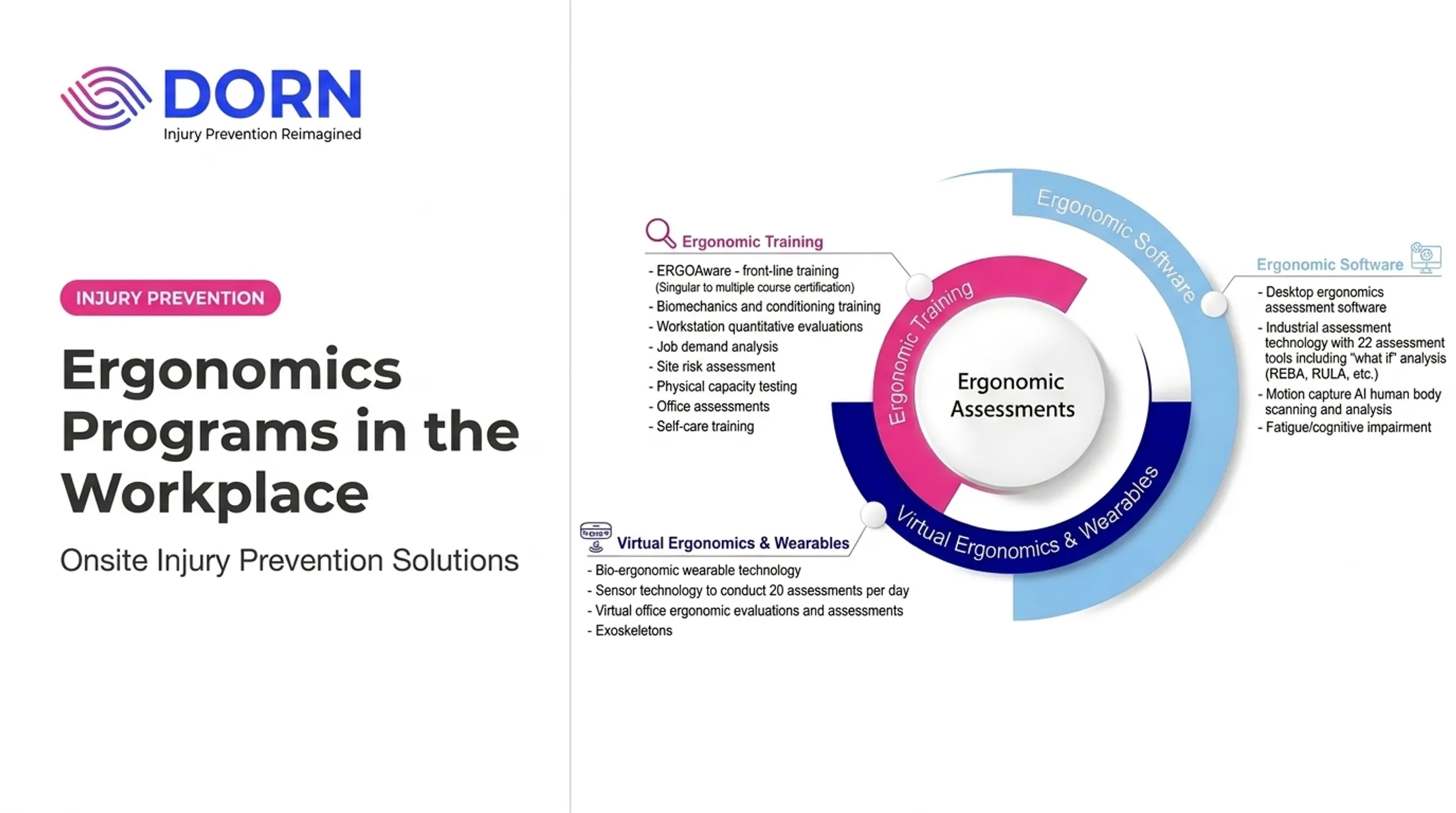
Ergonomic evaluations and early intervention catch musculoskeletal risk before it turns into a claim. DORN Companies supports this part of the plan with ergonomic assessments, onsite injury prevention specialists, education, coaching, and workplace wellness services that address risks before they escalate.
How to Create and Implement the Plan
Building a plan that gets used, not just filed, follows a logical sequence.
Baseline Review and Risk Prioritization
Start by reviewing injury and illness records, near misses, inspection findings, employee feedback, and current job tasks. This baseline tells you where the real risk sits, not where you assume it sits.
Then prioritize. OSHA directs employers to weigh:
- Severity — how bad could the outcome be?
- Likelihood — how often could exposure occur?
- Number of workers affected — how widespread is the risk?
- Control effectiveness — are existing measures actually working?
Address the highest-risk items first. Assign each plan component a specific owner (a manager, supervisor, safety professional, or employee representative).
Training, Access, and Ownership
Write procedures in plain language employees can use at the point of work: task steps, hazard warnings, required PPE, stop-work criteria, and revision dates.
Then train employees on the parts relevant to their roles. Verify understanding through demonstrations and drills rather than just an attendance sheet.
Make the plan accessible where people actually work:
- Posted emergency information at entry points
- Digital systems supervisors can pull up on the floor
- Onboarding materials for new hires
- Offline copies where connectivity is limited
Employers without internal ergonomics or safety staff often bring in outside support at this stage. DORN Companies provides onsite and virtual ergonomic assessments, injury-prevention specialists, and technology such as AI motion capture.
Teams use that support to address a specific injury trend, problem workstation, or multi-site rollout without hiring a full internal team.
After rollout, set a fixed review cadence. Revisit injury data, near misses, and employee feedback so the plan stays current as jobs and staffing change.

OSHA Requirements and Common Plan Types
Whether OSHA requires a written plan depends on your workplace, hazards, industry, and whether you fall under federal OSHA or an OSHA-approved state plan. This section is educational, not legal advice; verify current requirements against official OSHA and state sources before finalizing anything.
A general safety plan built as a management best practice is different from a written program that a specific OSHA standard requires. Common examples:
| Program | Triggering Activity | Standard |
|---|---|---|
| Emergency Action Plan | Required when an OSHA standard calls for one | 29 CFR 1910.38 |
| Fire Prevention Plan | Fire hazards, ignition sources, storage | 29 CFR 1910.39 |
| Hazard Communication | Hazardous chemicals onsite | 29 CFR 1910.1200 |
| Lockout/Tagout | Servicing equipment with hazardous energy | 29 CFR 1910.147 |
| Bloodborne Pathogens | Occupational exposure to blood/body fluids | 29 CFR 1910.1030 |
| Respiratory Protection | Respirators necessary or required | 29 CFR 1910.134 |
| Hearing Conservation | 85 dB(A) 8-hour TWA or higher | 29 CFR 1910.95 |
| Permit-Required Confined Spaces | Entry into permit spaces | 29 CFR 1910.146 |
Employers operating in multiple states need to check jurisdiction by jurisdiction. Twenty-two OSHA-approved state plans cover private-sector workers, and several impose stricter requirements than federal OSHA.
Having the document on file isn't the same as being compliant. Inspectors want to see controls implemented, employees trained, records maintained, and deficiencies actually corrected. Before an audit, confirm you have:
- Current plan versions with revision dates
- Accessible training records
- Recent inspection findings and closed corrective actions
- Emergency drill records
- An up-to-date hazard inventory
Review, Measure, and Improve the Plan
A plan that never changes stops matching reality. Set a review schedule tied to regulatory updates, new equipment, workforce changes, incident experience, and lessons from emergency drills.
Track both types of indicators:
- Leading indicators — inspections completed, hazard reports filed, training completion, ergonomic interventions made
- Lagging indicators — injuries, near misses, restricted-duty days, workers' comp costs, absenteeism
OSHA's guidance on leading indicators notes that lagging measures, like back injuries from repeated lifting, often show up only after the leading indicators were already flashing warning signs.

Metrics alone miss what workers see on the floor. Build employee feedback into the process through safety committees, surveys, and confidential reporting channels. When you revise the plan, document the version, the approval date, the responsible owner, and confirmation that affected employees received the update.
The improvement cycle then repeats:
- Identify the hazard
- Implement a control
- Verify it works
- Communicate the change
- Revise again when evidence shows current controls aren't enough
Frequently Asked Questions
What should be included in a workplace safety plan?
A complete plan covers management responsibilities, hazard identification and controls, training, communication, and emergency response. It also includes hazard and incident reporting, inspections, investigations, records, and a regular review process.
Does OSHA require a written safety plan?
Requirements vary by specific standard, hazard, industry, and jurisdiction. Some programs, such as hazard communication, are mandatory; others are voluntary best practices unless a state plan sets stricter rules.
What's the difference between SOP and SWP?
An SOP (standard operating procedure) standardizes how a process is performed for consistency. An SWP (safe work procedure) focuses on doing a specific task safely by identifying hazards, controls, precautions, and required PPE.
What are 5 examples of unsafe conditions?
Common examples include:
- Blocked exits
- Damaged equipment
- Unguarded machinery
- Spills or poor housekeeping
- Missing or unsuitable PPE
Adapt this list to your facility and tasks.
What are the 5 safety rules in a workplace?
- Follow training and written procedures
- Use required controls and PPE
- Report hazards and incidents promptly
- Keep work areas orderly
- Stop or escalate unsafe work immediately