Private industry employers reported 2.5 million nonfatal workplace injuries and illnesses in 2024, according to the Bureau of Labor Statistics. Many of these were preventable with earlier hazard identification.
This guide walks through how to scope an assessment, identify hazards, evaluate risk, choose the right controls, document findings, and keep the process alive as your workplace changes.
Key Takeaways
- Risk assessments identify hazards, evaluate exposure, and select controls that eliminate or reduce harm.
- Cover immediate physical dangers and cumulative risks such as ergonomic strain, fatigue, and workplace stress.
- Drive corrective action with the hierarchy of controls; treat PPE as a last resort, not a first response.
- Document findings, assign ownership, and review after incidents or workplace changes.
What Is a Workplace Health and Safety Risk Assessment?
Risk assessments rest on four terms that get used interchangeably but mean different things.
- Hazard: Anything with the potential to cause harm, like an unguarded machine part or a wet floor.
- Exposure: The extent to which a worker comes into contact with that hazard, such as how often someone lifts a 50-pound box.
- Risk: OSHA defines this as the product of hazard and exposure, meaning risk grows when exposure increases even if the hazard itself stays constant.
- Control: The measure put in place to remove or reduce that risk.
Take a heavy lifting task. The hazard is the weight of the load. Exposure is how many times per shift a worker lifts it. Risk is the combined likelihood and severity of a back injury from that repeated lifting.
The control might be a mechanical lift assist that removes the need to lift manually at all.
Qualitative, Quantitative, and Semi-Quantitative Methods
Assessments don't all work the same way. NIOSH describes qualitative assessment as exploring the nature and magnitude of risk descriptively, while quantitative methods apply numerical data where it's available.
Many organizations land somewhere in between, using scored risk matrices that combine likelihood and severity ratings. This semi-quantitative approach isn't an OSHA-mandated format. It's simply a practical tool organizations build internally.
Three Assessment Scopes
Not every assessment needs the same depth:
- Generic assessments cover recurring hazards or common activities, like forklift operation across multiple warehouses. Adapt these to the specific workplace rather than applying them blindly.
- Site-specific or task-based assessments account for a particular facility, job, process, or equipment setup.
- Dynamic assessments happen on the spot when conditions change unexpectedly, such as a spill or a sudden equipment malfunction.
Who Should Be Involved
A risk assessment built only by management from a clipboard tour misses things. Bring in:
- Safety personnel and supervisors
- Employees who actually perform the work
- Maintenance staff
- HR representatives
- Contractors or outside specialists when relevant
Workers doing the task daily often spot risks a five-minute walkthrough won't catch. Near-miss reports matter here too. They surface patterns before those patterns turn into recordable injuries.
Common Workplace Hazards to Assess
Hazards fall into recognizable categories, though the specific examples will vary by workplace. Treat this as a starting framework, not an exhaustive checklist.
Physical and Safety Hazards
Slips, trips, and falls remain among the most common workplace accidents. Same-level falls alone accounted for 405,540 cases requiring days away from work, job transfer, or restriction (DART) in the 2023-2024 period, per NSC data. Other physical hazards include:
- Struck-by and caught-in/pinch point incidents
- Vehicle traffic in warehouses and distribution centers
- Poor lighting, excessive noise, heat, cold, and vibration
- Blocked or inadequate emergency egress
Machinery, Electrical, Chemical, and Environmental Hazards
Machinery and electrical risks often include:
- Missing machine guards and unexpected startup during maintenance
- Lockout/tagout gaps
- Damaged electrical cords and exposed wiring
Chemical and environmental concerns include fumes, dust, poor ventilation, and incompatible storage of hazardous substances.
Ergonomic and Musculoskeletal Hazards
Three factors drive most musculoskeletal disorders: awkward posture, high force, and exposure time. Repetitive tasks with cycles under 30 seconds, overhead lifting, and cramped-space work all raise MSD risk. More than 30% of workplace injury claims relate to musculoskeletal disorders, costing nearly $20 billion annually in direct costs nationwide. Watch for:

- Forceful exertion, pushing, and pulling
- Static postures and awkward reaches
- Tool vibration and poor workstation design
- Insufficient recovery time between tasks
Organizational and Health-Related Hazards
Fatigue, excessive overtime, unclear procedures, and workplace violence belong in this category. Fatigue alone generates roughly $136 billion in annual lost-productivity costs, or between $1,200 and $3,100 per employee per year.
Who May Be Harmed
Don't assess hazards in isolation from the people exposed to them. Groups to account for include:
- Employees, temporary workers, and new hires (higher risk from job unfamiliarity)
- Contractors and visitors
- Remote workers
- Anyone needing reasonable accommodations
Manufacturing plants, warehouses, food and beverage lines, offices, and hybrid setups each carry a different mix of these hazards. Build the assessment around the actual environment, not a generic template.
How to Conduct a Workplace Risk Assessment
A structured, repeatable process beats an ad hoc walkthrough every time. Here's the sequence.
Step 1: Define the Scope and Prepare
Identify exactly what's being assessed, whether a facility, department, job, process, or equipment change. Before you start, gather:
- Prior assessments and incident or near-miss reports
- Job procedures and safety data sheets
- Applicable regulatory requirements
Step 2: Identify Hazards
Observe work as it's actually performed, not how the procedure manual says it should be done. Build the hazard list from multiple sources:
- Talk with employees who do the job daily
- Inspect equipment and the physical environment
- Review maintenance logs and incident history
- Cover nonroutine tasks: startup, shutdown, cleaning, and emergency response
Nonroutine work often carries hazards that routine operations don't.
Step 3: Evaluate and Prioritize Risk
For each hazard, assess who's exposed, how often, for how long, and what could realistically happen. Document your chosen rating method rather than assuming one universal scoring formula applies everywhere.
A risk register helps keep this organized. At minimum, it should capture:
| Field | Purpose |
|---|---|
| Hazard | What could cause harm |
| Affected people | Who's exposed |
| Existing controls | What's already in place |
| Risk rating | Likelihood x severity |
| Proposed action | Corrective measure |
| Owner | Who's responsible |
| Due date | When it's completed |
| Verification status | Confirmed effective or still pending |
Step 4: Select Controls
Apply the hierarchy of controls, covered in detail below. Prioritize removing the hazard or separating workers from it before leaning on procedures, training, or PPE.
Step 5: Document and Communicate
Write findings in language workers can actually understand, not compliance jargon. Explain new or revised procedures clearly and provide the required training. Contractors and temporary staff need the same information as full-time employees.
Step 6: Verify and Review
Confirm controls were actually installed, not just approved on paper. Check whether they work in real conditions. Update the assessment after any incident, near miss, equipment change, staffing shift, or new information about a hazard.

Choosing and Applying Risk Controls
The hierarchy of controls ranks interventions from most to least effective, and it's endorsed by NIOSH, OSHA, and the NSC.
- Elimination — Remove the hazard entirely. Example: redesigning a process so a chemical solvent isn't needed at all.
- Substitution — Replace the hazard with something less dangerous. Example: switching to a lower-toxicity cleaning agent.
- Engineering controls — Isolate people from the hazard or change how the task is performed. Example: installing a mechanical lift assist for repetitive heavy lifting.
- Administrative controls — Change work practices, schedules, or signage. Example: job rotation to limit repetitive-motion exposure time.
- Personal protective equipment — Protect the individual worker. Example: cut-resistant gloves for material handling.
Not every hazard can be eliminated outright, and that's fine. The goal is to work down the hierarchy as far as feasible before relying on the bottom rung.
Preventing Exposure vs. Reducing Harm
Elimination and substitution prevent exposure from happening in the first place. Engineering and administrative controls often reduce the frequency or intensity of exposure. PPE reduces harm after exposure occurs.
High-consequence hazards—such as hazardous chemicals or heavy machinery—often need multiple layers stacked together rather than a single control.
Turning a Finding Into Action
A finding sitting in a spreadsheet does nothing. Convert it into a corrective measure by specifying:
- The expected outcome
- A responsible owner
- A deadline
- Required resources or budget
- How affected workers will be informed
- How you'll verify the control actually works
Organizations that need outside expertise for this step, particularly around ergonomic risk, often bring in specialists.
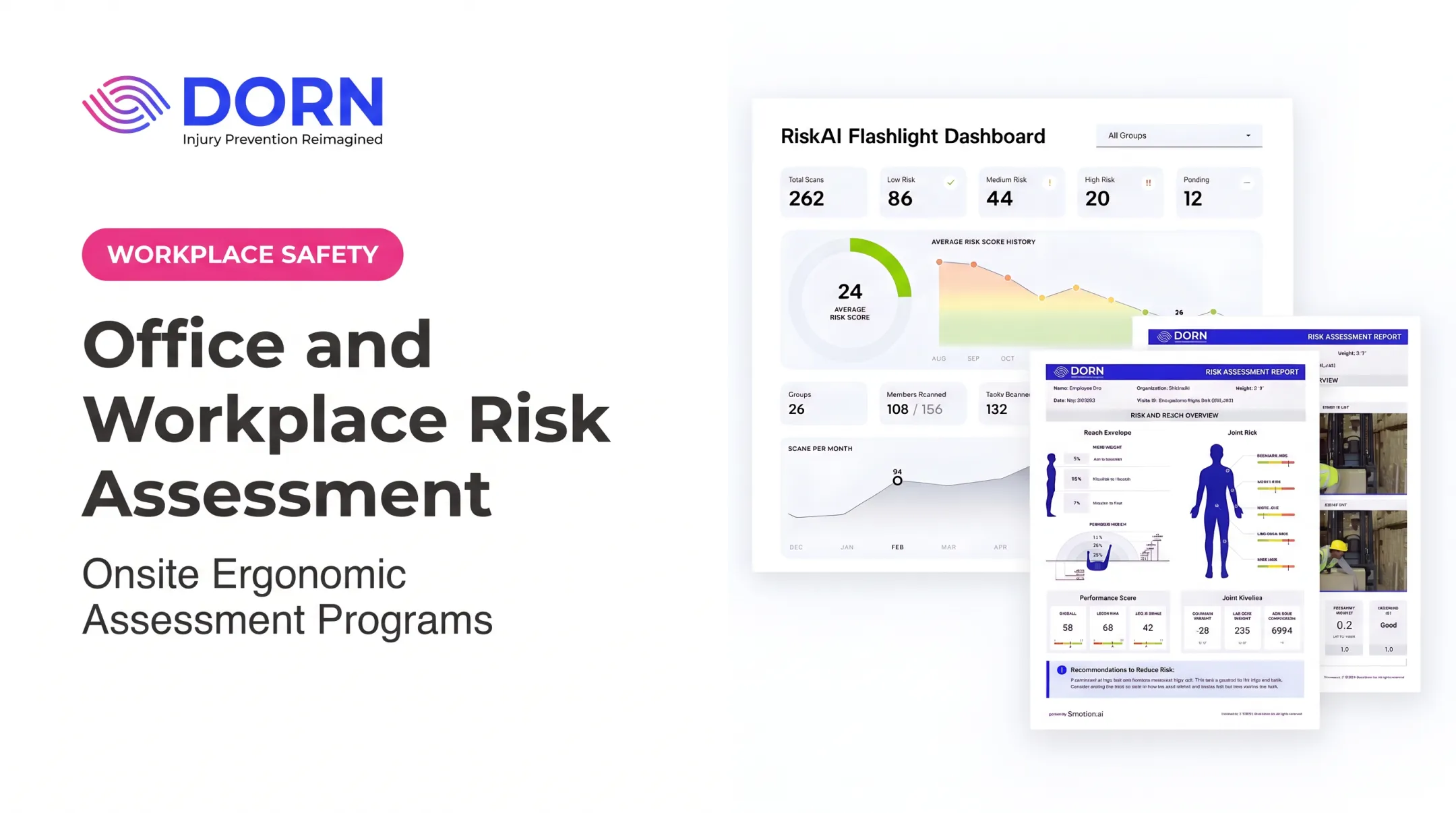
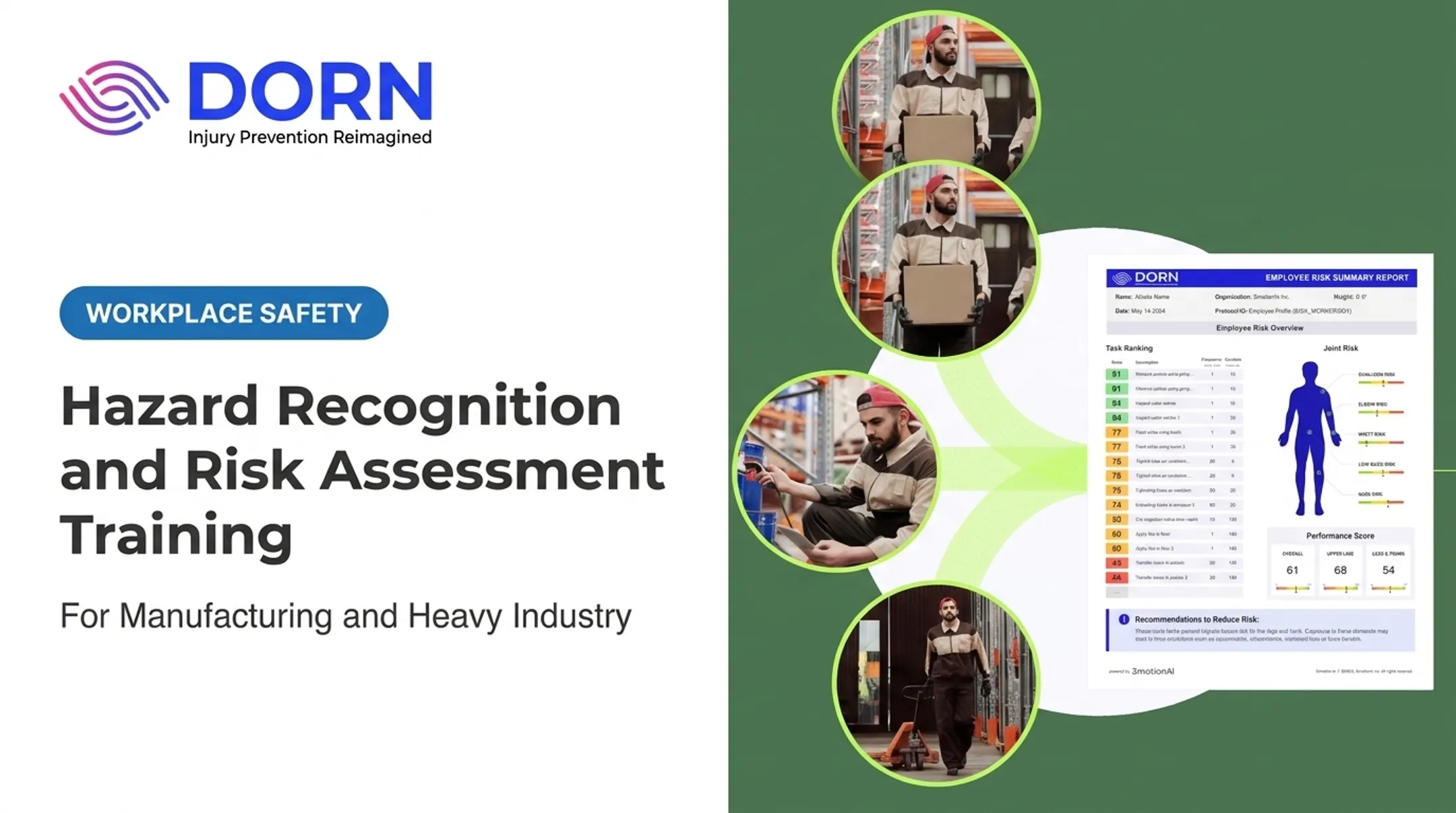
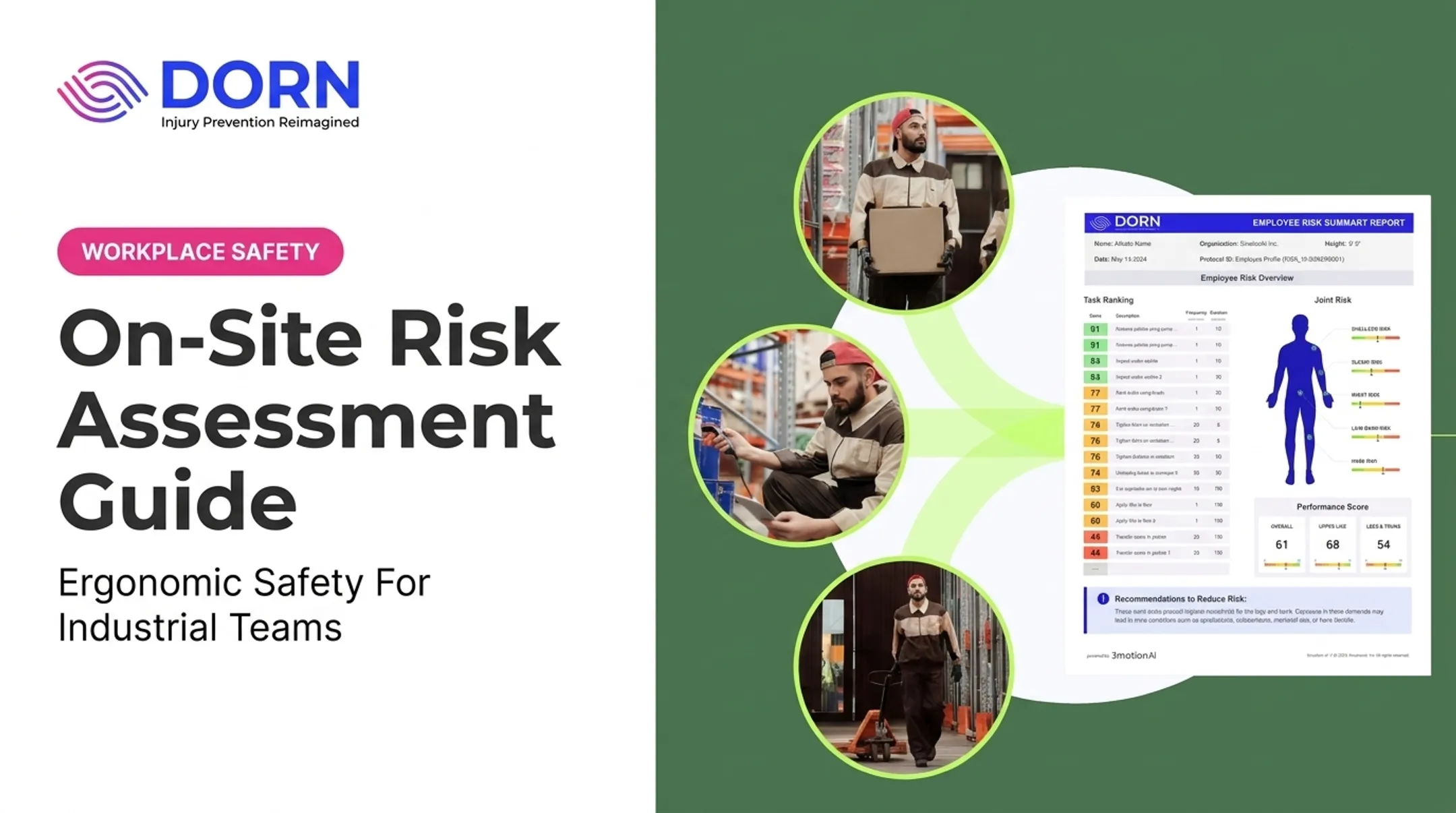
DORN Companies works with manufacturing plants, warehouses, and distribution centers on ergonomic assessments. Those assessments identify root causes of strain and repetitive injury, then turn findings into ranked recommendations with estimated risk-reduction impact. Onsite and virtual support helps teams that lack a dedicated ergonomics specialist on staff.
Turning Findings Into an Ongoing Safety Program
A completed assessment isn't a filing-cabinet document. It's a starting point that should feed directly into inspections, preventive maintenance schedules, training updates, incident investigations, return-to-work planning, and regular management review.

Track the Right Indicators
OSHA distinguishes between leading and lagging indicators: leading indicators are proactive measures showing whether safety activities are working, while lagging indicators track past events like injury rates. Useful metrics to monitor include:
- Corrective action completion rates
- Inspection findings over time
- Near-miss reporting volume
- Training completion rates
- Ergonomic concerns raised by workers
- Injury trends by department or task
A Whole-Person Approach to Prevention
Traditional hazard controls address the environment and the task. DORN's Body, Behavior, Environment (BBE) model layers on additional support:
- Body: hands-on care and mobility work
- Behavior: coaching and training
- Environment: site risk assessments and monitoring
A Total Worker Health approach complements standard controls rather than replacing them—especially for fatigue, repetitive strain, or return-to-work cases.
Where Technology Fits
Digital checklists, mobile incident reporting, wearables, and motion capture tools can support hazard observation and trend analysis at scale. They help spot patterns across shifts or facilities that a manual review would miss. Technology still doesn't replace worker judgment or a properly implemented control—it supplements the fundamentals covered in this guide.
Frequently Asked Questions
How do I conduct a risk assessment at my workplace?
Define the scope and gather existing safety data first. Identify hazards through observation and worker input, then evaluate and prioritize each risk. Select controls using the hierarchy of controls, document your findings, and schedule follow-up reviews.
What is a risk assessment for safety?
A risk assessment is a structured process for identifying hazards (potential sources of harm) and evaluating risk by likelihood and severity. The goal is preventing injury or illness before it happens, not just documenting compliance.
What are examples of risk assessment in health and safety?
Common examples include a machinery guarding assessment, an ergonomic task assessment for repetitive lifting, a chemical exposure evaluation, a site-specific facility inspection, and a dynamic assessment performed right after an unexpected workplace change.
Does OSHA require a risk assessment?
There's no single universal OSHA-mandated risk assessment format. However, specific standards, like PPE hazard assessments under 1910.132 and process hazard analyses under 1910.119, do require hazard evaluations. The General Duty Clause also obligates employers to address recognized serious hazards.
What are the 7 basic safety rules?
Lists vary by workplace, but seven common rules are: follow established procedures, use required PPE, report hazards promptly, keep areas clean, operate equipment correctly, stay alert, and avoid unauthorized tasks.