
Introduction: Ergonomics Studies and Workplace Safety
Most workplace injuries don't happen in a single dramatic moment. They build slowly through repetitive motion, awkward postures, excessive force, vibration, poor workstation design, or fatigue that accumulates shift after shift. By the time an employee reports pain, the underlying risk factor may have been present for months.
In the United States, poor workplace design is linked to roughly 20% of missed workdays, according to research on musculoskeletal disorder causes. That's a meaningful chunk of lost productivity tied directly to how work is designed, not to bad luck or careless workers.
An ergonomic study gives employers a structured way to see how work actually affects people. It helps prioritize practical fixes and connects small task-level improvements to a larger workplace safety strategy. This guide walks through what these studies examine, how to conduct one, and how to turn findings into lasting change.
Key Takeaways
- A strong ergonomic study maps tasks, equipment, environment, and worker interaction to pinpoint and cut injury risk.
- Effective studies assess both the job and the worker, and build in frontline feedback.
- Fix design and process first—don’t rely on training alone.
- Follow-up metrics confirm whether changes improved safety and performance.
What an Ergonomic Study Examines
An ergonomic study is a structured evaluation of work tasks, equipment, environmental conditions, and how workers interact with all three. It's different from a five-minute workstation check, a general safety walkthrough, or an employee satisfaction survey. Those tools have their place, but none of them systematically measure force, posture, repetition, and duration the way an ergonomic study does.
The goal is to fit the job to the worker, not the other way around. Done well, that approach reduces exposure to the core risk factors OSHA identifies:
- Excessive force
- Repetitive or prolonged motion
- Awkward or static posture
- Contact stress
- Vibration
- Combined exposures, such as cold plus force
The Body, Behavior, and Environment Perspective
DORN's ergonomic assessments use a framework called Body, Behavior, and Environment (BBE) to capture how these factors interact:
- Body – physical demands, worker capabilities, and existing pain or limitations that affect task fit
- Behavior – work techniques, movement patterns, and recovery habits observed on the job
- Environment – workstation layout, tools, department design, and facility-level conditions
What a Study Actually Collects
A thorough study typically gathers:
- Direct task observations under normal working conditions
- Force, load, reach, and height measurements
- Repetition rates and available recovery time
- Injury and near-miss reports
- Confidential worker interviews and feedback
Musculoskeletal disorders account for roughly one-third of all work-related injuries reported by employers. A quick visual scan won't catch a wrist angle that's slightly off on every cycle, but a structured study will.
How to Conduct an Ergonomic Study
Step 1: Define the Scope
Start narrow. Pick a specific task, workstation, department, or injury trend rather than trying to evaluate an entire facility at once. Ask a clear question: Why are back strains clustering in the packing line? Why did carpal tunnel claims spike after the new scanner rollout?
Step 2: Observe the Work
Watch the task under real operating conditions, across different shifts and workers when possible. Document:
- Posture and reach
- Force, lifting, pushing, and pulling
- Work pace and cycle time A task that looks fine at 8 a.m. can look very different by hour six of a shift.
Step 3: Bring in the People Doing the Job
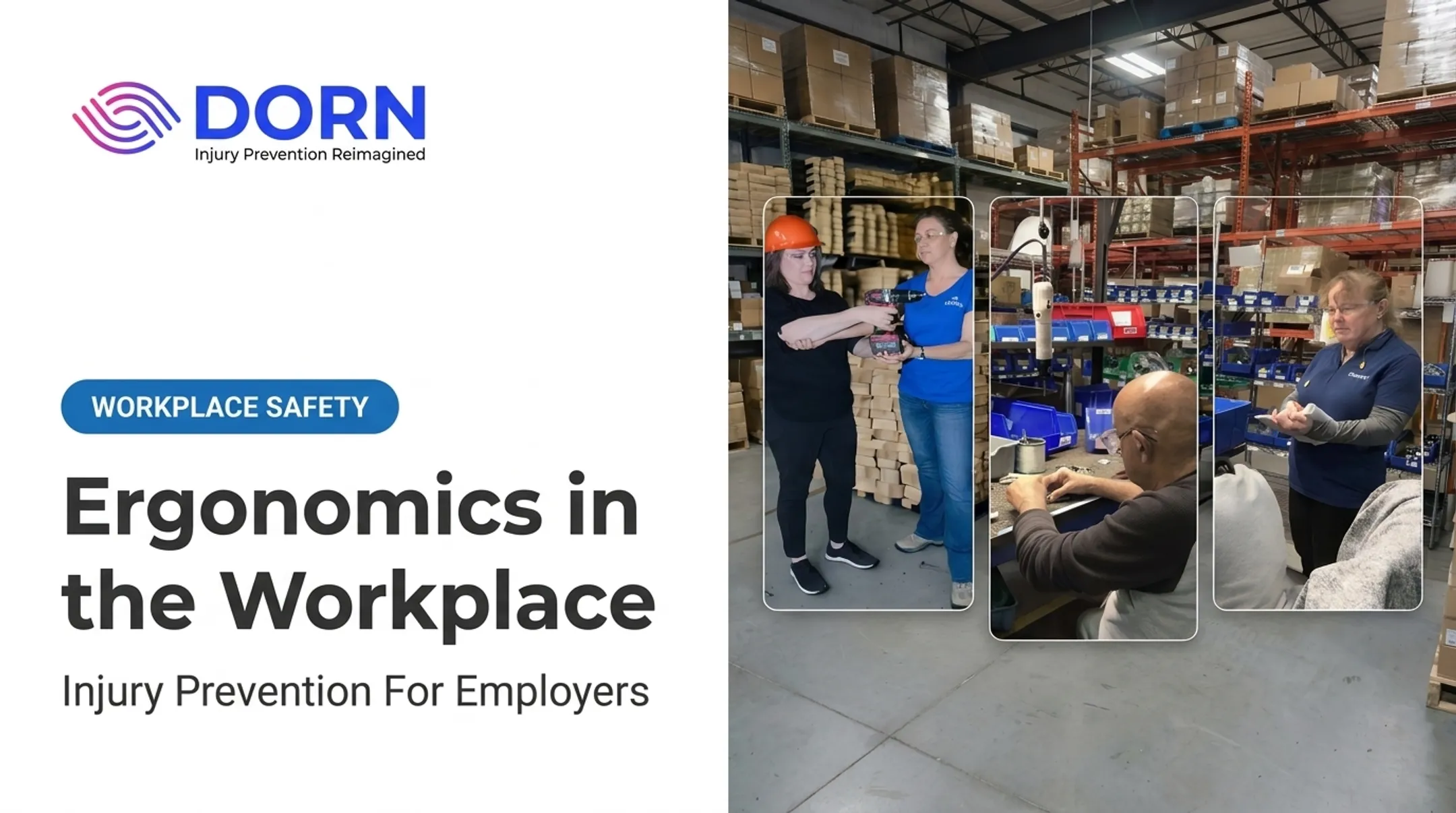
Employees performing the task daily — sometimes called "industrial athletes" — often spot problems that a short observation misses entirely: workarounds, near misses, equipment limitations, and fatigue patterns. Ask directly about excessive fatigue, awkward tool grips, and discomfort that doesn't show up in incident logs.
Step 4: Apply Objective Assessment Tools
Trained evaluators use validated tools matched to the specific exposure:
| Tool | Best For |
|---|---|
| NIOSH Lifting Equation | Manual lifting and low-back risk |
| RULA | Upper-body and wrist posture |
| REBA | Whole-body posture and loading |
| Snook Tables | Pushing, pulling, and carrying limits |
Photographs and video (with consent) support closer review of tricky motions. None of these tools replace professional judgment or worker input. They supplement both.
Step 5: Rank the Findings
Not every risk deserves the same urgency. Rank findings by:
- Severity of potential harm
- Number of workers exposed
- Likelihood of injury
- Feasibility of correction A high-frequency task tied to a current injury trend jumps to the top of the list.

Why Ergonomics Matters Across Work Environments
Ergonomic risk doesn't look the same everywhere, and the numbers back that up. In 2024, manufacturing recorded a DART rate of 1.7 per 100 workers, while warehousing and storage came in higher at 4.1 (BLS, 2024 Industry Rates). Office administrative work, by contrast, sat at just a 0.2 DART rate.
Manufacturing and Food Processing
Repetitive assembly, cutting, and packing tasks combine forceful exertion with standing and awkward reaches. Line-speed pressure and cold environments compound the exposure. Cold conditions alone link to more than 40,000 workplace injuries annually.
Warehouse and Distribution
Lifting, lowering, and carrying dominate the risk profile here. Storing heavy items between hip and chest height and keeping pallets under 50 inches reduces strain considerably. Long reaches into deep shelving are a frequent, underrated contributor to shoulder and back complaints.
Office and Remote Work
Prolonged sitting, poor monitor height, and makeshift laptop setups create their own slow-building risks. At one client facility, DORN found that 47% of lower-back complaints traced back to a single scheduling department, driven by poor posture and outdated office equipment.

The same principle plays out differently depending on the setting:
- Industrial workstation – lower a shelf height so parts sit at elbow level instead of requiring an overhead reach
- Warehouse – relocate high-frequency SKUs to mid-height racking instead of top shelves
- Home office – raise a laptop on a stand and add an external keyboard to fix wrist and neck angle
Turning Study Findings Into Workplace Safety Improvements
Findings only matter if they lead to action. The most effective employers follow the established hierarchy of controls, redesigning the work itself before adding training on top (NIOSH, Hierarchy of Controls).
Engineering Changes Come First
- Adjust work height so tasks fall within a neutral reach zone
- Move frequently used items closer to the worker
- Add lift-assist or tilt equipment for heavy handling
- Reduce manual carry distance with conveyors or better layout
- Upgrade hand tools to reduce grip force
Administrative Controls Support — They Don't Replace
Training, job rotation, rest breaks, and early-reporting procedures matter, but they work best alongside design changes, not instead of them. A rotation schedule doesn't fix a workstation that's still poorly designed for every rotating worker.
Before rolling changes out facility-wide, test them with a small group of employees. Document who was involved, what changed, which risk it targeted, and any remaining barriers.

Organizations that need structured support often bring in outside expertise at this stage. DORN's Certified Industrial Ergonomic Evaluators assess tasks directly and develop injury-prevention recommendations tailored to the specific workstation or process, rather than applying generic checklists.
Verification matters just as much as implementation. In one DORN-supported biomechanics training program, follow-up sessions produced clear gains:
- Technique scores rose from 13.24 to 21.2 out of 24
- Pain levels on a 10-point scale dropped 83%
- Absenteeism fell 57%
- Zero injuries reported during the program period
Those gains came from measuring outcomes after the changes, not assuming the redesign worked.
Building an Ongoing Ergonomics and Safety Program
A single ergonomic study is a snapshot. Equipment changes, staffing shifts, new production targets, and layout redesigns all reset the risk profile, which is why leading programs treat ergonomics as a continuous cycle rather than a one-time project.
Where ergonomic findings should feed into the broader safety program:
- Safety committee reviews and monthly reporting
- New-hire onboarding and supervisor coaching
- Return-to-work planning, including review of facility layout and physical demands
- Equipment procurement decisions before purchase, not after installation
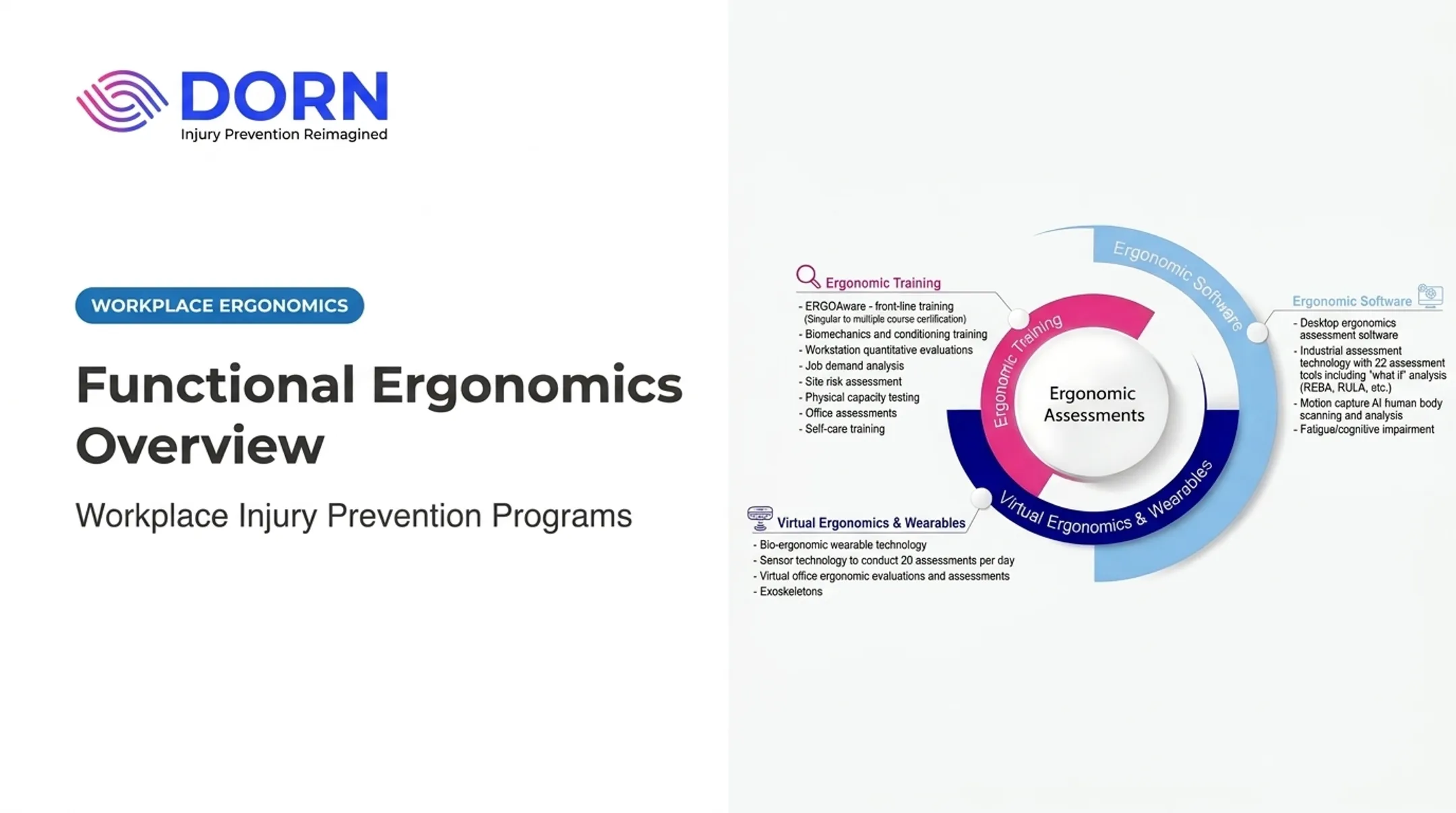
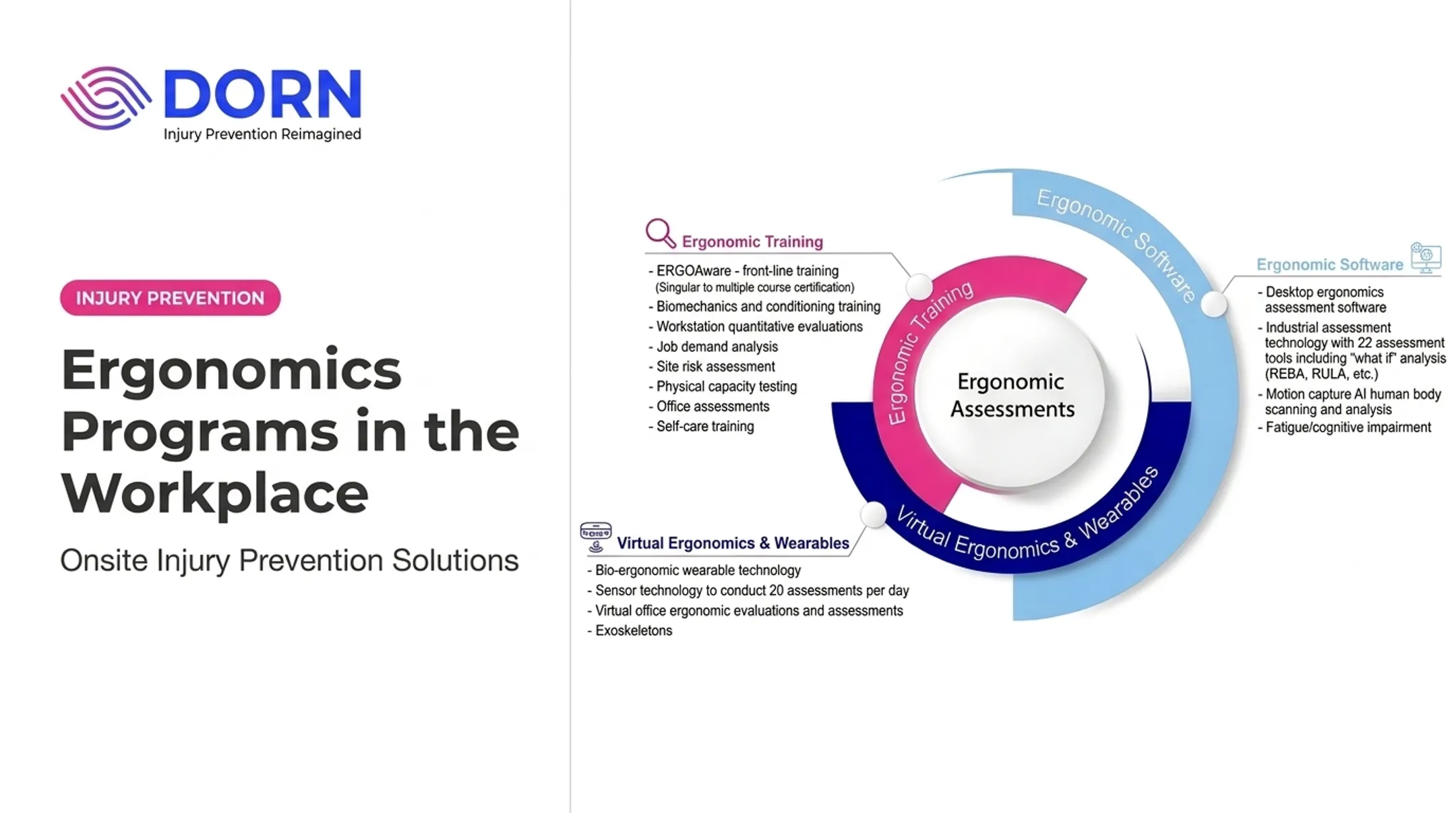
Turning those findings into lasting change means integrating them rather than treating each one as a standalone fix. DORN's broader approach combines ergonomic assessment with education, on-site coaching, virtual safety support, and technology tools like motion capture and wearables, layered together rather than treated as separate initiatives. The specific mix depends on the facility and its risk profile.
Employees also need a clear, low-friction way to report discomfort. If workers are working around a known hazard because there's no process to flag it, the organization loses its earliest warning signal.
Conclusion: Use Ergonomic Studies to Prevent Injuries Before They Escalate
An ergonomic study earns its value the moment findings turn into action. Observations and worker insight mean little sitting in a report; they matter when they become a redesigned workstation, an adjusted process, or a rotation schedule that actually gets followed.
Put the findings to work with a simple cycle:
- Start with one high-risk task
- Involve the people who perform it every day
- Bring in qualified evaluation where the risk warrants it
- Implement practical controls, then reassess
That cycle, repeated consistently, separates a safety program that reacts to injuries from one that prevents them.
Frequently Asked Questions
What is an ergonomic study?
An ergonomic study is a structured evaluation of work tasks, equipment, environmental conditions, and how workers interact with them. Its purpose is to identify and reduce ergonomic risk factors before they cause injury.
What is an example of ergonomic safety?
Redesigning a packing workstation to lower shelf height reduces both lifting force and awkward reaching. Another common fix is adjusting a keyboard tray to eliminate repetitive wrist bending during data entry.
What are the 5 principles of ergonomics?
The five core principles are: maintain neutral postures, reduce excessive force, minimize repetition and static loading, fit the task to the worker, and keep frequently used items within easy reach and proper height.
How is an ergonomic study conducted?
A typical study includes defining the scope, observing tasks under normal conditions, gathering worker input, applying objective risk-assessment tools, ranking findings, and implementing controls. Follow-up measurement confirms whether the changes worked.
When should a workplace complete an ergonomic assessment?
Common triggers include rising injury or discomfort trends, new equipment or processes, facility layout changes, repeated employee concerns, and periodic program reviews — even without a specific incident prompting it.