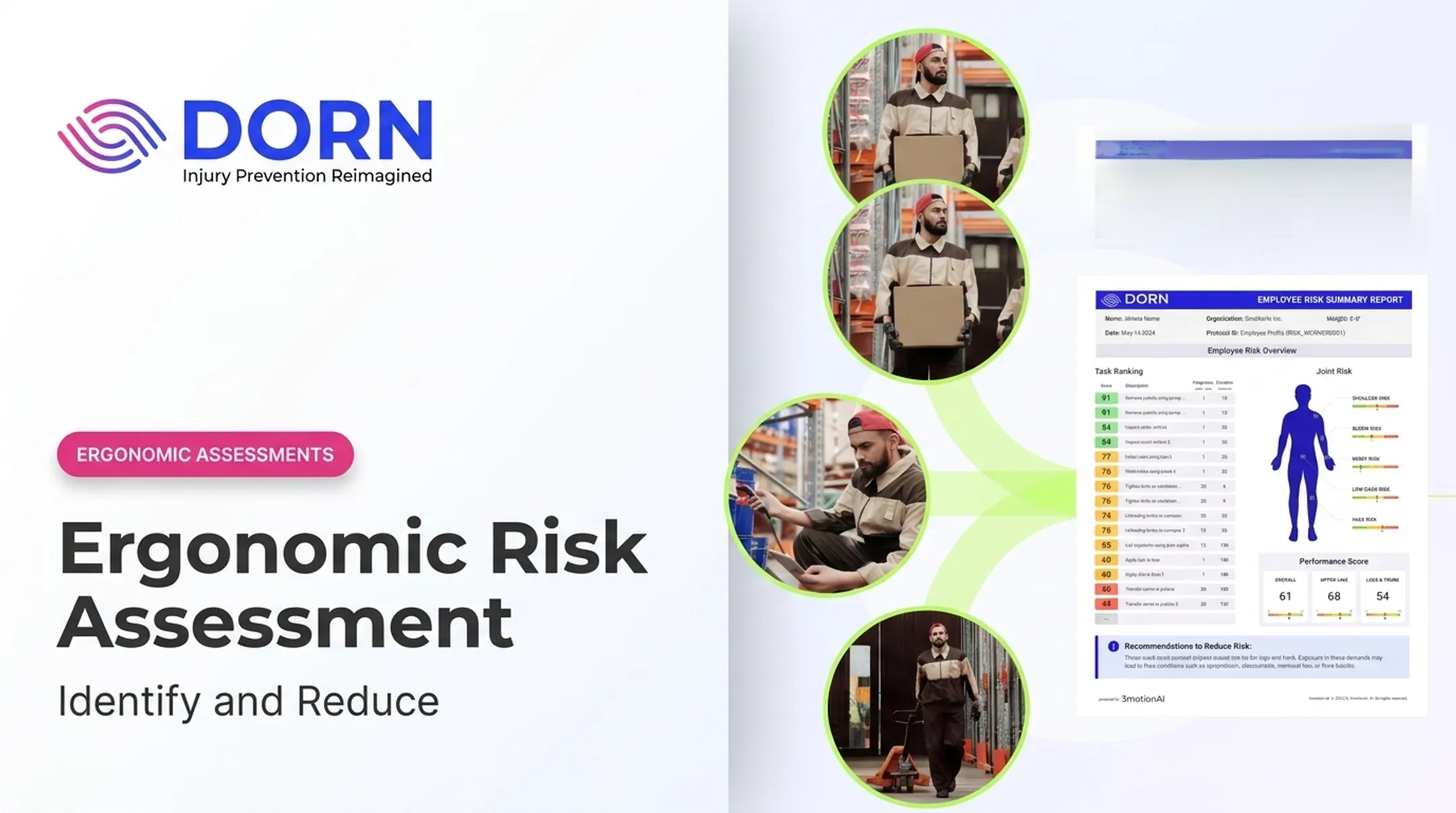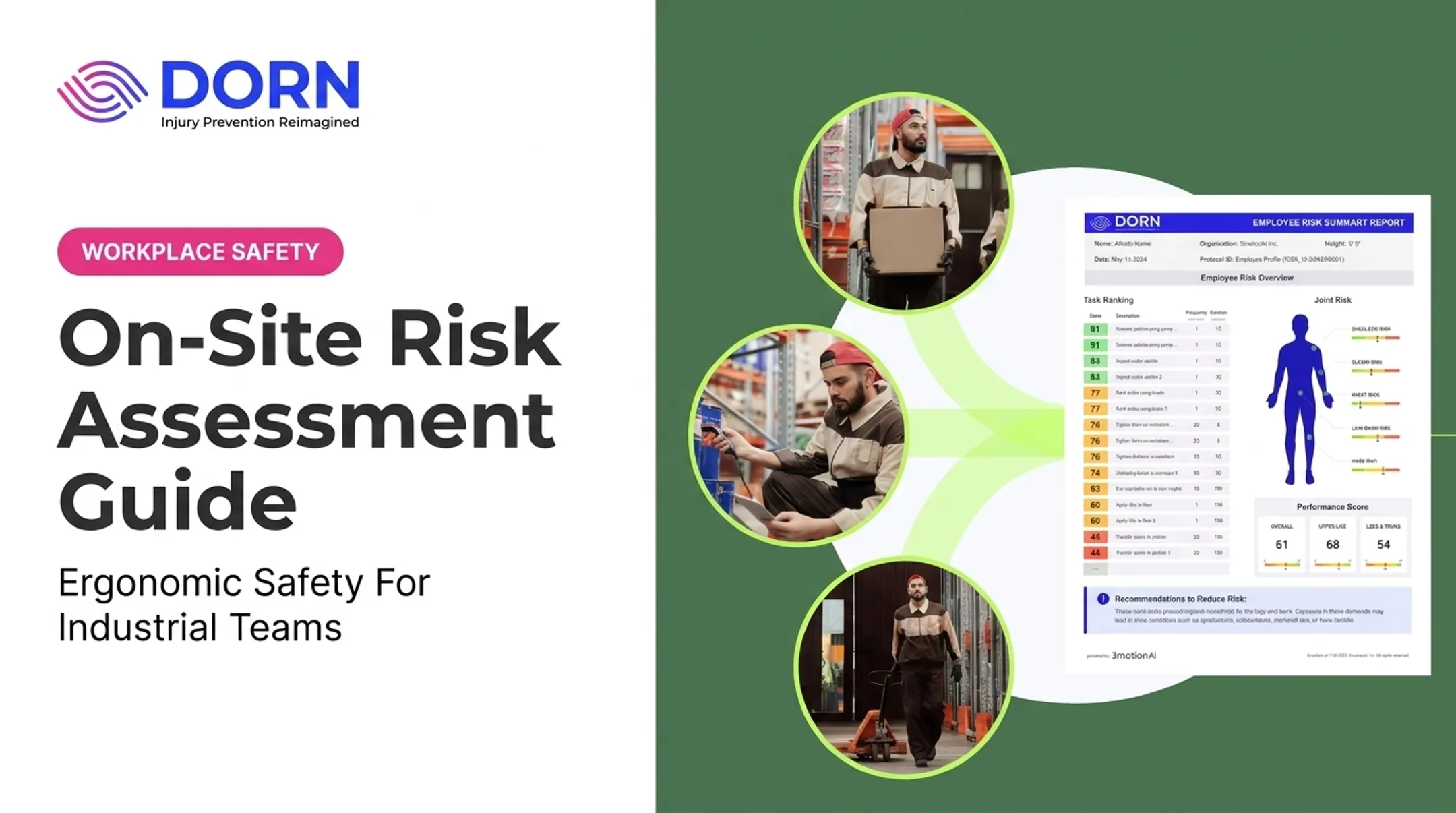

A manual handling risk assessment is a structured review of tasks that involve lifting, lowering, carrying, pushing, pulling, holding, or supporting loads by hand or bodily force. It looks at how work is actually performed, not how a policy manual says it should be performed.
This guide is built for US employers and safety leaders in manufacturing, warehousing, distribution, and food and beverage processing, where manual handling routinely contributes to musculoskeletal disorders (MSDs), lost workdays, and workers' compensation exposure. Musculoskeletal disorders alone account for 33% of workers' compensation costs in the United States, and material handling accounts for 32% of workers' compensation claims in factory and warehouse settings, according to internal industry cost analysis DORN has compiled from workers' comp claims data.
Too often, these assessments get treated as a box to check for compliance. Used correctly, they're an operational tool: observe real work, talk to the people doing it, and make changes that actually reduce risk. Below, we'll walk through the five-step process, the key risk factors to evaluate, the controls that work, and when to bring in outside expertise.
Key Takeaways
- A full assessment maps hazardous tasks, exposed workers, root causes, existing controls, and required actions.
- Work the full cycle—identify hazards, evaluate risk, implement controls, document findings, and review when conditions change.
- Assess task, load, environment, individual factors, and equipment together, not a generic lifting rule alone.
- Favor elimination, redesign, and mechanical aids over training and PPE as your primary controls.
What Is a Manual Handling Risk Assessment and Why Is It Used?
A manual handling risk assessment is a structured review of tasks that involve lifting, carrying, pushing, pulling, or holding loads. It differs from three activities it's often confused with:
- Training sessions teach technique but don't evaluate whether the task itself is hazardous.
- Job safety analysis (JSA) breaks a job into steps and flags general hazards, often as a one-time compliance exercise.
- Incident investigation looks backward at what already went wrong.
A risk assessment looks forward. It aims to spot where a task can cause injury or excessive fatigue, figure out why that risk exists, and select controls before someone gets hurt.

Activities Worth Assessing
Include any task where force or awkward posture is part of the job:
- Lifting from floor level or overhead shelving
- Carrying loads over distance
- Pushing or pulling carts, pallet jacks, or hand trucks
- Loading and stacking pallets
- Repetitive packing or line work
- Team handling of bulky or heavy items
- Holding or stabilizing awkward or unbalanced loads
Why This Matters for US Employers
OSHA's General Duty Clause under Section 5(a)(1) of the OSH Act requires employers to provide a workplace free from recognized hazards likely to cause serious harm. There's no single OSHA ergonomics standard, but overexertion injuries remain one of the most heavily reported causes of lost or restricted work time.
MSD-related costs run employers roughly $20 billion annually in direct costs, with about 2 million employees affected each year and 600,000 losing work time.
A documented assessment earns its keep in specific situations:
- High-frequency tasks performed dozens or hundreds of times per shift
- Jobs involving forceful exertion, twisting, or awkward reach
- Tasks tied to reported discomfort or near misses
- Work performed identically across multiple shifts or sites
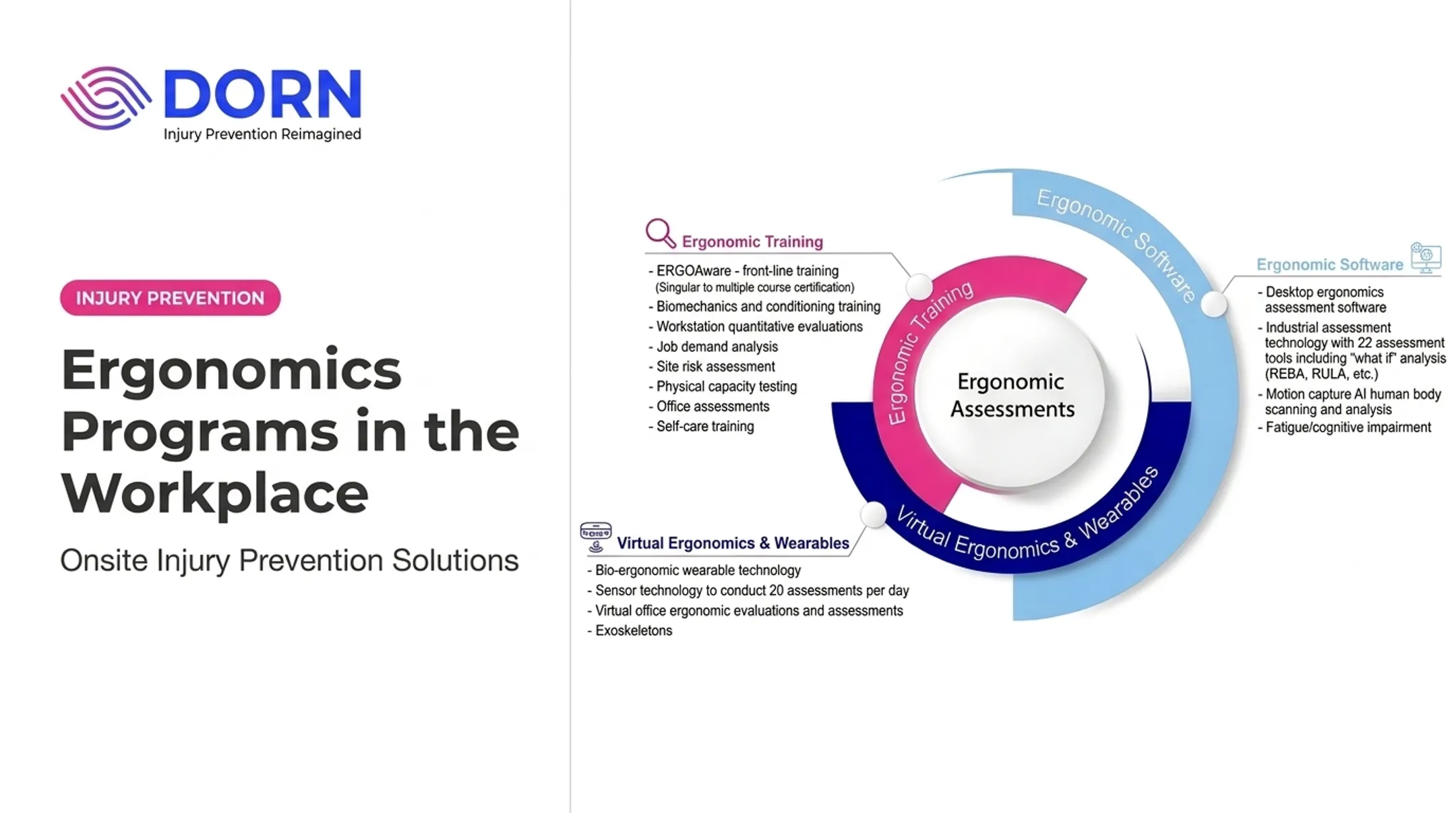
When internal teams need a second set of eyes, an outside ergonomic assessment or injury prevention specialist can evaluate Body, Behavior, and Environment together. This is the model DORN's certified Industrial Ergonomic Evaluators use when assessing a single workstation or an entire facility.
Their process combines video and photo evidence, worker testimony, and performance data to spot exertion patterns before those patterns turn into claims.
How a Manual Handling Risk Assessment Works: The Five Steps
The overall flow: observe the work as it's actually performed, gather input from the people doing it, identify hazards, evaluate risk, select controls, document decisions, and verify the changes worked. Skipping the verification step is one of the most common reasons assessments fail to reduce injuries.
Step 1: Identify Manual Handling Hazards
Map the task from start to finish. Include:
- Pickup point and hand positioning
- Movement path, including any repeated or team-handling segments
- Placement and storage location
- Recovery motion after setting a load down
Watch for forceful exertion, twisting, bending, reaching, sudden impacts, slippery surfaces, unstable loads, and blocked or cluttered routes. A five-minute walkthrough during peak production often reveals more than a written procedure ever will.
Step 2: Determine Who May Be Harmed and How
This step covers more than the person currently doing the job:
- Full-time employees performing the task regularly
- Temporary workers and contractors, who make up a substantial share of the industrial workforce
- New or inexperienced hires still building capacity
- Workers with existing restrictions or prior injuries
Worker consultation matters here. A short observation might catch the "textbook" version of a task, but only the workers doing it daily know about the fatigue, discomfort, and workarounds that show up by hour six of a shift.
Step 3: Evaluate the Risk and Select Controls
Weigh likelihood, severity, exposure frequency, duration, recovery time between exertions, and how well current safeguards are actually working. Then apply the hierarchy of controls, in this order:
- Elimination: remove the hazardous task entirely
- Substitution or redesign: change the process so the exertion isn't needed
- Engineering controls: conveyors, lift tables, adjustable workstations
- Administrative controls: job rotation, scheduling, pacing
- PPE and training: last resort, not first response

Specific examples of controls worth considering:
- Reducing load size or splitting large loads into smaller units
- Changing storage heights to keep lifts within the power zone
- Shortening travel routes between pickup and placement points
- Improving cart design or wheel quality
- Repositioning pallets to reduce reach distance
- Separating pedestrian and material movement paths
Objective tools can sharpen this evaluation. The Revised NIOSH Lifting Equation uses a load constant of 51 lb under optimal conditions, adjusted by multipliers for horizontal distance, vertical height, asymmetry, frequency, and grip quality, according to the 2021 NIOSH Applications Manual.
A Lifting Index of 1.0 or higher signals the task poses risk to a meaningful share of the workforce. That said, the equation only covers two-handed lifting under specific conditions.
It doesn't apply to one-handed lifts, carrying, pushing, or pulling, which is exactly why relying on one formula for every task falls short.
Step 4: Record Findings and Assign Actions
A useful record identifies:
- The task and specific hazard observed
- Affected workers or job roles
- Risk rationale (why this task scored the way it did)
- Existing controls already in place
- Additional actions needed
- Responsible owner and target completion date
- How you'll verify the fix worked
Photos, short task videos, measurements, and employee comments strengthen this record considerably, as long as they're handled under your company's privacy and safety policies.
Step 5: Review and Update the Assessment
Trigger a review after:
- An incident or near miss
- Reported discomfort or pain
- Process, layout, or equipment changes
- Changed production rates or new materials
- Staffing changes, including new hires or temp workers
- Evidence that existing controls aren't holding up
Set a risk-based review cadence rather than treating the assessment as finished once it's filed. High-exposure tasks deserve more frequent check-ins than low-risk ones.
Where Assessments Apply and What Factors Affect Risk
Manual handling risk assessments apply wherever workers repeatedly lift, carry, push, or pull. Common US settings include:
- Warehouse receiving, picking, and palletizing
- Manufacturing production lines
- Food and beverage processing floors
- Maintenance and facilities work
- Healthcare support tasks (patient handling, supply transport)
- Construction materials handling
- Office tasks involving boxes, supplies, or equipment moves
Recurring vs. Trigger-Based vs. One-Time Assessments
Not every task needs the same review schedule:
- Recurring reviews for high-exposure jobs performed daily
- Trigger-based reviews after incidents, layout changes, or new equipment
- One-time project assessments for new workstations, processes, or facility layouts
Full assessments can take longer. DORN mini-assessments typically need about 30 minutes of workplace analysis and still surface actionable risk factors and modifications.
A Practical Framework for Risk Factors
Many safety professionals use an informal mnemonic, sometimes called TILE or TILEO, to structure their observations. It's not an OSHA or NIOSH standard, but it's a useful memory aid alongside a full job observation:
- Task – repetition, force, pace, duration, travel distance, lift height, bending, twisting, team handling, recovery time between exertions
- Individual – training, experience, physical capability, fatigue, prior symptoms, and whether job demands fit the person assigned; avoid discriminatory assumptions or informal medical judgments
- Load – weight, size, shape, stability, grip surface, center of gravity, temperature, sharp edges, and whether it can be divided or mechanically moved
- Environment – floor condition, lighting, temperature, space constraints, traffic patterns, stairs, dock conditions, and storage height
- Other factors – equipment condition, staffing levels, production pressure, shift length, and training quality

There's no universal "safe lifting weight" that determines risk on its own. Even NIOSH's own lifting equation is explicit that its 51-lb load constant only applies under specific, favorable conditions. Change the frequency, the reach, or the grip, and the safe threshold changes with it.
Common Issues and When an Assessment Approach Is Not Enough
The Training-Only Trap
Telling workers to "lift with their legs" or running an annual refresher doesn't fix a poorly designed task. NIOSH and OSHA both rank engineering and process changes above training and PPE: training depends on consistent behavior under fatigue, while engineering controls remove the hazard regardless of who does the job.
One-time lifting training rarely sticks. Old patterns reassert themselves within a shift unless supervisors reinforce the change on the floor.
Light Loads Aren't Automatically Low Risk
A 10-lb part handled 400 times a shift, with a reach above shoulder height, can create more cumulative strain than a single 40-lb lift performed once. Watch for:
- High-frequency repetition
- Awkward reach or twisting
- Unstable or shifting contents
- Long carrying distances
- Poor lighting or slick floors
Documentation Failures That Undermine the Process
- Copying a generic form without observing the actual task
- Watching only the "ideal" version of the job, not the rushed version at hour ten
- Skipping employee input entirely
- Assigning no owner or deadline to corrective actions
- Never checking whether the fix actually worked
When to Escalate
Bring in a competent ergonomics or safety professional when you're facing:
- Complex forceful tasks that resist simple fixes
- Persistent discomfort or injury trends across a shift or line
- Multi-site standardization needs
- New automation or workstation design projects
- Conflicting production and safety requirements
A risk assessment does not diagnose injury and does not replace a medical evaluation. Reported symptoms should always go through your occupational health and reporting process.
For situations that need outside capacity, DORN's ergonomic assessment services, including short-term project work completed in 1–2 days, provide short- and long-term mitigation plans without a long-term contract.
Conclusion
An effective manual handling risk assessment connects real task observation with worker input, structured risk-factor analysis, practical controls, documentation, and follow-up. Done well, it reduces force, awkward posture, repetition, distance, and fatigue through better work design—not through paperwork alone.
Start with your highest-risk tasks. Involve the people doing the work. When a task needs specialized analysis, multi-site consistency, or technology-enabled monitoring, bring in ergonomics support built for that level of complexity.
Frequently Asked Questions
What are the 5 steps of a manual handling risk assessment?
The five steps are: identify hazards, determine who may be harmed and how, evaluate risk and select controls, record findings and assign actions, and review the assessment on a risk-based schedule.
What should a manual handling risk assessment include?
It should cover the task, load, individual factors, environment, and equipment involved, along with affected workers, current controls, additional actions needed, responsible owners, and review timing.
What are the 5 main risk factors of manual handling?
Most frameworks group risk factors into Task, Individual, Load, Environment, and Other factors (equipment, staffing, production pressure). Exact naming varies by organization, but the underlying checks stay consistent.
What are the 5 Ps of manual handling?
There's no standardized US regulatory framework called the "5 Ps" for manual handling. If you encounter this term, verify its source before applying it, since it's not tied to OSHA or NIOSH guidance.
How often should a manual handling risk assessment be reviewed?
Review it whenever work, equipment, layout, staffing, or production demands change, and always after an incident, near miss, or reported discomfort. High-exposure tasks warrant more frequent, risk-based check-ins.
Who should carry out a manual handling risk assessment?
The employer remains accountable, but a trained supervisor, EHS professional, in-house ergonomist, or external specialist can conduct the assessment, provided workers are meaningfully involved throughout the process.