
This isn't only a desk-job issue. Warehouse pickers, food-processing line workers, healthcare staff, and manufacturing operators all face the same mismatch between their bodies and their work. Ergonomic factors are a leading cause of injury across nearly every industry and operational level, from airports and hospitals to office cubicles and packing lines.
This article covers what poor ergonomics actually means, how it affects the body and job performance, the warning signs and injuries to watch for, and how employers can reduce risk through assessment and prevention.
Key Takeaways
- Poor ergonomics is a mismatch between workers, tasks, tools, and environment, not a personal posture failing
- Physical strain builds gradually, impairing concentration, movement quality, and morale before any injury is diagnosed
- Muscle strains, tendonitis, carpal tunnel syndrome, and lower-back pain are common outcomes
- Untreated ergonomic risk drives absenteeism, turnover, and rising workers' compensation costs
- Task-based assessments and early reporting are the most effective prevention tools
What Does Poor Ergonomics Mean?
Poor ergonomics happens when there's a mismatch between a worker, the task at hand, the tools or equipment provided, and the surrounding work environment. That mismatch creates strain the body doesn't need to carry.
OSHA defines ergonomics as fitting workplace conditions to the people doing the work; poor ergonomics is what happens when that fit is missing (OSHA).
Denise Pontbriand, DORN's senior certified ergonomic assessment specialist, describes it simply: ergonomics is the match between the person, the equipment, the process, and the work environment. When any one piece is off, strain follows.
Common Ergonomic Hazards
Ergonomic risk usually falls into these categories:
- Awkward or static postures — bending, twisting, reaching overhead, or holding one position too long
- Repetitive motion — task cycles shorter than 30 seconds done over and over
- Forceful exertion — heavy lifting, pushing, pulling, or high-grip work
- Contact stress — hard edges, tool handles, or surfaces pressing on skin or joints
- Vibration — power tools or heavy machinery transmitting shake into the body
- Environmental factors — poor lighting, extreme temperatures, or non-adjustable workstations
Why Exposure Matters More Than a Single Task
A single awkward reach rarely causes injury on its own. Risk climbs with how often a task happens, how long it lasts, how much force it requires, and whether a worker gets enough recovery between exertions. Combine two or three factors—heavy lifting, twisting, and almost no recovery time—and the danger compounds well beyond any one factor alone.
A few real examples make this concrete:
- An office monitor positioned too low, forcing a forward head tilt for hours a day
- A packing station requiring repeated twisting to reach materials on one side
- A warehouse task involving frequent lifting from floor level with no lift-assist equipment
- A machine operator running two machines at once in a forward-flexed stance for an entire shift
Discomfort Isn't the Same as a Diagnosis
Discomfort, fatigue, and early symptoms are warning signs, not medical conclusions. A sore lower back after a long shift doesn't automatically mean a herniated disc, and tingling fingers don't confirm carpal tunnel syndrome. Only a qualified healthcare professional can diagnose a musculoskeletal disorder. Ergonomic guidance flags those risk factors early, before discomfort turns into something more serious.
How Do Poor Ergonomics Impact Workers?
Repeated awkward postures, force, and repetition don't just tire muscles out. Over time, they place ongoing stress on tendons, nerves, joints, and the spine—tissues that aren't getting the recovery they need. A credible body of epidemiologic research shows a consistent relationship between these exposures and musculoskeletal disorders, particularly at higher exposure levels (NIOSH).
Physical Effects Workers Report
The most common complaints include:
- Neck and shoulder tension that builds through a shift
- Lower-back pain, often worse after prolonged sitting or standing
- Wrist and hand discomfort from repetitive gripping or typing
- Reduced range of motion in the joints
- Muscle fatigue and soreness that worsens during or after work
In one airline ergonomics program DORN supported, shoulder discomfort affected 26% of below-the-wing workers and 28% of above-the-wing workers, while neck concerns affected 9% and 31% respectively. Different tasks create different injury patterns, even within the same workplace.

Beyond the Body: Focus, Errors, and Secondary Injury Risk
Pain doesn't stay contained to the area that hurts. Roughly 80% of workers experiencing pain report that it interferes with their concentration and ability to focus on tasks. That matters on a factory floor or in a hospital. A lapse in attention can lead to a dropped tool, a missed step, or an unsafe compensatory movement that creates a second injury on top of the first.
Not every symptom signals a lasting injury. Short-term symptoms often ease with rest. A tired lower back after a long shift may feel better by morning. Persistent or worsening symptoms are different: pain that lingers for days, numbness that spreads, or stiffness that won't loosen with movement all call for prompt reporting and evaluation.
The Human Cost Adds Up
Chronic pain doesn't clock out at the end of a shift. It can disrupt sleep, make everyday tasks harder, and wear down morale over months or years. More than one in five U.S. adults reported living with chronic pain in a recent national health survey, a reminder that the strain workers carry home often outlasts the workday itself.
Fatigue tied to these conditions is linked to reduced concentration and unsafe task techniques. Early reporting matters: catching discomfort before it becomes chronic protects both the worker and their ability to stay engaged.
What Symptoms and Injuries Can Poor Ergonomics Cause?
Warning signs vary by body part, but they tend to follow a familiar pattern. Common early signals include:
- Aching, sharp, or burning pain
- Stiffness, swelling, or cramping
- Numbness, tingling, or weakness
- Reduced grip strength or clumsiness
- Noticeable loss of range of motion
None of these confirm a diagnosis alone, but together they're worth taking seriously.
Lower-Back Symptoms Deserve Extra Attention
The lower back is one of the most common trouble spots in physically demanding jobs. Watch for:
- Localized soreness or stiffness after long periods of sitting or standing
- Pain that flares during bending or lifting
- Symptoms that radiate down into the leg
- Weakness, numbness, or tingling in the leg or foot
Seek medical attention for back pain that's severe, doesn't improve with rest, lasts more than a few weeks, or comes with leg weakness or numbness.
Common Work-Related Conditions
Ergonomic exposures are linked to a recognizable set of conditions, though most have multiple possible causes.
| Condition | Typical Exposure |
|---|---|
| Muscle strains | Heavy lifting, sudden exertion |
| Tendonitis/tendinopathy | Repetitive motion, sustained tool or keyboard use |
| Bursitis | Repetitive motion, kneeling, carrying heavy loads |
| Carpal tunnel syndrome | Repeated wrist flexion, vibrating tools, forceful gripping |
| Trigger finger | Repetitive, forceful hand motions |
Once these conditions progress, the costs climb quickly. A serious back injury claim can run $40,000 to $80,000 in direct costs alone, while carpal tunnel claims average more than $28,000.
When to Report or Seek Care
Report symptoms rather than waiting them out when they:
- Persist for more than a few days or keep recurring during work
- Worsen over time instead of improving with rest
- Limit normal movement or grip strength
- Cause numbness, tingling, or weakness
- Start interfering with sleep or daily activities outside work
Only a qualified healthcare professional can diagnose a musculoskeletal disorder. Ergonomic guidance can flag risk and encourage early reporting, but it isn't a substitute for medical evaluation.
Why Poor Ergonomics Also Affects Organizations
Worker discomfort doesn't stay a worker-only problem. It shows up in absenteeism, presenteeism, restricted-duty assignments, turnover, and quality slips, all of which chip away at productivity and morale across a team.
In the most recent BLS reporting period, overexertion, repetitive motion, and related bodily conditions produced nearly 492,000 cases requiring days away from work, with a median of 14 days off per case (BLS).
Musculoskeletal disorders alone account for roughly 33% of all U.S. workers' compensation costs. Internal DORN data puts nationwide MSD-related costs as high as $54 billion annually.
The Costs Employers Absorb
- Medical expenses and workers' compensation claims
- Replacement labor and overtime to cover injured workers
- Retraining costs when employees can't return to their prior role
- Operational disruptions from restricted-duty accommodations
One medical call center DORN worked with saw a 15% ergonomic injury rate tied to cramped workstation layouts, along with a spike in absenteeism and four daily ergonomic complaints. Those complaints dropped to zero once the workspace was redesigned.

A Symptom of Bigger Process Problems
Ergonomic issues rarely exist in isolation. They often point to broader design problems:
- Materials stored in awkward locations
- Cycle times that don't allow natural movement
- Understaffing that forces workers to rush
- Equipment that was never built for the task it's now used for
Those same design gaps drive the injuries employers must track. OSHA's recordkeeping rules (29 CFR 1904.7) require documenting injuries involving days away, restricted work, or medical treatment beyond first aid. Not every ergonomic issue automatically triggers a recordable event or a violation; the obligation depends on the specific facts of the case.
How Can Employers Prevent Ergonomic Injuries?
Effective prevention starts with looking at the work as it's actually performed, not as it's described on paper.
Start With a Task-Based Assessment
A solid ergonomic assessment means:
- Observing tasks as employees actually do them, not how they're written up
- Talking directly with workers about pain points and workarounds
- Reviewing injury and near-miss trends to spot patterns
- Prioritizing fixes based on exposure level and potential severity
DORN's ERGOLite assessment, for instance, evaluates an entire department or job floor, worksites, employees, tasks, and environmental risk factors together, then ranks identified risks from highest to lowest so fixes get prioritized by real exposure.
Follow the Hierarchy of Controls
Prevention works best when it starts with redesigning the task itself rather than relying on the worker to compensate:
- Redesign the workstation or process to eliminate the hazard at its source
- Apply engineering controls, such as better equipment, adjustable furniture, or lift assists
- Use administrative controls, including task rotation and work-rest scheduling
- Train workers on technique, equipment use, and symptom recognition
- Rely on personal work practices only when the above options fall short
Practical fixes vary by setting. Common examples include:
- Adjustable workstations and better material heights
- Lift assists, carts, and less reaching or twisting
- Better tool selection and neutral wrist positioning
- Frequently used materials placed within easy reach
Train for the Actual Job
Training only helps when it matches the real job: task-specific technique, correct equipment use, early symptom recognition, and clear reporting steps—not a poster telling people to sit up straight.

DORN's ERGOAware training builds that skill on the floor so workers can spot hazards in their own workspace before those hazards turn into injuries.
Make It Easy to Report Discomfort Early
Early reporting works. DORN's internal data associates early symptom intervention programs with a 40% to 70% decline in MSD rates.
That drop depends on workers feeling safe flagging discomfort as soon as it starts. Support such as 24/7 nurse or athletic-trainer triage can evaluate a complaint right away and recommend next steps before it becomes a lost-time claim.
One Resource to Consider
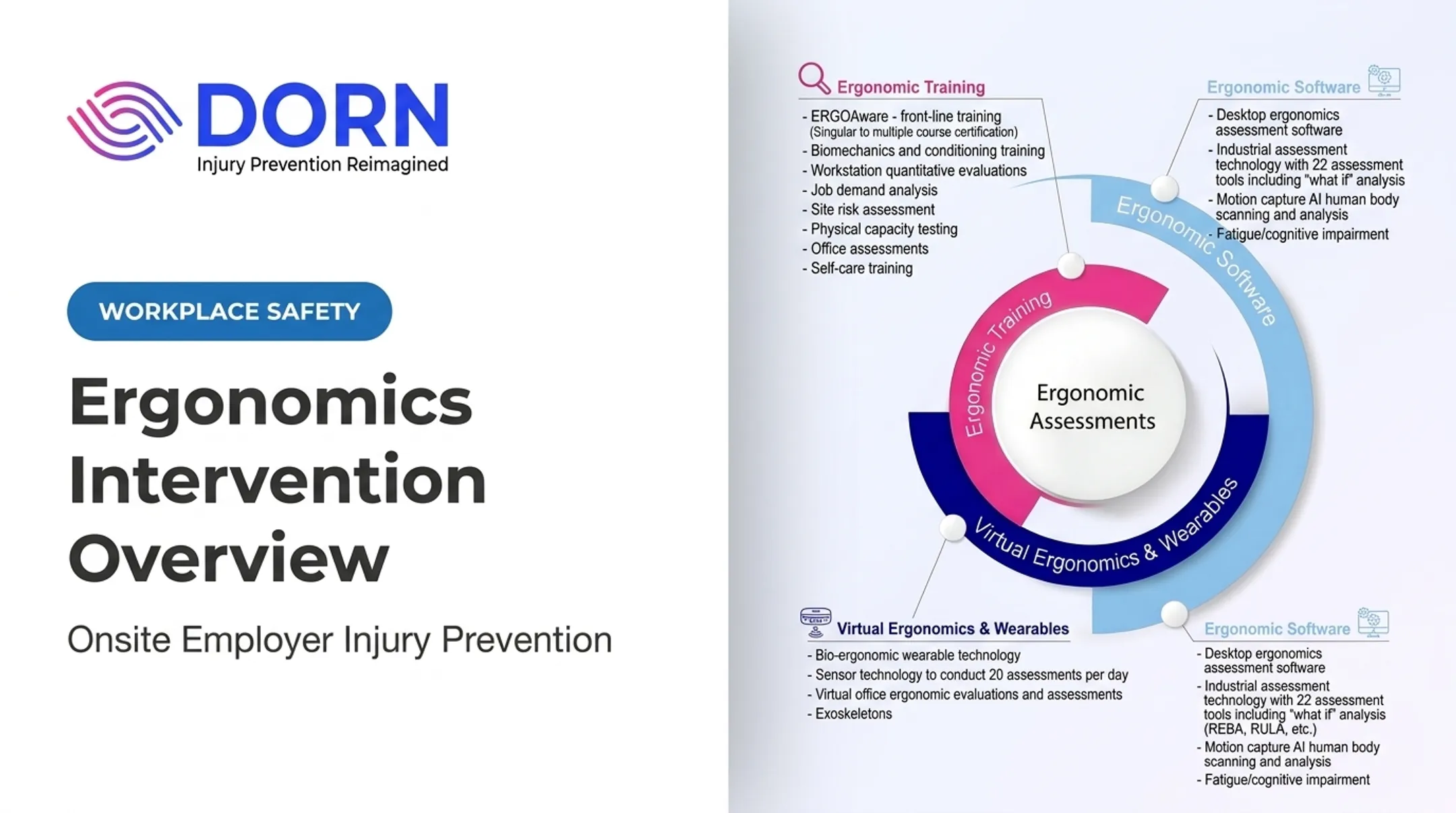
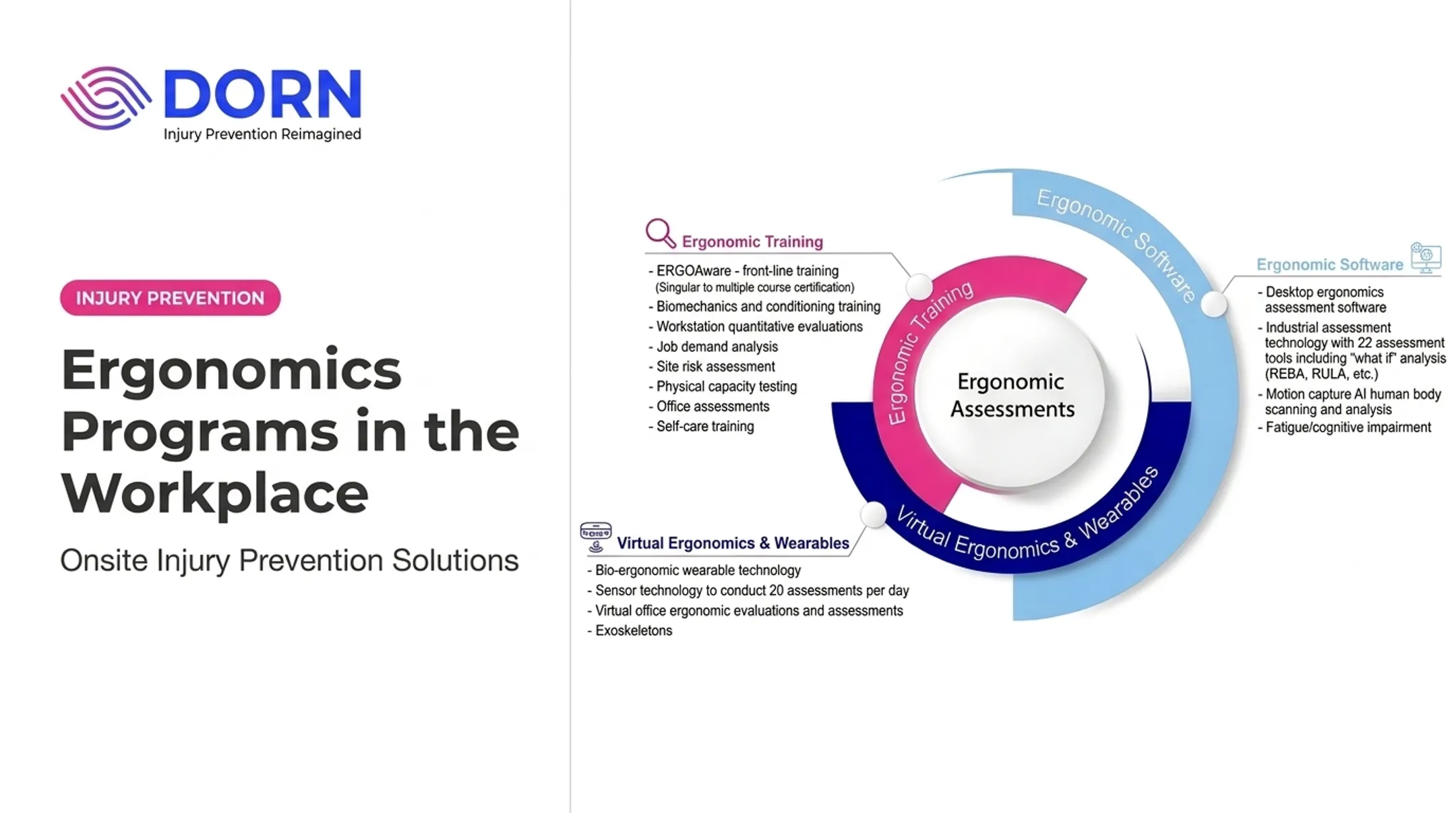
Employers without in-house ergonomic expertise sometimes bring in outside specialists. DORN Companies, for example, combines onsite assessments, workplace safety specialists, training, and virtual support.
The work is built around a Body, Behavior, and Environment framework: the worker's physical condition, work habits, and workstation treated as three connected pieces. Once a program is in place, track progress with indicators that reflect real change:
- Trends in reported discomfort over time
- Assessment completion rates
- Speed of corrective-action closure
- Restricted-duty case counts
- Absenteeism and injury claim trends
- Direct employee feedback
Conclusion
Poor ergonomics rarely comes down to personal posture alone. More often it is a preventable mismatch between people, tasks, tools, and environments. That mismatch shows up as discomfort long before it becomes a diagnosis.
For workers, that mismatch means fatigue, musculoskeletal symptoms, and a real risk of chronic pain that follows them home. For employers, it means absenteeism, turnover, quality issues, and injury costs that climb the longer a hazard goes unaddressed.
The fix starts with attention, not equipment catalogs:
- Identify the highest-risk tasks
- Listen when employees report discomfort
- Address the root cause rather than the symptom
When internal teams need more expertise than they have on staff, a qualified ergonomic assessment can pinpoint where the risk lives and how to fix it. DORN Companies has built these assessments for nearly 25 years, helping employers act on early discomfort before it turns into lasting injury costs.
Frequently Asked Questions
What does "poor ergonomics" mean?
Poor ergonomics is a mismatch between the worker, the task, and the tools. It covers work design, equipment, posture, or conditions that create unnecessary physical or cognitive strain—not a personal failing.
What are ergonomic hazards?
Common hazards include awkward or static postures, repetitive motion, forceful exertion, contact stress, vibration, and poor workstation setup. Lighting, temperature, and short recovery time can raise the risk.
What are the symptoms of bad ergonomics?
Symptoms include aching, stiffness, fatigue, numbness, tingling, weakness, swelling, and reduced range of motion. Report symptoms that persist, worsen, or limit normal movement.
What are the symptoms of musculoskeletal pain in the lower back?
Lower-back symptoms include aching or stiffness, pain when bending or lifting, and sometimes pain that radiates into the leg. Seek care for severe, persistent, or neurological symptoms such as leg weakness or numbness.
What is the definition of musculoskeletal pain?
Musculoskeletal pain affects muscles, bones, joints, tendons, ligaments, or related tissues. It ranges from occasional soreness to chronic pain and can stem from strain, overuse, injury, or other conditions.
What common injuries are caused by poor ergonomics?
Common injuries linked to poor ergonomics include muscle strains, tendonitis, carpal tunnel syndrome, bursitis, trigger finger, and lower-back injuries. A qualified healthcare professional should diagnose any of these.