Workers face repetitive motion, forceful exertion, awkward postures, and poorly designed workstations every day. Musculoskeletal disorders (MSDs) account for about one-third of all work-related injuries, and roughly 20% of missed workdays trace back to poor workplace design, according to internal DORN research on MSD causes.
This matters whether you run a warehouse floor, a food processing line, a manufacturing plant, or a distributed office workforce. This article breaks down what functional ergonomics actually means, how assessments work, and how employers apply it across different work settings.
Key Takeaways
- Functional ergonomics fits tasks, tools, and environments to human capabilities, not just furniture to bodies
- Strong programs assess Body, Behavior, and Environment together instead of chasing single equipment fixes
- The best interventions are task-specific, involve the people doing the work, and include post-rollout checks
- Track results with safety, operational, and employee-experience data, not guesswork
What Is Functional Ergonomics?
Functional ergonomics applies human capabilities and limitations to how work actually gets designed, whether that's a task, a tool, a workflow, or a physical space.
The Human Factors and Ergonomics Society defines ergonomics broadly as designing products, environments, and jobs for compatibility with human needs and abilities, according to HFES's overview of the discipline.
Basic workstation ergonomics stops at chair height and monitor placement. Functional ergonomics goes further. It examines:
- Movement patterns and repetition across a full shift
- Force required for lifting, pushing, and pulling
- Reach distances and awkward postures
- Recovery time between exertions
- Variability in task demands (startup vs. peak production vs. cleaning)
Ergonomics complements medical and safety guidance rather than replacing it. If someone reports pain, ergonomic redesign is one part of the response, not a substitute for appropriate care.
The Body, Behavior, Environment Framework
DORN's approach organizes risk factors into three interacting categories:
- Body – Physical capacity, movement patterns, fatigue, and individual factors like age or prior injury history
- Behavior – Work techniques, pacing, training, and whether employees can consistently apply recommended practices
- Environment – Workstation design, tools, floor layout, lighting, temperature, and scheduling
This isn't a one-time fix. A workstation redesign that ignores pacing, or training that ignores tool design, tends to underperform. Functional ergonomics treats prevention as an ongoing process, reviewed and adjusted as tasks change.
The Main Functional Ergonomic Factors
Body, Behavior, and Environment frame the main ergonomic factors. The specific risks sit inside each one.
Physical task demands drive most MSD risk. OSHA identifies forceful exertion, awkward postures, contact stress, repetitive movements, and vibration as core hazards, per OSHA's 2023 ergonomics guidance. Common examples include:
- Lifting, bending, and overhead reaching
- Pushing and pulling heavy loads
- Sustained or static postures
- Bent-wrist tool use and vibrating tools
Individual and organizational factors determine how hard those physical demands hit workers. Key variables include:
- Fatigue and recovery time
- Staffing levels and job rotation
- Training quality
Around 80% of workers in pain say it hurts their concentration, and inadequate recovery time contributes to chronic discomfort, per internal DORN pain-monitoring research.
Environmental and design factors shift risk up or down through:
- Workstation height and reach distances
- Tool selection and equipment accessibility
- Floor conditions
Risks Rarely Show Up Alone
A repetitive task done with moderate force usually isn't a major concern. Add high force and an awkward reach to that same task, and risk compounds fast. OSHA's guidance confirms that two or three factors together raise injury risk more than any single factor. Awkward posture, high force, and long exposure time are a common stack.
Context changes the specifics:
- Warehouse: Lifting inconsistent case weights, some over 100 pounds
- Food processing: Repetitive cutting motions in cold, chilled environments
- Manufacturing: Assembly-line work requiring bilateral hand controls and torso rotation
- Office: Static seated posture for the majority of an eight-hour shift
How Functional Ergonomics Is Applied in the Workplace
Applying functional ergonomics well follows a repeatable cycle, not a one-off purchase.
- Identify the task – Pick a specific job or process, not a vague department
- Involve the worker – Ask about fatigue, discomfort, and what actually happens during the shift
- Assess risk – Observe the full task, including startup, peak demand, changeovers, and cleaning
- Prioritize issues – Rank by exposure, severity, and number of workers affected
- Implement controls – Apply the hierarchy of controls (below)
- Verify the change worked – Follow up to confirm the fix actually reduced exposure
Why the Hierarchy of Controls Matters
NIOSH ranks intervention types by effectiveness, from most to least reliable, according to the CDC's Hierarchy of Controls guidance:
- Elimination or substitution – Remove the hazardous task entirely where possible
- Engineering controls – Redesign equipment, workstations, or material flow
- Administrative controls – Adjust job rotation, pacing, or scheduling
- PPE – Use as a last resort, not a primary fix
OSHA is direct about this: engineering controls are the most desirable option where feasible, and PPE alone shouldn't substitute for design changes that are otherwise possible.
Real interventions often look like this:
- Change material flow to cut travel distance
- Adjust work heights to reduce reaching
- Redesign tool handles to lower grip force
- Add mechanical assist for repetitive lifts
Whatever the fix, test it with the people doing the work. A solution that looks great on paper but slows production or feels awkward will not stick.

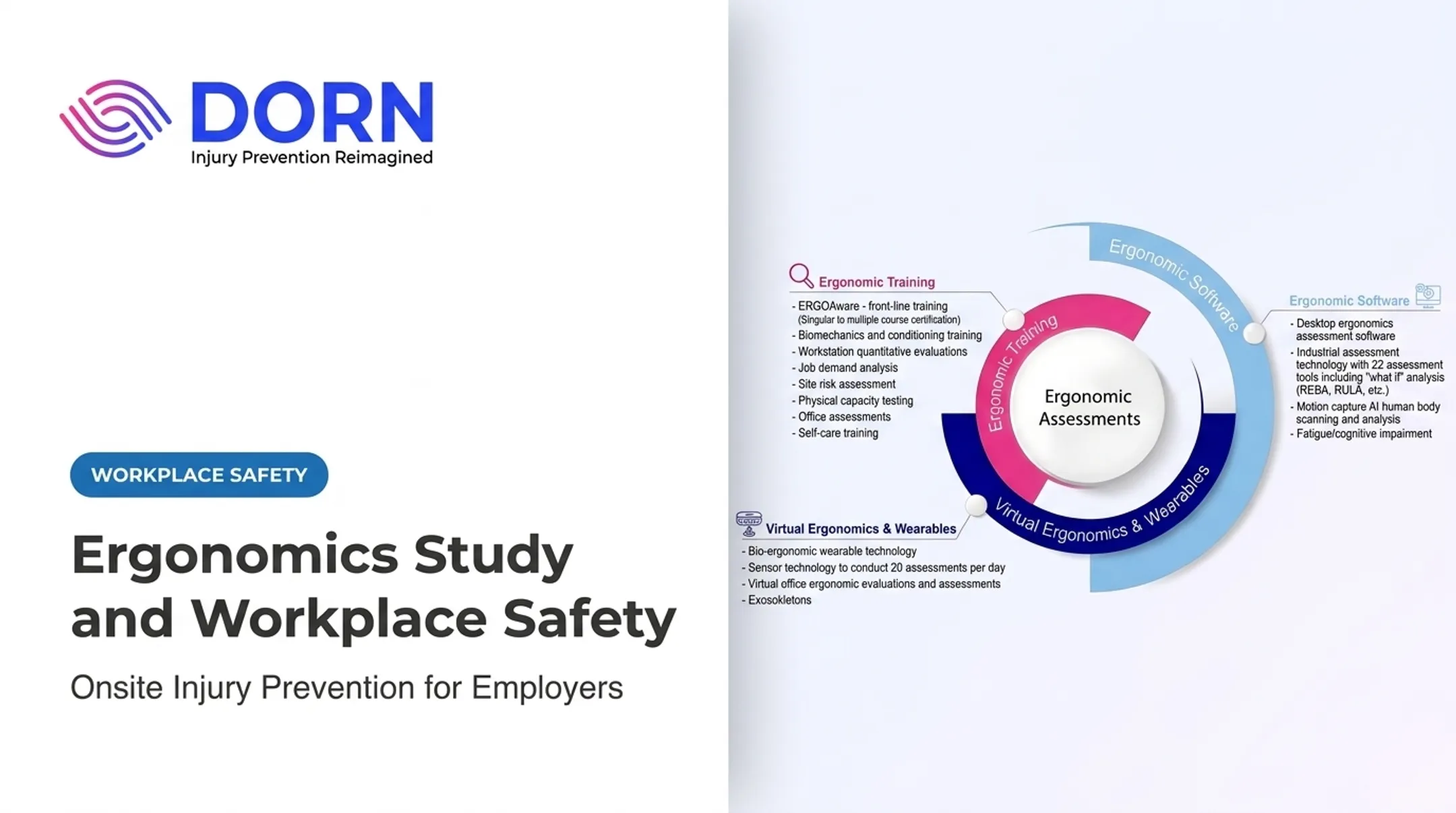
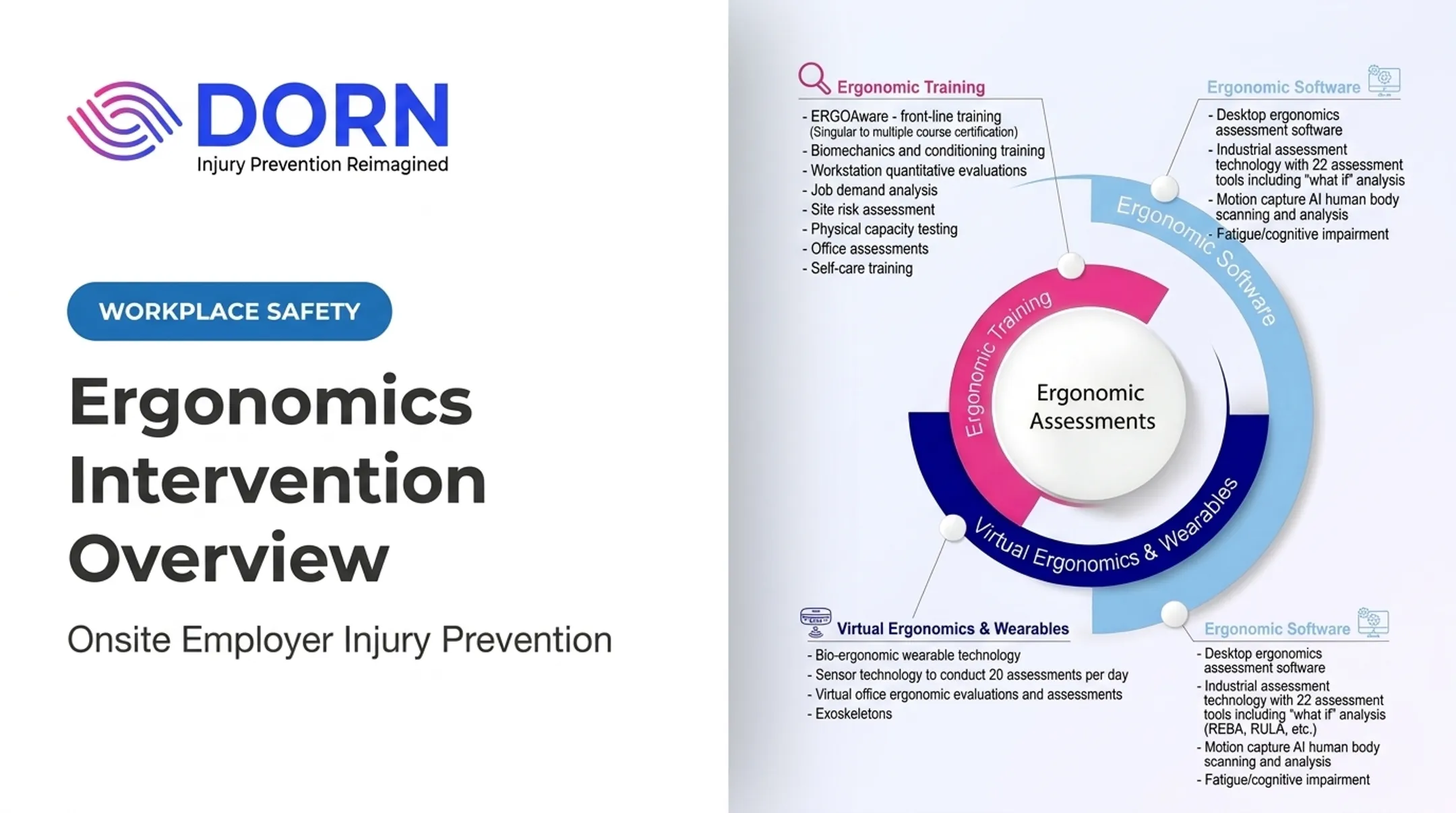
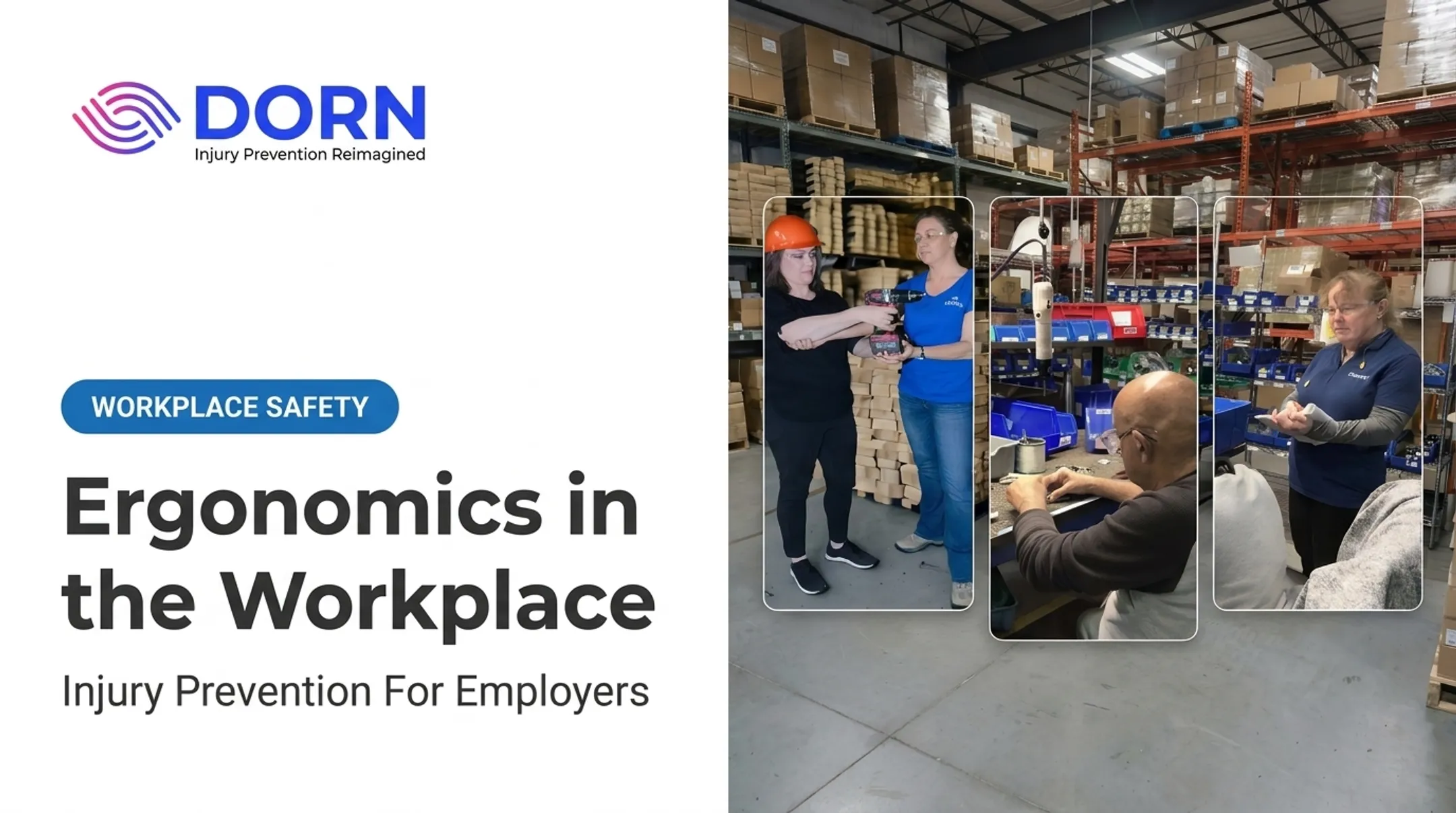
DORN Companies supports this process through Certified Industrial Ergonomic Evaluators. Onsite and virtual assessments identify task-specific risks and turn them into corrective action plans.
Functional Ergonomic Assessment Process
A solid assessment starts before anyone walks the floor. It begins with defining the business or safety concern — is this a response to injury trends, discomfort reports, or a new workstation design?
From there, an evaluator typically reviews:
- Task demands, forces, and postures
- Repetition frequency and duration
- Equipment, tools, and layout
- Work organization and scheduling
- Employee feedback and existing controls
Prioritization matters as much as identification. Not every risk gets fixed at once. Evaluators rank issues by exposure level, severity, frequency, how many workers are affected, and how feasible a control is to implement.
What the Report Should Include
A useful assessment report isn't just a list of problems. It should specify:
- Observed risks with supporting evidence (photos, video, or measurements)
- Recommended controls, ranked short-term vs. long-term
- Responsible owners for each action item
- Implementation timing
- A follow-up method to confirm results
That last piece gets skipped too often. Follow-up should confirm the intervention is actually being used, that it reduces the intended exposure, and that it hasn't introduced a new risk elsewhere. A height-adjustable workstation that nobody adjusts doesn't reduce risk; it just adds cost.
Functional Ergonomics Across Different Work Settings
The same three factors — Body, Behavior, Environment — show up differently depending on where the work happens.
Manufacturing and warehouses deal with lifting, carrying, pushing, and pulling as daily realities. OSHA notes that warehouse case-picking loads can range from a few pounds to over 100 pounds. Material handling and storage account for roughly 32% of total workers' compensation claims, according to internal DORN data. Conveyor work, pallet-jack use, and dock transitions all add distinct risk points.
Food and beverage processing brings its own combination: repetitive cutting or packing motions, cold or chilled environments, and production-line pace that limits recovery time. OSHA's poultry-processing guidance found carpal tunnel syndrome prevalence 2.5 times higher among poultry workers compared to non-poultry manual laborers, per OSHA's Prevention of Musculoskeletal Injuries in Poultry Processing.
Office and remote work centers on a different problem: designing around one static posture for too long. NIOSH's work-from-home guidance recommends:
- Varying posture throughout the day
- Standing periodically
- Keeping displays at arm's length, with the top at or below eye level

Standardizing Across Multiple Sites
Multi-site organizations face a tension: they need consistent principles and documentation, but each location has different equipment, layouts, and workforce conditions. Solutions can't just get copy-pasted from one site to the next. They need to adapt to local realities.
Virtual tools help extend reach here. DORN's virtual ergonomic evaluations, for instance, run 30-60 minutes using live video to assess seating and work surface arrangement remotely. Technology and remote assessments still supplement direct task understanding; they don't replace walking the floor and talking to the people doing the job.
Benefits and Measurement
A functional ergonomics program should produce outcomes you can actually track, not just a feeling that things improved.
Realistic benefits include:
- Reduced exposure to identified ergonomic hazards
- Earlier identification of discomfort before it becomes an injury
- Improved work design based on real task data
- Stronger employee engagement in safety processes
Measure results in these categories:
| Measurement Category | What to Track |
|---|---|
| Injury trends | MSD complaints, incidence rates, days away from work |
| Program completion | Assessments finished, corrective actions closed |
| Cost trends | Workers' comp claims, healthcare costs |
| Operational impact | Absenteeism, productivity, quality indicators |
| Employee input | Participation rates, feedback, survey results |
Research supports tracking these outcomes. Punnett's 1999 automotive manufacturing study found that at least 50% of work-related MSDs could be prevented through ergonomic job design. Some workplace modifications paid for themselves within a few months.

Common Barriers to Watch For
Programs stall for predictable reasons:
- Low employee participation or buy-in
- Controls that slow down production
- Inconsistent supervisor reinforcement
- Fixes that are hard to maintain long-term
Establishing a baseline before you start, then reviewing results over a defined period, matters more than any single metric. DORN's approach pairs ergonomic assessments with training, coaching, technology, and ongoing monitoring so results stay visible over time.
Frequently Asked Questions
What are the top 3 ergonomic factors?
Body, Behavior, and Environment. For example, a warehouse worker (Body) using poor lifting technique (Behavior) at a workstation set too low (Environment) faces compounded risk from all three factors interacting together.
What is functional ergonomics?
Functional ergonomics fits people, tasks, tools, equipment, and environments together to reduce injury risk and support performance. It goes beyond furniture adjustments to examine how work actually gets done across a full shift.
How is functional ergonomics different from traditional ergonomics?
Traditional ergonomics often focuses narrowly on workstation setup, like chair height or monitor position. Functional ergonomics examines real task performance, covering physical, behavioral, environmental, and organizational factors together.
What does a functional ergonomic assessment include?
Assessments cover task observation, employee input, physical demands, equipment and workspace design, and work organization. The output is a prioritized set of recommended controls with follow-up built in.
What are examples of functional ergonomics in the workplace?
Examples include redesigning lifting procedures in warehouses, adjusting cutting station heights in food processing, improving reach distances in manufacturing assembly, and varying posture guidance for remote office workers.
How can employers improve functional ergonomics?
Start with employee involvement and a task-specific risk assessment. Prioritize design or equipment changes over training alone, then follow up to confirm the fix worked and measure results against a baseline.