Introduction
Musculoskeletal disorders don't announce themselves. An employee adjusts how they lift, twists a little more to reach a bin, or shifts weight to a sore knee without saying a word. By the time discomfort becomes a workers' comp claim, the pattern has often been repeating for months.
An ergonomic assessment checklist gives employers a repeatable way to catch these risks before they turn into injuries. It documents how workers interact with their tasks, tools, equipment, and environment, so risks are flagged consistently instead of by chance.
Informal walkthroughs have real limits. Employees adapt to discomfort and stop mentioning it. Risk factors shift by shift, product run, or season. A checklist, however thorough, still doesn't replace a qualified assessor or genuine employee input.
This guide covers how to prepare for an assessment, what to put on office and industrial checklists, how to rank findings, and how to turn those findings into corrective action.
Key Takeaways
- Assess the interaction between the worker, task, equipment, and environment—not just posture in isolation
- Combine employee feedback, injury records, direct observation, and task-specific risk data in every review
- Rank findings by severity, exposure, and urgency, then assign owners, deadlines, and verification steps
- Customize checklists for office workstations, manufacturing, warehousing, food processing, and remote work
What Is an Ergonomic Assessment?
An ergonomic assessment is a structured evaluation of how work demands, tools, workstation design, job organization, and environmental conditions affect worker safety and performance. It's typically the first step in identifying musculoskeletal disorder (MSD) risk before it becomes a claim.
Checklist vs. Self-Audit vs. Professional Assessment
These three aren't interchangeable:
- A checklist supports consistent, repeatable observation across shifts, teams, or sites
- A self-audit lets employees flag concerns about their own workstation or task
- A professional assessment, conducted by a certified evaluator, can analyze complex tasks, biomechanical data, and feasible engineering controls that a checklist alone can't capture
That layered model is how many employers start. DORN Companies' ERGOLite assessment, for example, is a high-level review of a department, facility, or worksite. It flags environmental hazards, outdated equipment, poor task design, and technique issues, often before a deeper quantitative evaluation.
Core Risk Factors to Screen For
Every checklist should screen for the same underlying exposures, regardless of industry:
- Forceful exertion — heavy lifting, forceful pushing or pulling, high-force gripping
- Repetition — short task cycles repeated throughout a shift
- Awkward or static posture — bending, twisting, overhead reaching, or holding one position too long
- Duration and recovery time — working near maximum capacity without adequate rest
- Vibration and contact stress — from tools, equipment, or hard edges pressing against the body
- Manual handling — carrying bulky or unstable loads
Awkward posture, high force, and exposure time matter most. Workers often face two or three together, and the combined load compounds risk instead of adding it neatly.

OSHA does not maintain a single mandatory ergonomic standard. It relies on the General Duty Clause and publishes industry-specific guidance and tools rather than one universal checklist. Verify which legal, industry, and internal requirements apply to your operation before treating any generic checklist as complete.
How to Conduct an Ergonomic Assessment
A good assessment follows a sequence. Skip a step, and you risk missing the real cause of a problem.
1. Prepare Before You Walk the Floor
Define the scope first:
- Location, department, and specific job or workstation
- Task being evaluated, assessor name, date, and shift
- Employees involved
Then pull supporting data: injury records, near-miss reports, absenteeism trends, discomfort complaints, and any prior recommendations that were never implemented.
2. Talk to Employees First
Interview before you observe. Ask what feels difficult, where discomfort shows up, and which parts of the task change throughout the shift. Workers often develop workarounds that never appear in the written procedure, and those workarounds are usually where the real risk lives.
3. Observe the Task as It's Actually Performed
Watch setup, reaching distances, lifting mechanics, tool use, pacing, and transitions between tasks. DORN ergonomists have completed 47 individual office assessments in two days when reviewing workstation configuration and equipment design across a facility—proof that one focused observation block can cover a lot of ground.
Use photos or video only within your company's privacy and consent policies.
4. Record Exposure Without Assuming One Threshold Fits All
Note force, frequency, duration, posture, load characteristics, and recovery time. Conditions often differ by worker, product, shift, or season, so avoid applying a single cutoff across every job.
5. Analyze for Contributing Causes, Not Individual Blame
Compare the written procedure against actual practice. A worker who twists through the spine instead of pivoting on their feet isn't being careless. That pattern usually points to a design problem, such as poor material placement. The layout is forcing an awkward movement hundreds of times a shift.
6. Document Consistently
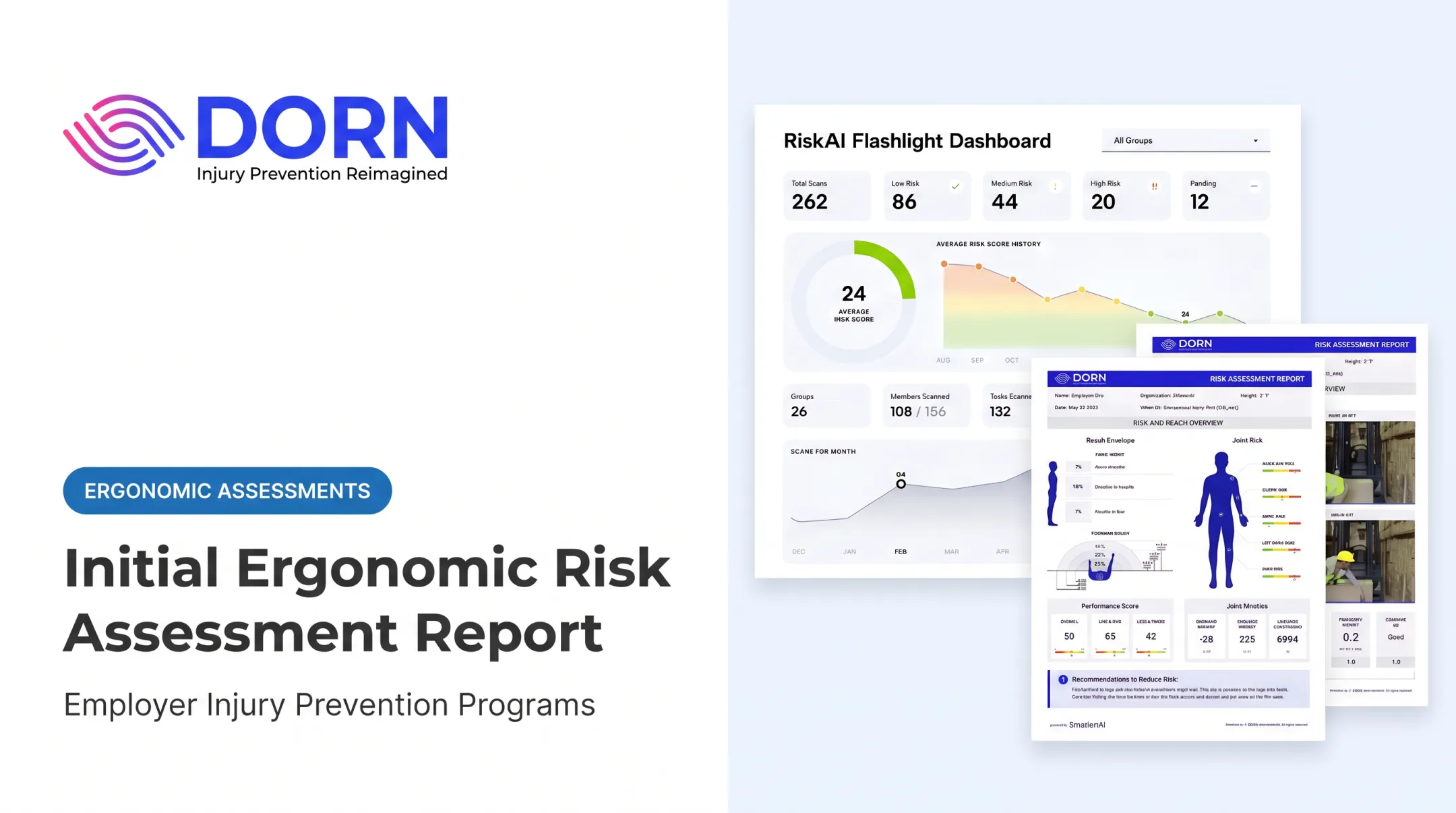
Every assessment should produce a record with observations, risk rating, recommended controls, an assigned owner, a target date, and a follow-up date. DORN compiles these findings in spreadsheet format with a risk-reduction score on each recommended intervention, so owners can track progress against target and follow-up dates.

What to Include in an Ergonomic Assessment Checklist
A complete checklist has six functional sections. Miss one, and you end up with data that's hard to act on.
Assessment Details
Capture the basics so every record is traceable:
- Facility or remote-work location, department, and job title
- Task, shift, and current production or workload conditions
- Assessor, employee or work group, and date
- Equipment used during the assessment
Employee and Health-Symptom Section
Document reported discomfort, fatigue, and prior concerns tied to the task. Note barriers to reporting and any differences between experienced workers and those newly assigned to the role.
Posture and Workstation Design
| Area | What to Check |
|---|---|
| Head and neck | Forward flexion, sustained rotation |
| Shoulders | Elevation, reach above shoulder height |
| Elbows and wrists | Alignment, deviation, bent-wrist posture |
| Trunk | Bending, twisting, unsupported leaning |
| Seated/standing support | Chair adjustability, foot support |
| Workstation layout | Reach distances, clearance, monitor/input-device placement |
Physical Demands and Exposure
Cover each demand and record the time or frequency tied to it:
- Lifting, lowering, carrying, pushing, and pulling
- Gripping, pinching, and contact stress
- Repetition, static work, and load stability
- Overhead reaching, kneeling, and squatting
- Vibration exposure
Tools, Equipment, and Environment
Check tools and conditions that drive force, posture, and recovery:
- Handle design, tool condition, and equipment controls
- Work-surface height and access to mechanical aids (for example, lift assists)
- Lighting and glare, temperature, and floor conditions
Findings and Action
For every flagged item, log:
- Evidence and risk level
- Recommended control and interim protection
- Corrective-action owner and completion date
- Verification method
Practical tip: Build the checklist with Yes/No/Not Applicable fields plus an open observations box. Customize questions and risk criteria to the job, and validate them against current OSHA and NIOSH guidance instead of a single generic template.
Adapt the Checklist to the Work Setting
A checklist built for an office won't catch what matters on a production line. Adapt the categories, not just the wording.
Office and Computer Workstations
Focus on:
- Chair and desk adjustability
- Monitor height and viewing distance
- Keyboard and mouse placement
- Laptop use, lighting, and glare
- Opportunities to change position throughout the day
DORN's virtual live office assessments let remote employees self-correct at their own workstation, with a specialist responding within 48 hours. That format works well for distributed teams where an in-person visit isn't practical.
Manufacturing, Warehousing, and Food Processing
These environments demand a different lens:
- Lifting and material handling patterns
- Repetitive line work and forceful exertion
- Awkward reaches around conveyors or fixed equipment
- Vibration exposure from powered tools
- Cold, wet, or slippery floor conditions
- Variation across shifts or seasonal production volumes
Standardizing Across Multiple Sites
For multi-site programs, keep the core questions and rating language identical across locations, but let each site add task-specific hazards. Use the same fields for photographs, employee feedback, and follow-up dates so results are actually comparable, not just similarly formatted.
Knowing When to Escalate
Office workstation assessments often work well as guided self-assessments or virtual reviews. Complex industrial tasks, injury trends, new equipment, or high-risk exposures usually call for an on-site visit from a qualified professional instead.
How to Prioritise Findings and Implement Corrective Actions
How to Prioritize Findings and Implement Corrective Actions
Not every finding needs the same urgency. A risk-ranking method keeps corrective action focused on what matters most.
Ranking Findings
OSHA's hazard-identification approach offers a workable model: weigh the severity of potential harm, likelihood of exposure, and number of workers affected, then prioritize the highest-risk items first.
Some ergonomic scoring systems translate this into numeric bands, for example:
| Risk Score | Category | Action |
|---|---|---|
| 400+ | Very high risk | Discontinue operation |
| 200–400 | High risk | Immediate correction required |
| 70–200 | Substantial risk | Correction needed |
| 20–70 | Possible risk | Attention indicated |
| Below 20 | Low risk | Likely acceptable |
DORN has used this kind of scoring in practice. One manufacturing site in Carol Stream, Illinois, started with an initial risk rating of 3,000. After equipment redesigns and handling changes, follow-up scoring dropped to 800, then 36 at final review.
Apply the Hierarchy of Controls
Don't jump straight to "use better posture." NIOSH lists a clear order of preference for controls: elimination, substitution, engineering controls, administrative controls, and PPE last.
Feasible examples include:
- Changing material presentation so it sits at working height
- Reducing reach distance with lift or transport aids
- Redesigning tool handles to cut contact stress
- Rotating tasks to break up repetitive exposure
- Improving workstation adjustability

Small changes add up. Pivoting on the feet instead of rotating through the spine adds maybe two seconds per movement, but it removes hundreds of rotational loads from the lumbar spine over a shift.
Assign, Track, and Reassess
Every action needs a named owner, a realistic deadline, and a way to confirm it actually addressed the original risk, not just that something changed. Reassess after implementation, and again whenever equipment, staffing, layout, or reported symptoms shift.
MSDs remain a significant share of workplace injury. BLS data shows MSDs accounted for roughly 30% of all private-sector days-away-from-work cases in 2018.
That is a strong reason to track completed actions, recurring complaints, and injury trends over time rather than treating one assessment as a finish line.
When to Bring in a Professional
Escalate to an ergonomics specialist when you see persistent symptoms, several interacting risk factors, complex manual handling, a real injury trend, or disagreement about which controls will actually work.
DORN's Certified Industrial Ergonomic Evaluators (seven on staff) provide onsite and virtual assessment support built around a Body, Behavior, and Environment approach. That model addresses physical exposure, work habits, and workplace conditions together.
No assessment guarantees injury elimination or a specific cost outcome. It is a tool for identifying and reducing risk systematically.
Frequently Asked Questions
How much does a DSE assessment cost?
Pricing for a DSE (display screen equipment) assessment varies by provider, complexity, employee count, and virtual vs. onsite format. Reporting depth and follow-up needs also affect cost, so request a scope-based quote.
What is included in an ergonomic assessment?
A full assessment covers task observation, employee input, posture and physical-demand analysis, equipment review, and environmental factors. It ends with documented findings, recommended controls, and a follow-up plan.
How often should a DSE assessment be conducted?
Reassess whenever the workstation, employee, job duties, or reported symptoms change. Beyond that, set periodic review intervals based on your organization's risk level and internal policy rather than a single universal timeframe.
What does the OSHA ergonomic assessment checklist include?
OSHA doesn't publish one universal checklist. It provides guidance and industry-specific tools covering force, repetition, awkward posture, and workstation design. Employers should select the resources relevant to their task and confirm current requirements apply.
What are the 10 basic ergonomic principles?
Common principles include neutral postures, reduced force and repetition, items within reach, proper work heights, limited static positions, and recovery time. A New Hampshire government ergonomics toolkit lists all ten in detail.
What are the 5 components of ergonomics?
Frameworks vary, but most examine the person, the task, the tools or equipment, the physical environment, and work organization. A solid checklist evaluates how these five pieces interact, not just each one in isolation.