Introduction
Manufacturing plants, warehouses, distribution centers, and food and beverage facilities share a common risk: repetitive, physically demanding work that wears the body down over time. Office workers face a quieter version of the same problem—hours at poorly configured desks.
Musculoskeletal disorders (MSDs) rarely appear overnight. Awkward postures, forceful exertion, and repeated motion stack up until discomfort becomes a recordable injury.
The numbers are hard to ignore. Private industry logged 937,620 MSD-related DART cases, including 484,620 cases with days away from work and a median of 24 days away per case, per National Safety Council data drawn from BLS reporting.
That is lost productivity, workers' comp exposure, and disrupted operations—often tied to tasks that could have been evaluated and fixed before someone got hurt.
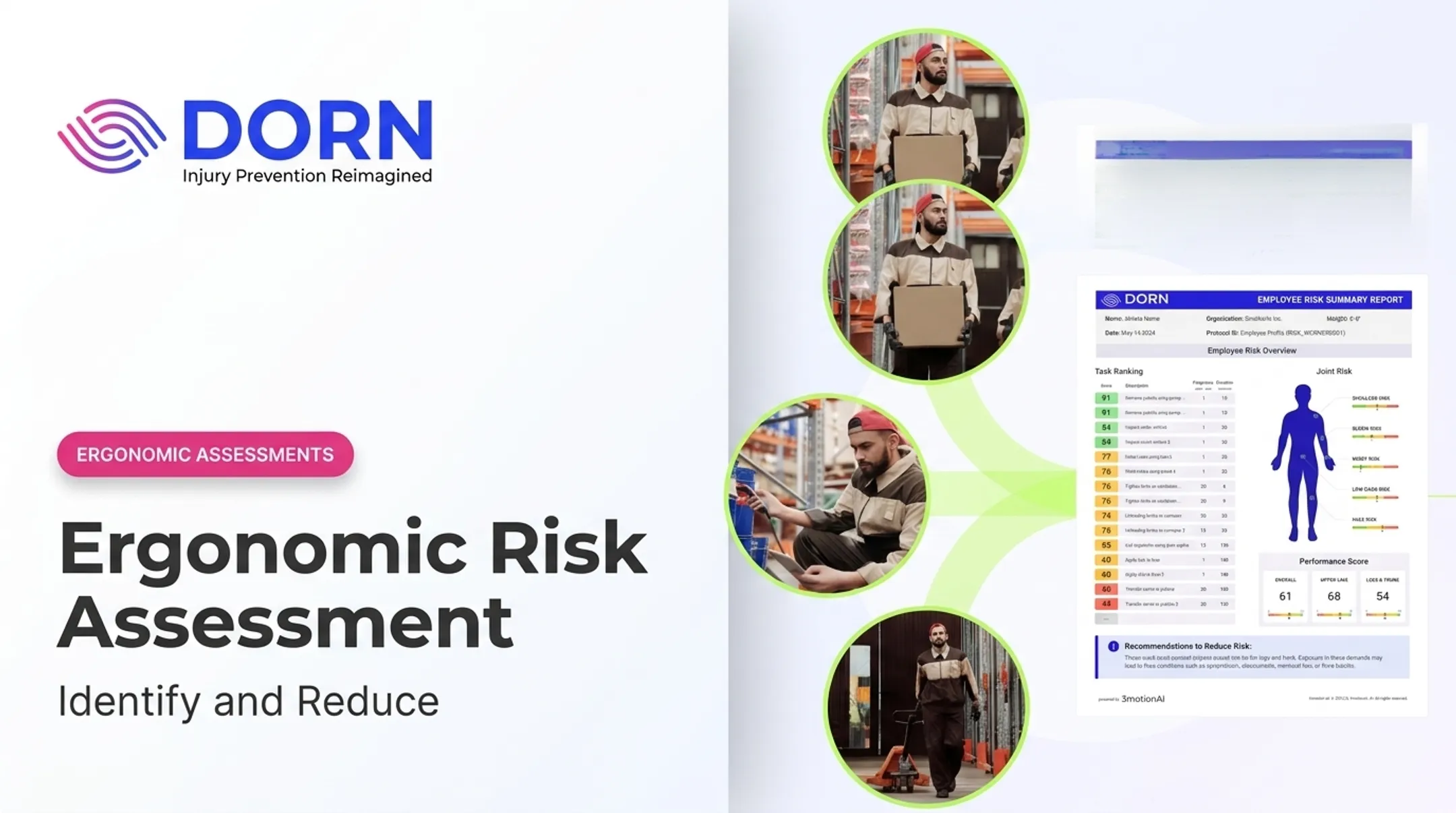
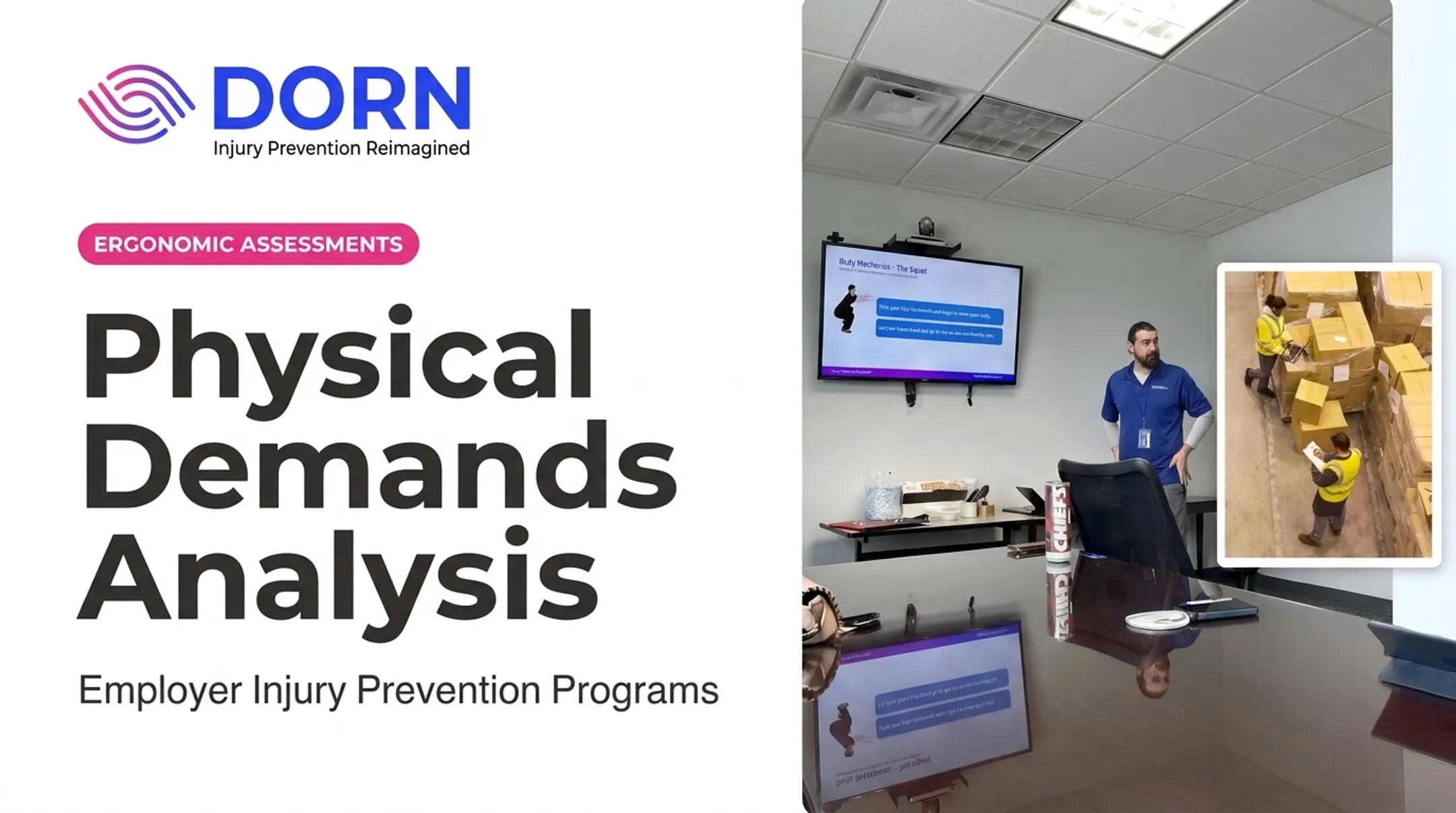
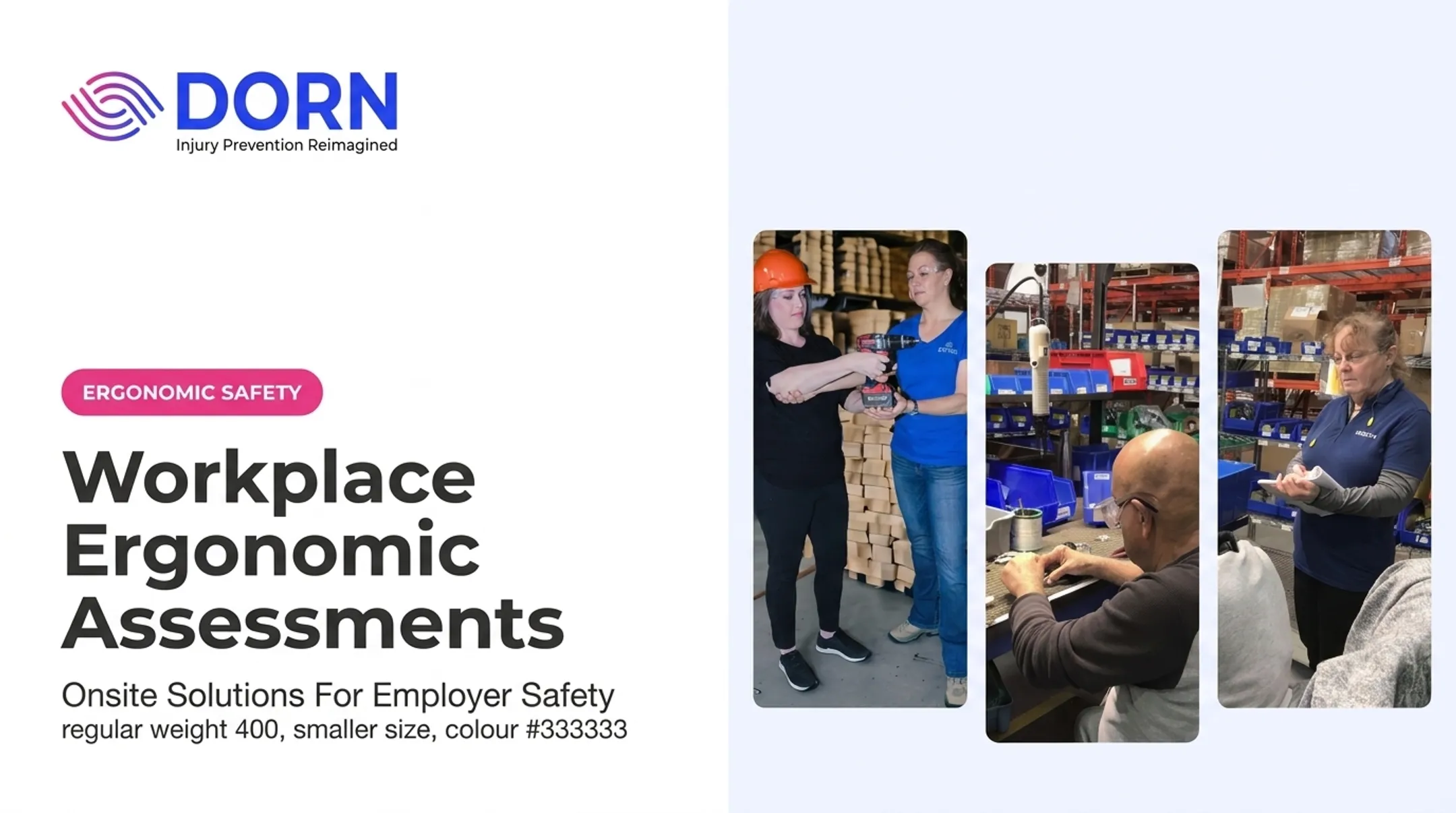
This guide covers what ergonomic evaluations involve, why they matter for injury and cost control, and how the process runs from first observation to verified results.
Key Takeaways
- Ergonomic evaluations map how workers use tasks, tools, and workstations so you can spot musculoskeletal disorder (MSD) risk factors early.
- Strong assessments blend injury data, direct observation, employee feedback, and objective measurement tools.
- Assessment results should drive prioritized corrective actions—not a static hazard list.
- Follow-up measurement verifies the fix cut risk, not only that equipment or process changes went in.
What Is an Ergonomic Evaluation and Assessment?
"Ergonomic evaluation," "ergonomic assessment," and "ergonomic risk assessment" are often used interchangeably in workplace safety conversations. All three describe the same core activity: identifying and ranking the factors most likely to contribute to musculoskeletal disorders on a specific job or in a specific facility.
These evaluations show up across a wide range of work:
- Manual material handling, lifting, pushing, and pulling
- Repetitive production line tasks
- Workstation and office desk setups
- Tool use and hand-arm vibration exposure
- Awkward postures held for extended periods
- Remote and home-office arrangements
Qualitative Observation Meets Quantitative Measurement
A useful assessment doesn't rely on one method alone. Qualitative work includes watching how someone actually performs a task and asking about discomfort. Quantitative and semi-quantitative methods score specific factors like posture, force, repetition, and duration to produce a more defensible, comparable result.
Three Interacting Areas: Body, Behavior, Environment
DORN Companies structures its ergonomic work around three interacting areas:
- Body — physical capability and technique
- Behavior — how a worker actually performs the task day to day
- Environment — equipment, layout, and workstation design
Swapping out a piece of equipment without addressing technique, fatigue, or work organization often leaves part of the risk untouched.
An ergonomic evaluation is not a medical diagnosis. It doesn't replace clinical care, occupational health support, or the need to report symptoms and hazards right away.
Why Ergonomic Assessments Are Critical in the Workplace
Early identification matters because MSD risk rarely announces itself with a single injury. Discomfort, fatigue, and restricted duty often build for months before a recordable event forces the issue. OSHA notes that early reporting speeds up job assessment and can prevent or reduce symptom progression before it becomes a formal claim.
Assessments also replace guesswork with evidence. Instead of assuming a task is fine because nobody has complained loudly, evaluators combine task-specific observation, worker input, and injury history into a documented set of priorities.
Core operational and workforce benefits include:
- Reduced exposure to high-risk lifting, reaching, twisting, and prolonged static postures
- Clearer prioritization for EHS and operations teams choosing between engineering controls, training, job rotation, or equipment changes
- A structured channel for workers to report discomfort and suggest practical fixes
- Lower absenteeism and more consistent output when paired with sustained follow-through
Overexertion involving outside sources is the single largest driver of serious workplace injury costs—$13.7 billion annually, largely tied to manual material handling, according to Liberty Mutual's 2025 Workplace Safety Index.

When to Trigger a Reassessment
Ergonomic risk isn't static. A one-time evaluation loses relevance as conditions change. Revisit assessments after:
- Process changes or new equipment installations
- Facility redesigns or line reconfigurations
- Emerging injury trends or recurring near misses
- Workforce turnover or staffing shifts
- Expansion into remote or hybrid work arrangements
How Ergonomic Evaluations Work
Ergonomic evaluation works best as a repeating cycle. Work through each stage in order:
- Define the objective
- Review existing information
- Observe the work
- Gather employee input
- Measure risk
- Recommend controls
- Verify results
Skipping a stage weakens the outcome.
Common mistakes that undercut this cycle:
- Evaluating a task outside normal production conditions
- Overlooking non-obvious forces, like grip or contact stress
- Treating worker discomfort as anecdotal rather than data
- Choosing a control before understanding the root cause
- Failing to revisit the task after changes go in
Review the Objective and Existing Information
Start by naming what prompted the evaluation, whether it's a specific task, an injury trend, or a new workstation design. Then pull whatever's available: injury and illness logs, workers' comp records, first-aid reports, absenteeism patterns, job descriptions, and any prior assessments.
Observe the Task and Gather Worker Feedback
Watch the job under normal operating conditions, not a slowed-down demonstration. Note pace, workload, equipment interaction, reach distances, and how experienced versus newly assigned workers handle the same task differently.
Ask direct questions about discomfort, fatigue, difficult steps, and workarounds. Workers often know exactly which part of a task causes problems; they just need to be asked in a way that feels safe to answer honestly.
Select and Apply Appropriate Assessment Methods
Match the tool to the exposure being examined:
| Method | Best Used For |
|---|---|
| NIOSH Lifting Equation | Manual lifting tasks, low-back risk |
| REBA | Whole-body posture in variable, unpredictable work |
| RULA | Upper-limb and neck posture at fixed workstations |
| Snook Tables | Pushing, pulling, and manual handling |
| Vibration-specific methods | Hand-arm or whole-body vibration exposure |
These tools support professional judgment. They don't substitute for task observation, employee interviews, or knowledge of how long and how often the exposure occurs.
Analyze, Prioritize, and Recommend Controls
Organize findings by risk level, number of affected employees, potential severity, and feasibility. Separate immediate fixes from longer-term engineering changes.
CDC/NIOSH's hierarchy of controls ranks interventions by preference:
- Elimination
- Substitution
- Engineering controls
- Administrative controls
- Personal protective equipment
For most ergonomic findings, start by redesigning the workstation or material flow, then fill gaps with training, rotation, or scheduling changes.
Verify Implementation and Review Outcomes
A control that gets installed but never used, or that doesn't address the original risk, hasn't solved anything. Follow-up should include completion checks, renewed employee feedback, discomfort reports, and a reassessment score where relevant. Update the evaluation whenever equipment changes or evidence suggests the fix isn't working as intended.

Practical Ergonomic Assessment Example: From Risk Identification to Corrective Action
Picture a production task involving repeated lifting, reaching, and twisting to move parts from a conveyor into a storage bin.
Step 1: Review existing information. The evaluator pulls first-aid logs and finds three reports of shoulder discomfort tied to this station over six months.
Step 2: Observe and interview. Watching the task during a normal shift reveals workers reaching across a wide bin to place parts. Several mention fatigue by mid-shift. One worker twists at the waist instead of stepping, a workaround meant to save time.
Step 3: Select a method and document findings. REBA scoring captures the awkward trunk rotation and static shoulder loading. The evaluator identifies an oversized reach distance built into the bin design as the root cause, with inconsistent lifting technique among newer hires as a secondary factor.
Step 4: Prioritize recommendations.
- Immediate: Reposition the bin closer to the conveyor to cut reach distance.
- Short-term: Refresh lifting technique training for the crew.
- Longer-term: Evaluate a mechanical lift-assist for the highest-volume shift.
Step 5: Verify. A follow-up observation two weeks later checks whether the reduced reach distance changed worker posture. First-aid reports for that station are then tracked over the following quarter.
How DORN Companies Can Help
DORN Companies has worked in workplace safety and injury prevention for over 20 years, with a nationwide team that includes Certified Industrial Ergonomic Evaluators.
Specialists support both one-off project work and ongoing programs across manufacturing plants, warehouses, food and beverage facilities, and multi-site enterprises.
Capabilities include:
- Customized ergonomic evaluations covering job demand analysis, workstation review, and site risk assessment
- Virtual evaluations for remote and home-office workers, plus on-site assessments
- Technology-enabled approaches, including motion capture, wearables, and fatigue identification
- Coaching, monitoring, and biomechanics training tied directly to assessment findings
Engagements range from rapid office rollouts to multi-year plant programs. In one project, specialists completed 47 office ergonomic assessments in two days. In a multi-year manufacturing partnership, 116 workers, representing 63% of the site's workforce, completed individual and workstation evaluations in the first year alone.
One long-running client saw workers' compensation claims drop from 6.8% to 5.0%, then to just over 1% of the workforce over roughly two years, with year-over-year absenteeism reductions of 59-61%.

If your organization has a specific job task, injury trend, workstation, or multi-site rollout that needs evaluation, DORN can outline a project-based or ongoing assessment plan for your facility.
Conclusion
An ergonomic evaluation pulls together floor observations, worker input, and hard data. It turns all of that into a prioritized action list. That's the difference between a hazard report that sits in a drawer and a program that actually changes outcomes.
The most effective approach combines:
- The right assessment method for the exposure
- Genuine employee involvement
- Practical controls chosen through the hierarchy of controls
- Follow-up that confirms the fix worked
Don't wait for a cluster of injuries or a major facility redesign to force the issue. Assessing high-risk tasks now, while you still have options, is almost always cheaper than reacting later.
Frequently Asked Questions
Who is qualified to perform an ergonomic evaluation?
Qualifications depend on the task and risk level. Evaluators need training in ergonomics, occupational safety, industrial hygiene, or human factors, plus hands-on experience. DORN's team includes Certified Industrial Ergonomic Evaluators; other credentials can also fit the situation.
Can employees get an ergonomic evaluation for a home office?
Yes. Home-office and remote-work evaluations can be done virtually, through employee self-assessment, or on-site when needed. They typically cover chair setup, desk height, monitor position, keyboard placement, lighting, and work habits.
What are the main ergonomic factors to consider?
Key factors include force, repetition, awkward posture, duration, contact stress, vibration, and workstation or tool design. Environmental conditions and fatigue matter too, since risk depends on how intensely and how often a worker is exposed, not just the task on paper.