
Introduction
Repeated lifting, reaching, pushing, twisting, and standing rarely look dangerous in the moment. No single motion sends anyone to the emergency room. Stack those motions across an 8- or 10-hour shift, though, and crews start dealing with sore joints, slower work, and injuries that keep people off the floor.
That gradual buildup is what industrial ergonomics is built to stop. In 2024, private industry employers reported 888,100 cases involving days away from work. Sprains, strains, and tears accounted for 568,150 of them, according to the Bureau of Labor Statistics.
This guide explains what industrial ergonomics means, why it affects your injury rates and costs, and how to build a program that fits tasks and tools to the people doing the work.
Key Takeaways
- Fit tasks, tools, workstations, and processes to workers—not the other way around—to reduce MSD risk
- Track posture, force, repetition, duration, vibration, and environmental conditions as core risk factors
- Build programs around engineering controls, worker input, targeted training, and repeat assessments
- Measure success with safety, workforce, operational, and financial data—not training completion alone
What Is Industrial Ergonomics?
Industrial ergonomics is the science of designing work so it fits the worker's body, rather than forcing the worker to adapt to a poorly designed task, tool, or workstation. It's a subset of the broader ergonomics field, but it lives on the production floor, not behind a desk.
Office ergonomics deals with chair height and monitor placement. Industrial ergonomics deals with warehouses, distribution centers, food-processing lines, maintenance shops, and manufacturing plants, where physical demands are higher and the margin for error is smaller.
The Three Elements Every Assessment Should Cover
Every ergonomic evaluation looks at three interacting pieces:
- The worker — physical capabilities, limitations, and how those change across a shift
- The task — what's actually being lifted, reached for, or repeated, and how often
- The environment — layout, equipment, lighting, temperature, and tools available
Observe, Then Redesign
The process itself has two parts. First, observe and measure how work actually happens (not how the job description says it should happen). Second, redesign the task, tool, or workflow to cut unnecessary physical demand.
DORN's own assessments follow this same logic, examining required tasks, worksite conditions, and each worker's specific abilities before recommending changes. The goal is reducing avoidable strain while keeping output consistent.
Common fixes include:
- Raising or lowering a work surface to a neutral height
- Moving frequently used materials within easy reach
- Redesigning tool grips to reduce wrist deviation
- Adding a lift table, hoist, or powered cart
- Rerouting material flow to cut unnecessary carrying distance
Those redesigns add up on the floor. A US Department of Labor study found that up to 30% of back injuries that might otherwise lead to surgery can be prevented through better workplace design and ergonomics alone—hard to ignore in a field some employers still treat as optional.
Why Industrial Ergonomics Matters
Poorly designed work doesn't just cause injuries. It creates a slow drag on the entire operation: fatigue, discomfort, restricted duty, absenteeism, turnover, and production disruptions that compound over time.
The scale is bigger than most safety managers assume. Musculoskeletal disorders account for roughly one-third of all workplace injury claims, and OSHA estimates that around 2 million employees suffer MSD-related issues annually, with 600,000 losing time at work as a direct result.
Indirect costs, including replacement labor, training, and lost productivity, can run up to five times higher than direct medical costs.
The Business Case, Not Just the Safety Case
Ergonomic risk shows up on multiple financial lines:
- Workers' compensation premiums and claims
- Overtime or temporary staffing to cover restricted-duty workers
- Reduced productivity and quality from fatigued employees
- Turnover in physically demanding roles
Shoulder and back injuries tied to material handling alone average $20,000 to $40,000 per case. That figure excludes the 12 missed workdays a typical ergonomic injury generates and the drag on morale that follows.

Safety conditions also shape engagement. Only 29% of workers report feeling fully engaged at work, and workplace safety is a major driver of that number.
Why Waiting for an Injury Report Is a Losing Strategy
Injury reports are lagging indicators. By the time one lands on your desk, the damage is done. Early intervention depends on signals that show up sooner:
- Employee feedback on discomfort or fatigue, gathered before it becomes a claim
- Near-miss observations from supervisors watching daily operations
- Discomfort reporting systems that make it easy for workers to flag issues
Ergonomics isn't a replacement for job hazard analysis, medical care, or regulatory compliance. It works alongside those controls, closing gaps that broader safety programs sometimes miss.
Common Industrial Ergonomic Hazards and Controls
Most industrial MSD risk falls into a handful of categories. Each has its own set of practical fixes.
Posture-related risk covers bending, twisting, overreaching, overhead work, kneeling, and prolonged static positions. Controls include height-adjustable workstations, repositioned controls, and layout changes that bring materials into a neutral reach zone.
A simple example: pivoting with the feet instead of rotating through the spine adds maybe two seconds per motion, but removes hundreds of rotational loads from the lumbar spine across a 50-hour week.
Force-related risk comes from lifting, lowering, pushing, pulling, and gripping heavy or unstable loads. Practical controls include:
- Lift tables and conveyors
- Hoists and powered carts
- Improved handle design
- Reduced load size or weight where feasible
Note that pushing is almost always safer than pulling. Pulling rounds the back, strains the spine, and reduces visibility of the path ahead.
Repetition, duration, and recovery matter even when force is modest. High-frequency motions without adequate recovery time still build strain. Task variation, job rotation, micro-breaks of one to five minutes, and pacing adjustments all help.
Environmental and equipment factors can raise force demands or push workers into awkward movement:
- Vibration and poorly maintained tools
- Cold temperatures and restrictive PPE
- Poor lighting, noise, and floor conditions
Cold environments stiffen muscles and raise grip force requirements, which compounds other MSD risks on the line.

A Quick Risk-Identification Checklist
Ask these questions about any task:
- What are workers actually doing, versus what the job description says?
- How often is the task repeated per shift?
- How much force does it require?
- What body positions does it demand?
- Are employees reporting fatigue or discomfort in this role?
Follow the Hierarchy of Controls
NIOSH's hierarchy of controls ranks solutions from most to least effective: elimination, substitution, engineering controls, administrative controls, and personal protective equipment. Elimination and engineering changes work without relying on ongoing human compliance.
Administrative rules and PPE require constant reinforcement, and they should be the last resort, not the first move.
How to Build an Effective Industrial Ergonomics Programme
How to Build an Effective Industrial Ergonomics Program
A one-off assessment rarely sticks. Programs that hold up over years share a common structure.
Start With Ownership, Not Just a Checklist
Someone needs to own this. Ideally, that's a cross-functional team spanning EHS, operations, engineering, maintenance, HR, supervisors, and frontline workers. Without a named champion, ergonomic recommendations tend to sit in a drawer.
Prioritize Where You Look First
Not every job needs an assessment on day one. Prioritize based on:
- Injury and discomfort trends
- High-force or high-repetition tasks
- Employee concerns
- New equipment or process changes
- Jobs with restricted-duty or turnover patterns
What a Task Assessment Actually Involves
A solid assessment combines direct observation, employee interviews, photos or video where useful, and measurements of force and reach. It should also pull in existing injury or near-miss data. DORN's process typically starts with an initial site assessment evaluating hazards, job demands, and the specific factors contributing to fatigue and discomfort.

Involve the People Doing the Job
Participatory ergonomics works because the person doing the task 500 times a shift knows things an outside observer won't catch in an hour of watching. Involve workers in identifying hazards, testing proposed changes, and reporting whether a fix actually works during a real shift, not just a demo.
CDC/NIOSH's seven-step ergonomics framework reflects this same logic:
- Identify risk factors
- Involve and train management and workers
- Gather medical evidence
- Implement changes
- Evaluate results
- Support recovery
- Maintain long-term commitment
Turn Recommendations Into Assigned Actions
Recommendations that don't get assigned an owner, deadline, and budget line tend to disappear. Every corrective action needs:
- A named owner
- A deadline
- Budget approval where equipment is involved
- A maintenance plan
- A method for confirming it was actually implemented
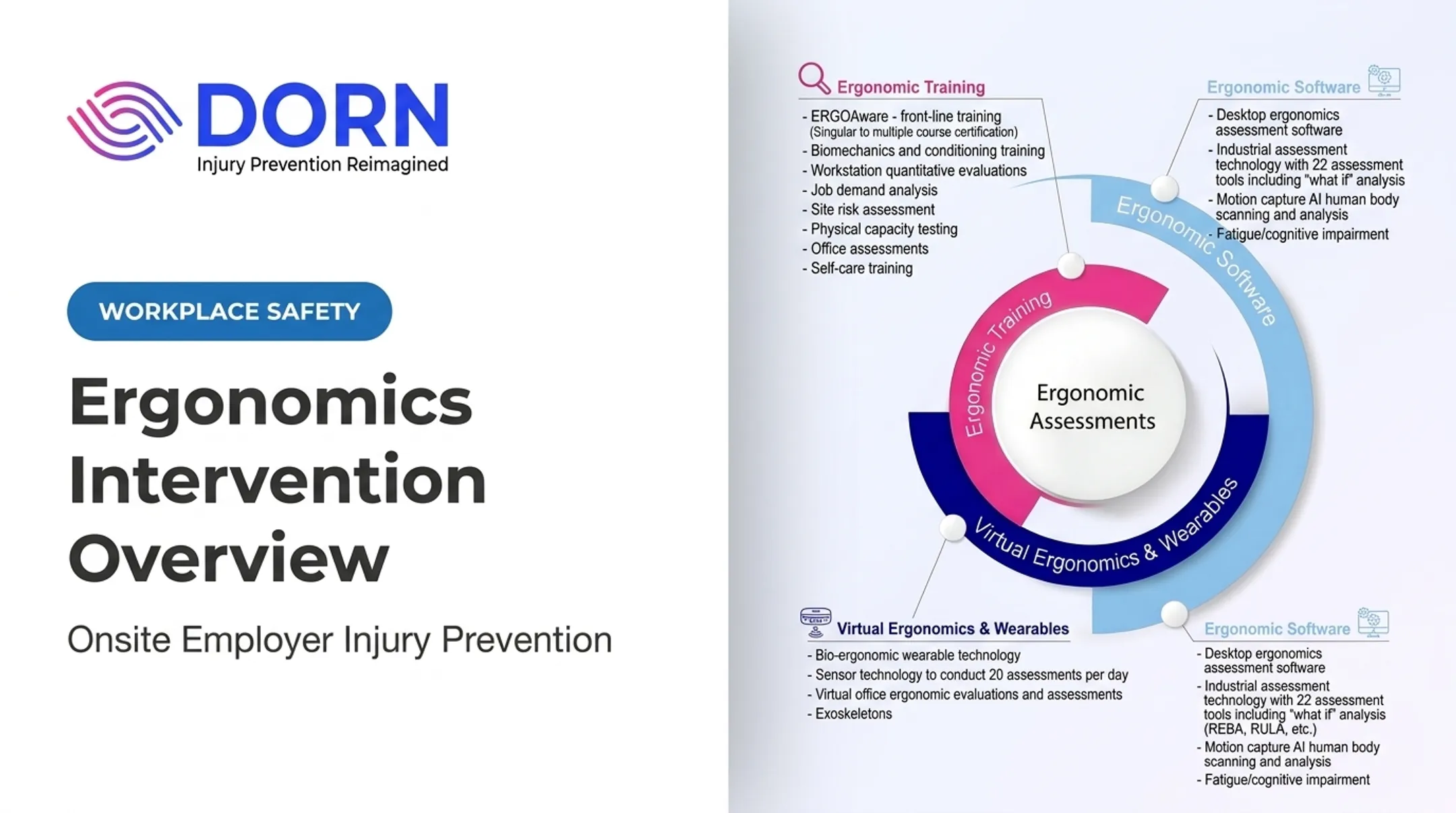
For organizations that need outside expertise, DORN Companies offers customized ergonomic assessments delivered by certified industrial ergonomic evaluators. These combine onsite visits, virtual evaluations, education, coaching, and technology-enabled tools.
That's not a guarantee of results on its own, but it's a way to bring dedicated bandwidth to a process that often stalls when it's someone's fourth priority.
Training, Follow-Up, and Continuous Improvement
Generic "lift with your legs" training has a poor track record when the underlying task, equipment, or pace still demands too much. A worker can know the correct technique perfectly and still get hurt if the workstation forces awkward posture 400 times a shift.
Box transfers happening several hundred times per shift can make torso twisting automatic within weeks. That habit sticks around for months, regardless of how good the initial training was.
Train on the Actual Job, Not a Generic Version
Effective training uses the real tools, materials, and workflow employees encounter daily, with demonstrations and room for worker feedback.
Deere and Company shows what that looks like in practice. After worker feedback flagged heavy lifting and poorly designed tools, the company retrained employees and redesigned workstations and hand tools. The result was an 83% reduction in back injuries and a 32% drop in workers’ compensation and related healthcare costs over 10 years.

Follow Up or Watch It Fade
Post-training follow-up matters as much as the training itself:
- Supervisor observations to confirm new techniques stick
- Employee check-ins on whether equipment gets used
- Refresher coaching when old habits creep back
Studies of implementation rates across industries found only 26% to 34% of ergonomic recommendations were actually put into practice in some sectors, though healthcare facilities saw rates as high as 47% to 83%. Without follow-up, even strong training fades.
Make Improvement Continuous
Reassess when conditions change—or on a set cycle:
- After an injury trend or near-miss pattern
- After staffing, process, or line-speed changes
- After new equipment or workstation installation
- On a defined periodic review schedule
Common mistakes to avoid:
- Running assessments without implementing controls
- Excluding frontline workers from the process
- Treating training as a standalone fix
- Skipping equipment maintenance
- Never checking whether a change introduced a new problem
Assessing and Measuring Ergonomic Improvements
Before making changes, establish a baseline. Capture metrics your organization can define and verify:
- Injury and claim trends
- Discomfort reports
- Restricted-duty days and absenteeism
- Productivity or quality metrics Guessing at numbers later makes it impossible to prove anything worked.
Leading Indicators Tell You What's Happening Now
- Completed ergonomic assessments
- Corrective actions closed out
- Employee participation rates
- Supervisor observations logged
- Equipment actually in use on the floor
Lagging Indicators Tell You What Already Happened
These outcomes matter, but a single metric never proves causation on its own:
- MSD-related injuries
- Claim frequency and severity
- Restricted or lost work days
- Absence trends
Compare before-and-after results while accounting for staffing changes, production volume shifts, and seasonality.
When programs run well, the numbers move. After one DORN intervention, injury rates dropped 81%. Clients using DORN's customizable ergonomic services reported a 60% reduction in workers' compensation costs and a 59% reduction in absenteeism between 2015 and 2017.

Technology sharpens measurement further. Motion capture, wearables, and safety-monitoring apps give more objective data than observation alone. DORN and similar providers offer these tools—confirm current capabilities before you commit, since service details change.
Frequently Asked Questions
What is industrial ergonomics?
Industrial ergonomics is the practice of designing tasks, tools, workstations, and environments to fit workers rather than forcing workers to adapt. It focuses on physically demanding settings like plants, warehouses, and distribution centers.
What kind of degree do you need to be an ergonomist?
Common pathways include degrees in human factors, industrial engineering, occupational health, kinesiology, or biomechanics, plus field experience. Professional certification usually requires a graduate degree—or a bachelor’s with required coursework—plus several years of documented field experience.
Why is industrial ergonomics important?
It reduces musculoskeletal disorder risk, which drives roughly a third of all workplace injury claims and carries significant direct and indirect costs. Beyond safety, it supports productivity, morale, and retention in physically demanding roles.
What are the most common industrial ergonomic hazards?
Common hazards include awkward postures, forceful exertion, repetitive motion, long durations without recovery, vibration, and manual material handling. Cold temperatures and poor lighting often add risk.
How do you conduct an industrial ergonomic assessment?
Assessments combine direct task observation, employee interviews, and review of injury or discomfort data, along with measurements of force and posture where relevant. Teams prioritize findings by risk level and turn them into specific corrective actions.
How can employers improve industrial ergonomics?
Involve workers in spotting problems, then redesign equipment and workflow with engineering controls first. Add job-specific training, and follow up with supervisor observation and periodic reassessment as conditions change.