
Ergonomics isn't just about office chairs or heavy lifting. It's the practice of fitting work to the worker, so tasks, tools, and workstations don't force unnecessary strain, fatigue, or long-term musculoskeletal damage. That principle applies to a keyboard operator just as much as a forklift driver.
This article breaks down the common risk factors behind ergonomic hazards, shows how they show up across US workplace environments, and walks through practical assessment methods and controls employers can put to work right away.
Key Takeaways
- Ergonomic hazards appear in offices, warehouses, healthcare, plants, construction, vehicles, and service roles
- MSD risk is driven by repetition, awkward postures, force, lifting, vibration, pace, and poor workstation design
- Assess risk with observation, employee feedback, task analysis, and injury or near-miss trends
- Put engineering and design fixes ahead of training or PPE
What Are Ergonomic Hazards, and Why Can They Exist Anywhere?
An ergonomic hazard is any workplace condition, task, tool, or process that places excessive physical or cognitive demand on a worker in a way that can contribute to a musculoskeletal disorder (MSD). NIOSH describes work-related MSDs simply as musculoskeletal injuries attributable to the work environment and the way work is performed.
Hazard and risk aren't the same thing. A hazard is a potential source of harm, like a repetitive scanning motion or an overhead reach. Risk depends on how often that exposure happens, how much force is involved, how long it lasts, and whether any controls are already in place.
That distinction matters because ergonomic risk isn't tied to how physically demanding a job looks. Prolonged computer use, standing at a register, driving a delivery route, or repeating a fine-motor task at a lab bench can all create meaningful strain, even in settings most people wouldn't flag as hazardous.
Why ergonomic hazards often go unnoticed
Ergonomic injuries rarely announce themselves. They build gradually through repeated exposure rather than one dramatic incident. Early warning signs such as tingling, stiffness, fatigue, or reduced range of motion often get dismissed as normal soreness until they become chronic.
Several conditions make this worse without changing how a workspace looks:
- Rising production targets or piece-rate pressure
- Understaffing that removes recovery time between tasks
- Poorly maintained tools or equipment
- Changes in work methods introduced without a matching ergonomic review
This isn't a small problem. Private industry logged 937,620 MSD-related DART cases (days away, restricted, or transferred) in the most recent 2023-2024 reporting period, with a median of 24 DART days per case, according to National Safety Council analysis of BLS injury data.

Healthcare and social assistance workers logged the highest number of days-away cases, while transportation and warehousing led in DART cases overall.
Common Ergonomic Hazards Across Workplace Environments
OSHA groups ergonomic risk factors into a handful of categories, and nearly every workplace has at least one of them somewhere in its daily operations.
Repetition and static positions show up in typing, barcode scanning, assembly work, food prep, standing at a service counter, and long stretches of driving. Holding any posture without a break, even a "neutral" one, adds up over a shift.
Awkward postures and excessive reaching come from bending, twisting, overhead work, kneeling, leaning, and extended neck positions, such as looking down at a phone or up at a shelf for hours at a time.
Forceful exertion and manual handling cover lifting, lowering, pushing, pulling, gripping, pinching, carrying, and patient transfers, especially when loads are bulky, unstable, or awkward to reach.
Vibration, contact stress, and poorly designed tools include powered hand tools, forklifts, delivery vehicles, hard work surfaces, and tools that demand excessive grip force. According to OSHA's guidance on ergonomic risk factors, contact stress from pressing or inserting parts with fingers or palms is a recognized hazard on its own, separate from repetition or force.
Environmental and organizational contributors include poor lighting, temperature extremes, uneven flooring, cramped layout, long shifts, and limited control over work pace all amplify physical strain that might otherwise be manageable.
How the same hazard appears in different jobs
Take repetition as an example. It looks completely different depending on where you find it:
- Keyboard work: Thousands of small keystrokes and mouse clicks per hour
- Production lines: The same assembly motion repeated every few seconds
- Retail scanning: Repeated wrist rotation and reach across a register
- Laboratory procedures: Fine-motor pipetting or sample prep repeated all shift
- Food packing: Rapid, repeated hand motions in a cold, fast-paced environment
Controls have to match the task, not the job title. Workers rarely face one hazard in isolation. Common combinations compound risk faster than any single factor:
- Repetitive gripping in cold temperatures
- Forceful lifting under a rushed pace
- Prolonged sitting in a poorly adjusted chair
Which Workplace Environments Can Have Ergonomic Hazards?
If a task involves a human body doing repeated or sustained work, it can carry ergonomic risk. Here's how that plays out across different settings.
Offices and remote or hybrid workspaces. Monitor height, keyboard placement, unsupported seating, and laptop-only setups on a kitchen table all contribute to strain. Remote work adds a wrinkle: employers can't walk the floor to spot problems, which is why virtual assessments matter.
In one internal DORN case, a medical call center with a 15% ergonomic injury rate cut daily discomfort complaints from four to zero after installing height-adjustable desks and redesigning the floor plan.
Manufacturing, warehouses, and distribution centers. Lifting, picking, packing, pushing, pulling, and conveyor work stack up quickly under fulfillment-rate pressure. A DORN-reviewed die-cast plant invested $495,500 in pallet lifts and generated $1.91 million in benefits over ten years, largely by reducing lifting-related strain.
Healthcare, food processing, construction, and field work. Patient handling, repetitive cutting or packing, cold and wet conditions, tool vibration, and overhead work are routine here. DORN specialists evaluating airport ramp agents found similar strain patterns from moving luggage and freight, right alongside customer service reps working fixed counter positions.
Less obvious environments carry ergonomic exposure too:
- Retail and hospitality
- Laboratories and schools
- Transportation and call centers
An aerospace manufacturer DORN worked with reported $300,000 to $500,000 in average annual MSD costs, driven by overhead reaching and gripping tasks in confined spaces—not the risk profile most people expect outside heavy production lines.

The lesson holds across every example: assessment should follow the task, not assumptions about how risky an industry sounds.
How to Identify and Assess Ergonomic Hazards
Spotting ergonomic hazards takes more than a walk-through with a clipboard, though that's a solid starting point.
- Observe the full work cycle. Watch force, repetition, posture, reach distance, load characteristics, and environmental conditions across an entire task, not just a snapshot.
- Ask employees directly. Confidential surveys, interviews, and toolbox talks surface which tasks cause fatigue, pain, or informal workarounds nobody's reported yet.
- Review existing evidence. Injury records, first-aid logs, near-misses, absenteeism, and overtime patterns often reveal a pattern before anyone connects the dots.
- Evaluate Body, Behavior, and Environment. Consider worker capability alongside how tasks are actually performed and how layout, temperature, lighting, and workflow shape exposure.
- Prioritize by severity and exposure. Rank hazards by how many workers are exposed, how often, for how long, and how feasible a fix is right now versus later.
Tools like the NIOSH Lifting Equation, RULA (Rapid Upper Limb Assessment), and REBA (Rapid Entire Body Assessment) give posture and load reviews a consistent, comparable score rather than a subjective guess.
When to reassess
Ergonomic assessment isn't a one-time inspection. Reassess when:
- Tasks, equipment, staffing levels, or production targets change
- A new injury, near-miss, or cluster of discomfort reports appears
- New technology or a new work location gets introduced
- A previous control isn't being used, or hasn't reduced exposure as expected
After each assessment or reassessment, document the hazard, the control chosen, who owns it, when it was implemented, and how you'll verify it. That record keeps the program continuous instead of a snapshot filed away and forgotten.

How to Control and Prevent Ergonomic Hazards
Use the hierarchy of controls to prioritize fixes. NIOSH lists elimination and engineering controls as the most effective route, well ahead of training or personal protective equipment.
Start with engineering and design changes. Redesign workstation heights, reposition materials within easy reach, mechanize lifting where feasible, and choose tools that reduce twisting or grip force. Deere and Company redesigned workspaces and introduced new hand tools based on worker input, reducing back injuries by 83% and workers' compensation costs by 32% over ten years.
Apply administrative controls where redesign isn't immediately possible. Rotate tasks, adjust pace, schedule recovery periods, and vary postures across a shift.
Use training as a supporting layer, not a substitute. Teach workers and supervisors to recognize risk factors, adjust their own equipment, and report early symptoms before they become claims.
Build in individual adjustability. Equipment that accommodates different body sizes, dominant hands, and temporary restrictions works better than a one-size-fits-all setup.
Measure whether it's actually working. Gather follow-up feedback, repeat observations, and track symptom trends. Confirm that productivity gains haven't increased physical exposure elsewhere.
Common control examples by hazard
| Hazard | Practical Controls |
|---|---|
| Lifting and force | Mechanical aids, load redesign, better storage heights, team-lift procedures |
| Repetition and static posture | Task variation, adjustable equipment, micro-breaks, automation where suitable |
| Vibration and contact stress | Equipment maintenance, lower-vibration tools, cushioned surfaces, exposure limits |
| Environmental factors | Lighting upgrades, temperature control, flooring changes, specialist consultation |
None of these fixes require guessing. A DORN assessment of an operator running two machines simultaneously, for example, found significant hand contact stress and poor wrist positioning. The fix combined micro-breaks and job rotation as an immediate step, with workstation redesign following once resources allowed.
How DORN Can Support a Proactive Ergonomics Programme
How DORN Can Support a Proactive Ergonomics Program
DORN Companies has worked in workplace safety and injury prevention for nearly 25 years, with certified specialists supporting industrial, office, remote, and multi-site workforces across the country.
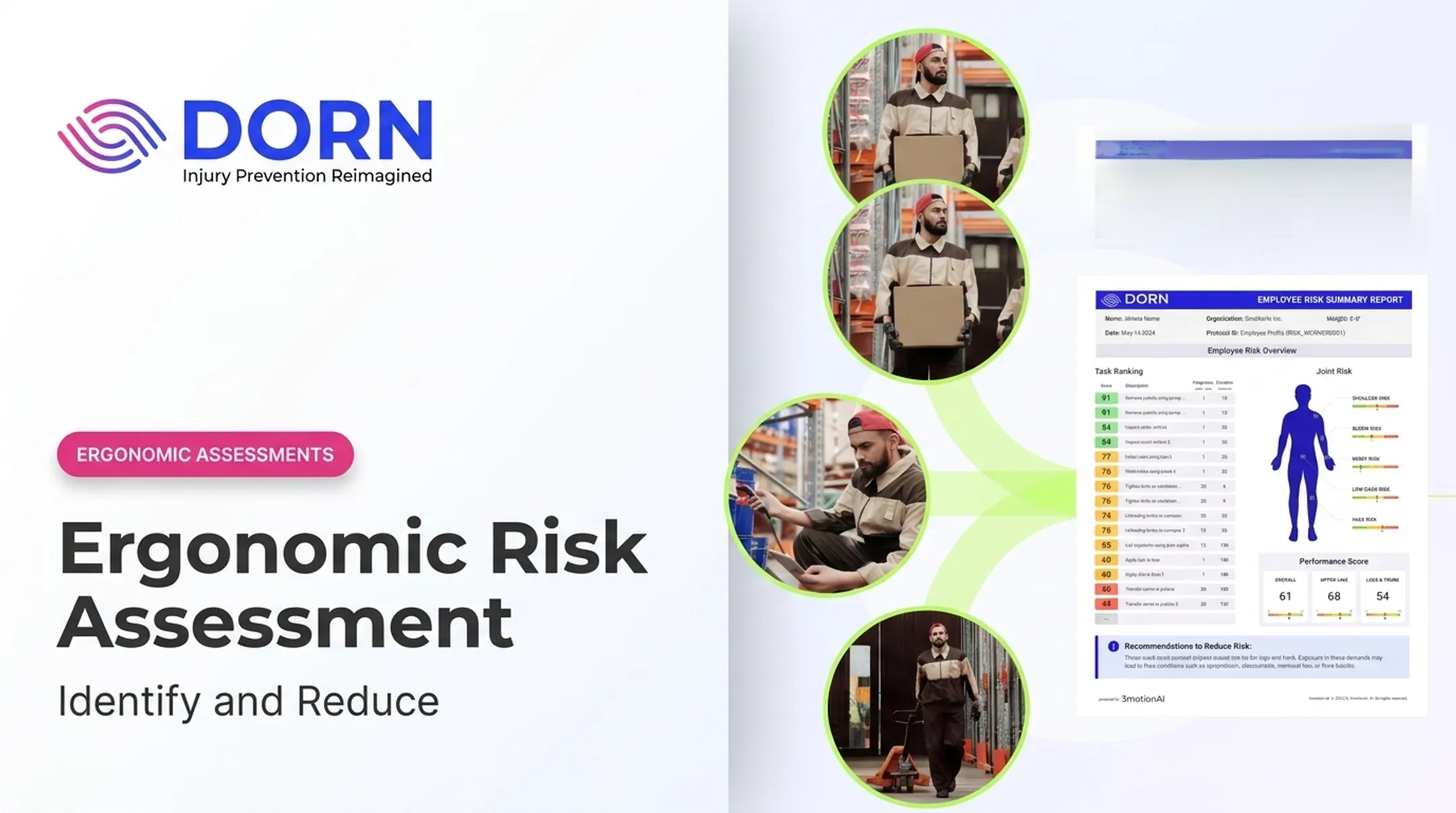
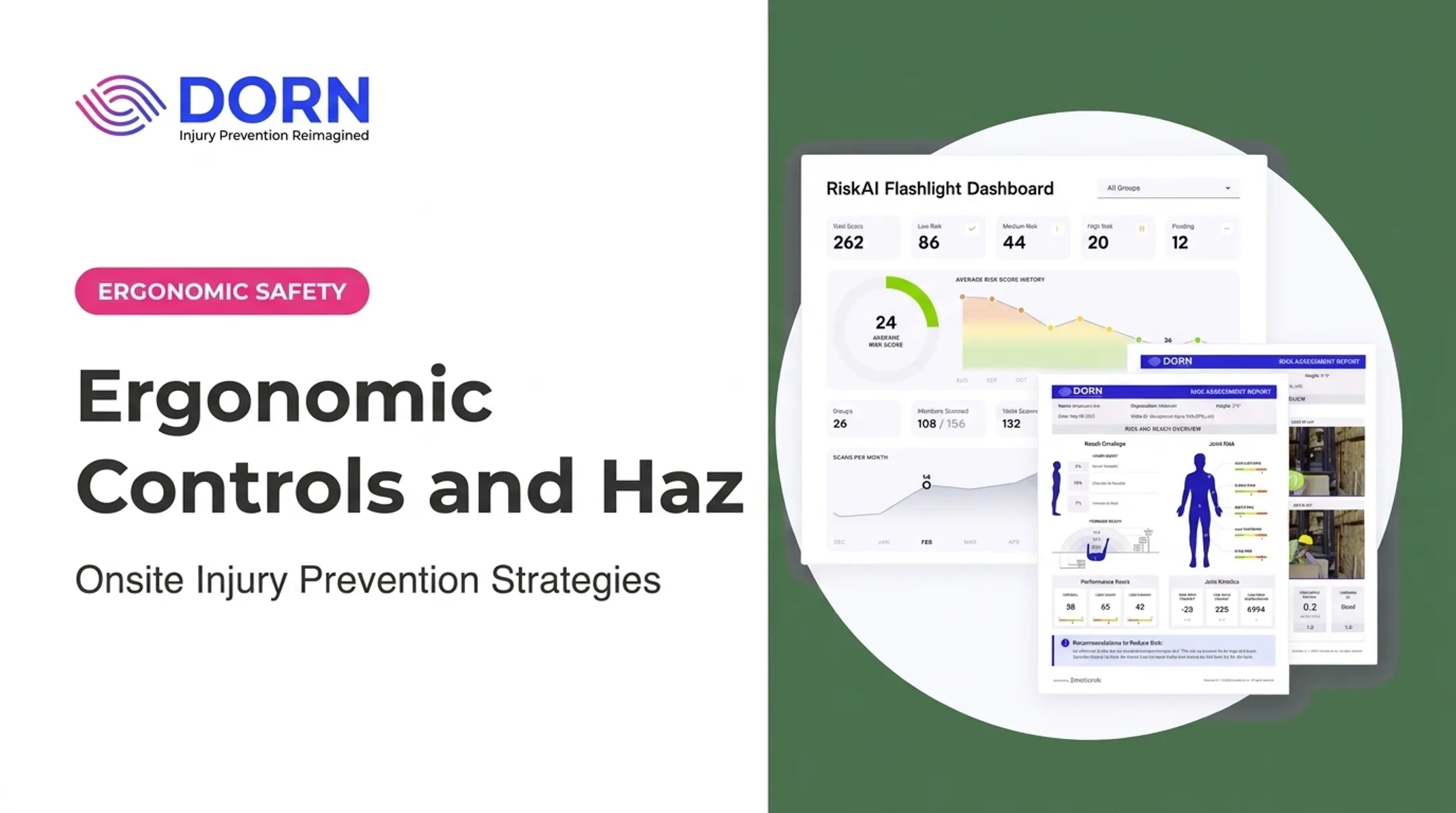
DORN's ergonomic assessments evaluate Body, Behavior, and Environment together, rather than treating posture, workflow, and workspace design as separate problems. That approach combines:
- Onsite ergonomic assessments and job demand analysis
- Virtual evaluations for remote and hybrid employees
- AI motion capture and wearable sensor technology
- Coaching, early symptom intervention, and follow-up monitoring
For organizations without in-house ergonomic expertise, or with risk spread across several locations, external support fills the gap between spotting a problem and fixing it. No program prevents every injury, but a structured approach finds hazards before they turn into claims.
Organizations exploring where to start can request an ergonomic assessment or talk through a program tailored to their specific sites and tasks.
Frequently Asked Questions
Can ergonomic hazards exist in every workplace?
Nearly any workplace can contain ergonomic hazards. Risk depends on how work is designed and performed, not on the industry or how physically demanding a job appears from the outside.
What are the most common ergonomic hazards?
The most common factors are repetition, awkward or static postures, forceful exertion, lifting, vibration, contact stress, poor workstation design, and environmental or organizational contributors like pace and shift length.
Are ergonomic hazards only found in physically demanding jobs?
No. Offices, remote work, laboratories, retail, and transportation jobs can all involve prolonged posture, repetition, reaching, or poorly designed equipment, even without obvious physical intensity.
How can employers identify ergonomic hazards?
Combine task observation, employee feedback, and a review of injury or symptom data. Reassess whenever tasks, equipment, staffing, or work locations change.
What is the best way to prevent ergonomic injuries?
Prioritize engineering controls that redesign or eliminate the hazard first, then support those changes with administrative controls, training, and early symptom reporting.
Does OSHA have a specific ergonomic standard?
No dedicated federal ergonomics standard exists; Congress rescinded the original rule. OSHA can still cite ergonomic hazards under the General Duty Clause and issue hazard alert letters. Follow current OSHA guidance and work with qualified safety professionals.