
Introduction
When a workplace injury happens, what occurs in the next ten minutes often determines what happens over the next ten months. An injury management program gives employers a consistent process for preventing injuries, responding when incidents occur, coordinating care, and helping employees return to safe work.
Without one, the gaps show up fast: delayed medical care, inconsistent incident reports, repeat injuries on the same task, and workers' compensation claims that drag on for months.
U.S. businesses incur an estimated $61.88 billion in workers' compensation claims annually, or roughly $1.19 billion every week. Claims reported within the first two weeks of injury average about $13,120, while delayed reporting can push costs up by as much as 51%.
This article covers a full framework: prevention, immediate response, investigation, coordinated medical care, modified duty, communication, and measurement, with the research and citations to back each piece up.
Key Takeaways
- Treat injury management as the full lifecycle, not only the workers' compensation claim.
- Combine prevention, early intervention, documentation, and root-cause fixes to cut repeat injuries.
- Match return-to-work plans to medical restrictions and real job demands.
- Track leading indicators (training, hazard reports) with lagging ones (injury trends, lost time).
- Confirm OSHA and state workers' comp rules with authoritative sources before finalizing policy.
What Is an Injury Management Program?
An injury management program is a coordinated system for preventing workplace injuries and responding promptly when they occur. It also manages medical care and communication, and supports an employee's safe return to work—linking efforts that often run as separate silos.
How It Differs From Related Activities
People frequently use "injury prevention," "injury response," and "return to work" interchangeably, but they're distinct pieces of a larger system:
- Injury prevention identifies and controls hazards before an incident occurs: ergonomic assessments, job hazard analyses, and training.
- Injury response covers immediate care, incident reporting, documentation, and required notifications after something happens.
- Return to work supports an employee's progression back to regular or modified duties once treatment begins.
An injury management program links all three so nothing falls through the cracks between them.
Who Should Own It
Assigning full responsibility to a single workers' compensation coordinator is a common mistake. Effective programs give defined roles—before and after an injury—to:
- EHS staff and supervisors
- HR and senior leadership
- Employees
- Medical providers and insurers
A written program creates consistent expectations across shifts, departments, facilities, and remote or hybrid settings. A night-shift supervisor in one plant should respond the same way as a day-shift supervisor across the country.
Procedures still need to reflect the employer's industry, job hazards, workforce, state requirements, and any collective bargaining obligations.
Why Employers Need a Structured Injury Management Program
Poor injury management drives costs in two directions. Direct costs include medical treatment and claims expenses. Indirect costs, often larger and harder to see, include overtime, replacement labor, retraining, production delays, and administrative time spent chasing paperwork.
According to the National Safety Council, total U.S. work-injury costs reached $181.4 billion, including $54.9 billion in wage and productivity losses and $64.5 billion in administrative expenses. The NSC also estimates a cost of roughly $1,120 per worker and $48,000 per medically consulted injury.

The Reporting Gap Makes It Worse
Fewer than 40% of eligible injured workers apply for benefits, leaving an estimated 60% to absorb injury costs themselves. Employer-provided workers' compensation benefits cover only about 21% of actual workplace-injury costs, including lost wages, medical expenses, and rehabilitation.
Structured, supportive response processes close that gap. Consistent triage and early intervention:
- Improve the quality of information collected at the time of injury
- Clarify the right level of care instead of guesswork
- Reduce delays that inflate claim costs
- Surface hazards before they injure more workers
A supportive reporting culture also encourages employees to flag symptoms and near misses earlier. Employers must never discourage legally required reporting or retaliate against workers who report injuries.
Signs You Need a Formal Program
- Recurring musculoskeletal disorders on the same tasks or lines
- Inconsistent or incomplete incident records across shifts
- Rising lost-time or restricted-duty days
- No clear modified-duty options for common restrictions
- Repeated communication breakdowns between supervisors, HR, and medical providers
Building an Injury Management Program: Core Components and Implementation
A functional injury management program links policies, people, and processes into one framework. Six components typically need to work together.
Core Components
- Immediate response and triage — who provides first aid, who calls emergency services, how the area gets secured, and how employees access proper medical evaluation.
- Reporting and documentation — required notifications, reporting timelines, witness statements, photos or measurements, and privacy-conscious record handling.
- Medical coordination and case management — designated contacts who relay job demands and restrictions to authorized providers, insurers, and the injured employee while respecting confidentiality.
- Incident investigation — identifying immediate, contributing, and root causes, then assigning corrective actions with owners and deadlines.
- Return-to-work and transitional duty — written job descriptions, physical demands, temporary restrictions, and a path back to regular duty.
- Prevention and continuous improvement — connecting injury trends to ergonomic assessments, training, and equipment or process changes.
With those pieces defined, roll them out in a deliberate sequence.
Implementation Steps
- Run a baseline assessment. Review injury reports, OSHA records, workers' comp data, absenteeism, and near misses to spot recurring risks.
- Define ownership. Assign executive sponsorship, an operational program owner, and specific duties for supervisors, HR, EHS, medical providers, and case managers.
- Write practical procedures. Cover reporting, emergency response, investigation, medical referral, and restricted work — accessible to every shift and literacy level.
- Build job-specific return-to-work resources. Include accurate physical-demand descriptions and a reviewed list of transitional tasks.
- Train supervisors and employees. Use realistic scenarios for symptom reporting, near misses, documentation, and non-retaliation expectations.
- Pilot in one department or site. Gather feedback, fix bottlenecks, then roll out consistently.
- Review on a schedule. Reassess after major incidents, process changes, or new equipment.
As you write reporting procedures, align them with OSHA recordkeeping thresholds. Under OSHA's general recording criteria (29 CFR 1904.7), a case is recordable when it involves:
- Death
- Days away from work
- Restricted work or job transfer
- Medical treatment beyond first aid
- Loss of consciousness
- A significant diagnosed injury or illness
That threshold should shape how your reporting procedure is written.
Prevention, Recovery, and Return-to-Work Best Practices
Control Hazards at the Source
A hierarchy-of-controls approach fixes hazards before leaning on reminders or training alone. Prefer controls in this order:
- Elimination
- Substitution
- Engineering controls
- Administrative controls
- Personal protective equipment
Engineering controls such as lift-assist devices and workstation redesign usually beat training-only tactics for cutting musculoskeletal strain.

Job hazard analyses and ergonomic assessments should evaluate force, repetition, posture, reach, lifting, pushing, pulling, and environmental conditions. DORN's certified ergonomists pair quantitative data with direct observation so discomfort and repetitive strain are traced to the real source.
Bring employees into the process as active partners:
- Staff safety committees and near-miss reporting channels
- Interview workers who perform the tasks daily
- Review workstations after incidents
- Confirm corrective actions fixed the problem
Coordinate Recovery Around Capabilities
Build recovery around documented capabilities. Give the authorized medical provider precise job-demand information and require clear functional restrictions with review dates instead of a vague "light duty" note.
Keep transitional work meaningful and supervised. Practical options include:
- Light or modified duty
- Limited-hour schedules
- Internal relocation
- Temporary telecommuting when the role allows it
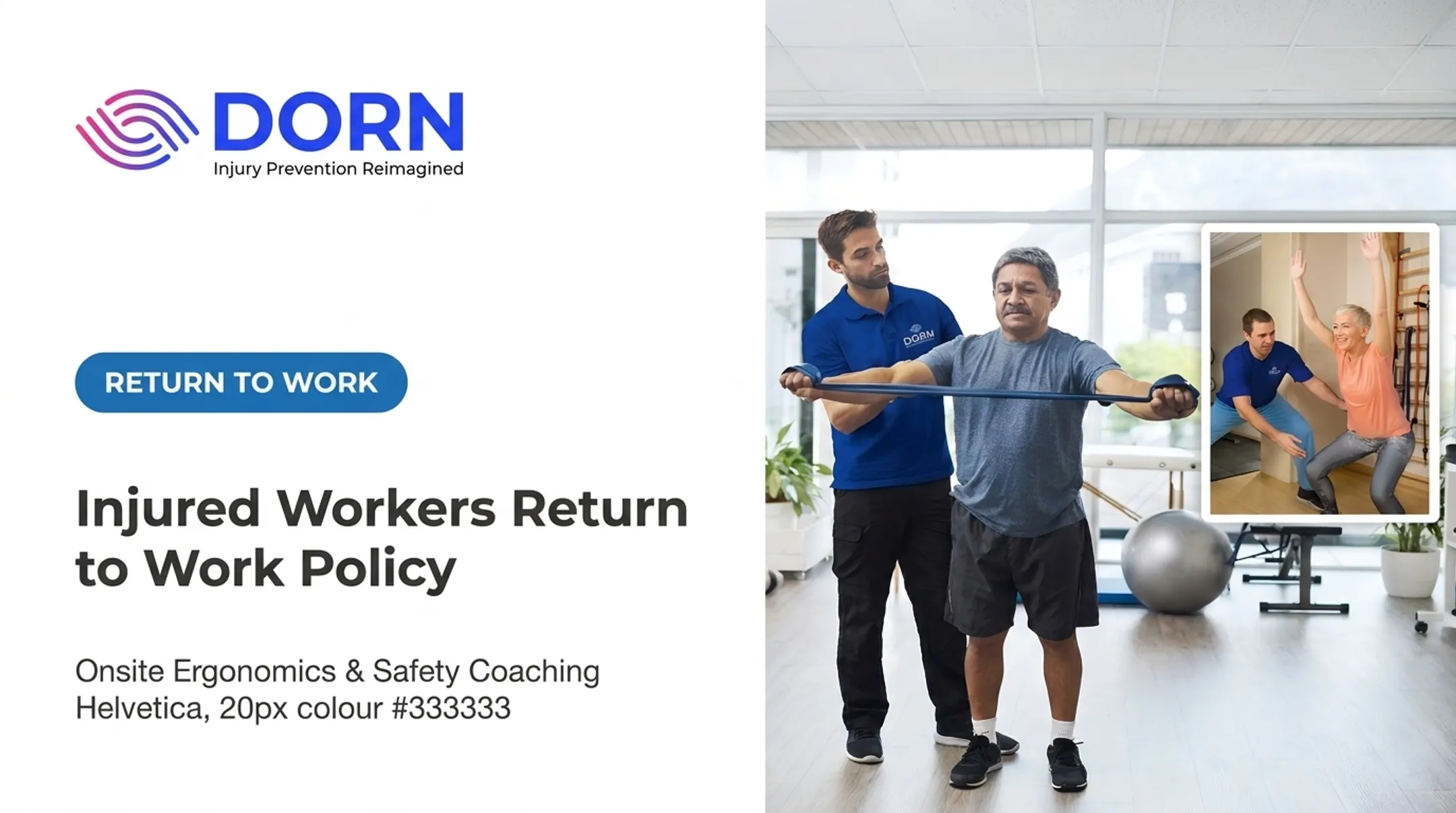
DORN's Return to Work approach uses work hardening (simulated tasks that rebuild strength, endurance, and confidence) to lower re-injury risk on the path back to full duty.
Supportive communication matters as much as the physical plan:
- Schedule regular check-ins with the employee
- Share timely updates with supervisors who need them
- Define a clear process when restrictions change
How to Measure Program Performance
Two categories of metrics tell different parts of the story.
Leading indicators are proactive measures that reveal whether your prevention activities are working before an injury happens, according to OSHA's guidance on leading indicators. Examples include:
- Hazard-correction completion rates
- Ergonomic assessments completed
- Training completion rates
- Near-miss reporting volume
- Follow-up completion after corrective actions
Lagging indicators measure what already happened:
- Injury frequency and severity trends
- Restricted or lost workdays
- Repeat injuries and claim duration
- OSHA-recordable trends
Setting a Measurement Cadence
- Frontline reviews: weekly, at the supervisor level
- Management reviews: monthly or quarterly
- Program evaluation: annually, with an assigned owner per metric
Break results down by site, department, shift, task, body region, and injury mechanism where legally and operationally appropriate. This is where patterns hide: a single line or task often drives a disproportionate share of injuries.
One caution: metrics should guide prevention and support, never pressure employees to underreport symptoms or injuries. If lagging indicators start improving while leading indicators (like near-miss reporting) drop, that's usually a red flag, not good news.

How DORN Companies Can Support an Injury Management Program
DORN Companies has spent nearly 25 years working with U.S. employers on workplace safety and injury prevention, with more than 100 providers across 60-plus locations. That depth helps manufacturing, warehouse, distribution, and food and beverage employers cover gaps internal EHS and HR teams often lack bandwidth to handle alone.
DORN's approach centers on three connected components: Body, Behavior, and Environment:
- Body: hands-on manual therapy and direct care for musculoskeletal issues before they become recordable injuries
- Behavior: on-site coaching, technique correction, and self-care education
- Environment: ergonomic assessments addressing workstation, department, and organizational-level risk
Engagement models flex to how your sites operate:
- One-time ergonomic assessments or short-term projects
- Recurring on-site coaching and monitoring
- 24/7 nurse and athletic trainer triage
- Multi-site program rollouts for enterprise EHS teams
- Virtual and technology-enabled options, including motion capture and wearables
If your organization is seeing recurring injury trends, unclear modified-duty options, or inconsistent reporting across sites, talk with a specialist about fitting support to those gaps. DORN's Return to Work Program and on-site injury prevention services are built to work alongside, not replace, your existing safety team.
Frequently Asked Questions
How much compensation can you get for an injury at work?
Compensation varies by injury severity, lost wages, medical needs, and state workers' compensation law. There's no single national figure. This isn't legal advice; consult your state agency or a qualified professional.
What does an injury management program do?
It connects prevention, immediate response, documentation, medical coordination, incident investigation, recovery support, return-to-work planning, and continuous improvement in one process. These functions work together instead of in isolation.
What are the four types of injury classifications?
Classification systems vary by context. Under OSHA recordkeeping, common categories include days away from work, restricted work or job transfer, medical treatment beyond first aid, and other recordable cases. Confirm whether you are using OSHA, workers' comp, or clinical definitions before applying them.