This question comes up constantly: an employee returning after surgery, a worker managing new restrictions, recurring shoulder or back complaints on a production line, a redesigned workstation, or simple uncertainty about whether a task can be done safely. This article covers what gets assessed, how the process works, how results translate into safer work decisions, and when to bring in occupational-health, medical, ergonomics, or legal professionals.
Key Takeaways
- Job capacity means safely performing a job's essential demands under defined conditions, not general employability.
- An assessment compares documented job demands with evaluated capabilities. It is not a diagnosis or an automatic employment decision.
- Findings can support accommodations, modified duty, ergonomic changes, and return-to-work planning.
- Defensible outcomes depend on consistent documentation, protected health information handling, and professional guidance.
What a Job Capacity Assessment Evaluates
Job capacity is the ability to perform defined tasks safely, consistently, and within any medically or professionally set restrictions. It is not a fixed trait.
Capacity is role-specific. Someone may handle a packing job with no trouble but struggle in a role that needs sustained overhead reaching or heavier lifting.
This is why a written job title tells you almost nothing. Two positions with the same title in two different facilities can have entirely different physical, cognitive, and environmental demands.
How This Differs From Related Evaluations
People often confuse job capacity assessment with related processes. The distinctions are:
- Medical evaluation: Focuses on diagnosis, treatment, and health status.
- Functional capacity evaluation (FCE): Uses standardized tests to measure physical abilities across general work-related activities, not one specific job.
- Job capacity assessment: Centers on the relationship between a person's evaluated abilities and the requirements of one particular position.
- Performance review: Evaluates work output or conduct. It should never substitute for a health or capacity assessment.
What Actually Gets Reviewed
A thorough assessment typically covers three domains:
- Physical demands — lifting, carrying, pushing, pulling, walking, standing, sitting, bending, kneeling, climbing, reaching, gripping, and repetitive motion.
- Cognitive and behavioral demands — concentration, decision-making, communication, work pace, and tolerance for interruptions, when relevant to the role.
- Environmental factors — vibration, temperature, noise, lighting, workstation design, tools, equipment, shift patterns, and fatigue exposure.
Written job descriptions rarely match reality. Peak-demand periods, informal tasks, awkward postures under time pressure, and shift-to-shift variation all matter.
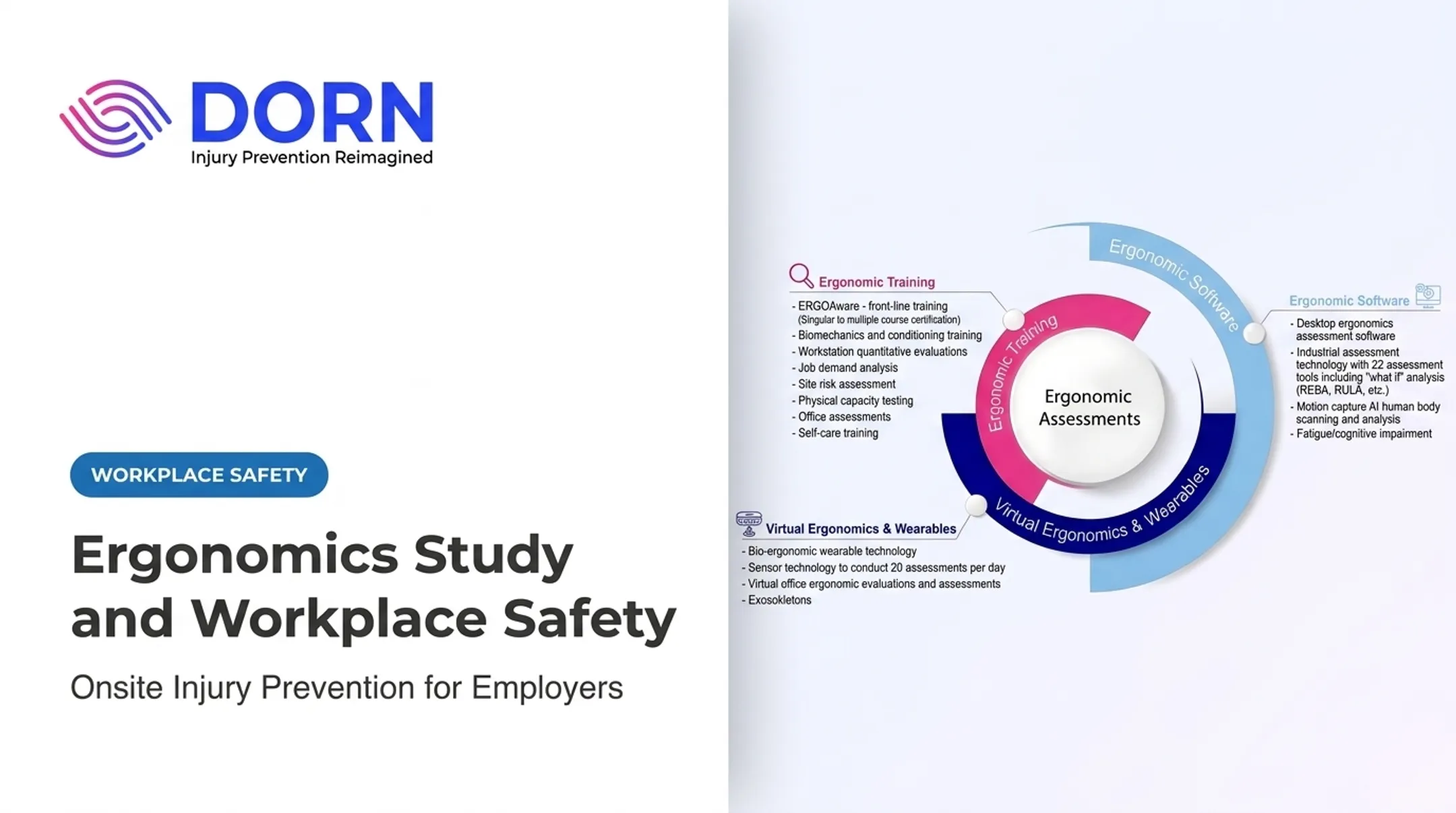
DORN's ergonomic assessment process pairs quantitative data collection—measurements, motion capture, and force gauges—with qualitative observation. That mix surfaces gaps a paper job description alone tends to miss.
Why Job Capacity Assessments Matter for Workplace Safety
A structured assessment surfaces mismatches between what a job demands and what a worker can currently do — before those mismatches turn into discomfort, aggravation, or a documented injury. The payoff is practical: catch the gap while it is still cheap and reversible.
The scale of the underlying problem is well documented. In the 2023–2024 reporting period, overexertion, repetitive motion, and related bodily conditions produced 946,290 DART cases (days away, restricted, or transferred) — the largest single event/exposure category tracked by the Bureau of Labor Statistics. For context:
- Overexertion and related bodily conditions: 946,290 DART cases
- Contact incidents (next-largest category): 860,050 cases
Those figures are workers whose job demands outpaced their capacity.
OSHA flags recognizable risk factors behind this trend: lifting, bending, overhead reaching, pushing and pulling, awkward postures, and repetitive tasks. According to OSHA's ergonomics guidance, exposure to these factors increases musculoskeletal disorder (MSD) risk — and work-related MSDs are preventable.

A job capacity assessment connects those risk factors to a specific role and a specific worker. Findings should drive:
- Better job and task design
- More targeted ergonomic controls
- Earlier intervention before symptoms escalate
- Safer modified-duty assignments
- Clearer communication between employees, supervisors, HR, safety teams, and treating providers
One caution: an assessment should solve problems, not label people. Treating a temporary limitation as a permanent judgment—or using results to sideline someone—defeats the purpose.
When a Job Capacity Assessment May Be Appropriate
Certain situations should trigger a request almost automatically:
- Return to work after an injury or illness
- A change in symptoms or new complaints
- A request for modified duty
- A new job, task, or workstation
- A recurring injury trend in a department
- A physically demanding task nobody has formally evaluated
- Suspicion that written restrictions don't match actual work demands
Assessments don't need to be purely reactive. High-risk environments such as manufacturing, warehousing and distribution, food and beverage processing, healthcare, and construction benefit from proactive use. That matters most where repetitive or physically demanding tasks are built into the job by design.
Individual vs. Job-Level Assessment
Treat these as two related but distinct approaches:
- Individual assessment: Considers one worker's capabilities against one job's demands.
- Job or ergonomic assessment: Evaluates task design and risk factors that could affect multiple employees, regardless of who's currently in the role.
Often the two intersect. One employee's limitation can reveal a workstation or process flaw affecting the entire shift — which is why DORN's assessment strategy scales from facility-wide evaluations down to individual workstations.
An assessment should never function as cover for discrimination, and it can't replace required medical, workers' compensation, disability, or employment-law processes. Jurisdiction-specific rules vary, so involve qualified professionals rather than guess.
How a Job Capacity Assessment Is Performed
Building the Job-Demand Analysis
The process starts by documenting the job itself. Assessors capture:
- Essential functions and task frequency
- Force requirements, postures, and distances
- Tools, equipment, and work pace
- Environmental exposures
- Differences between normal and peak conditions
They build this from job descriptions, supervisor and employee interviews, direct observation, task measurements, and standardized ergonomic tools.
DORN's certified ergonomists use recognized measurement methods for this stage, including tools for lifting and lowering analysis, posture assessment for upper-body and whole-body movement, and pushing/pulling force evaluation. The goal is objective, measurable data.

Reviewing Capability Against Demand
The capability review covers:
- Professionally documented restrictions
- Reported difficulties or discomfort
- Observed movement or task strategies
- Endurance across a shift
- Ability to perform required activities consistently
Not every assessment includes formal medical or physical testing. DORN's POET (Physical Capacity Testing) is one example of standardized testing, typically used after a job offer and before employment begins. It confirms a candidate can safely meet a role's essential physical demands.
Medical diagnoses and private health details stay with qualified providers and get shared only when necessary and permitted.
Identifying the Gap and Documenting Findings
The assessor then compares demand against capability to flag specific mismatches — a lifting requirement that exceeds a documented restriction, or a workstation forcing sustained awkward reaching. The written output should summarize:
- Tasks assessed
- Relevant limitations or risks identified
- Recommended controls or modifications
- Testing conditions and any uncertainties
- Whether follow-up or referral is needed
A qualified ergonomics partner keeps this step consistent and defensible. DORN's workplace safety specialists and Certified Industrial Ergonomic Evaluators cover job-task, ergonomic, and injury-prevention needs, so employers get an evidence-based process rather than an ad hoc one.
How Employers Can Use the Results
Findings should feed directly into a hierarchy of controls, the standard framework for reducing hazards. Per NIOSH's hierarchy of controls, controls rank from most to least effective:
- Elimination and substitution
- Engineering controls
- Administrative changes
- Personal protective equipment (last resort) PPE is the least effective option, not the default fix.
Turning Recommendations Into Action
Vague advice gets ignored. Specific instructions get implemented. Compare these two approaches:
| Vague recommendation | Operational version |
|---|---|
| "Avoid repetitive work" | Set task limits, build a rotation schedule, adjust equipment, add recovery periods |
| "Reduce lifting strain" | Install a lift-assist device, lower shelf height, split loads |
| "Fix awkward posture" | Adjust workstation height, reposition tools within reach zones |
| Each change needs clear ownership and follow-through: |
- Assign an owner (supervisor, facilities, HR, safety, or occupational health)
- Set a review date
- Define a metric for measuring success
Return-to-Work Planning and Communication
Assessment results support an individualized return-to-work or modified-duty plan. Define tasks, restrictions, duration, supervision level, and progression criteria up front. DORN's Return to Work Program pairs pain management with mobility training and work hardening so injured employees rebuild strength and confidence with less re-injury risk. Good communication matters as much as the plan itself:

- Share functional recommendations only with people who need them
- Avoid unnecessary disclosure of diagnoses
- Train supervisors on how to apply restrictions day-to-day
- Give employees a clear path to report worsening symptoms Aggregated, de-identified findings across departments can also reveal recurring ergonomic risks without drawing unsupported conclusions about any one employee. DORN helps organizations act on those patterns with ergonomics, early intervention, and workplace rehabilitation across onsite and multi-site environments.
How to Prepare for and Interpret an Assessment
Employer Checklist
Before an assessment begins, gather:
- Current job description and essential-function analysis
- Shift and production information
- Equipment list
- Known incident or injury trends
- Existing restrictions and prior ergonomic findings
- Contact details for responsible stakeholders
Employee Checklist
Workers should come prepared to describe:
- Which specific tasks are difficult
- When symptoms or limitations occur
- Any relevant restrictions or provider instructions
- Workarounds already in use
- Questions about how results will be used
Reading the Results Correctly
Context shapes interpretation. Assessment conditions, temporary versus ongoing limitations, task variability, fatigue, training gaps, and equipment availability all affect what a single observation proves.
One observation is not definitive proof of capacity or incapacity. Follow-up is warranted when:
- Symptoms change
- Job duties shift
- Recommended controls never get implemented
- The employee can't safely perform the agreed plan

Coordinate with HR, occupational-health providers, workers' compensation administrators, disability specialists, and legal counsel before making decisions based on assessment findings. This article provides general information, not legal or medical advice specific to your situation.
Frequently Asked Questions
What does "job capacity" mean?
Job capacity is the ability to safely perform the essential physical, cognitive, and environmental demands of a specific job under defined conditions. It's not the same as general employability or a medical diagnosis.
What is a capacity assessment?
It compares a person's professionally evaluated capabilities or restrictions against the actual demands of a role. The goal is identifying safe work options, limitations, or needed modifications.
What is included in a job capacity assessment?
Job-task demands, workplace conditions, relevant capabilities or restrictions, observation or testing where appropriate, and practical recommendations for controls or modifications.
How is a job capacity assessment different from a functional capacity evaluation?
A functional capacity evaluation measures general physical abilities using standardized tests. A job capacity assessment focuses specifically on one job's demands. Terminology and scope can vary by provider and jurisdiction.
When should an employer request a job capacity assessment?
Common triggers include return-to-work decisions, modified-duty questions, changing restrictions, recurring ergonomic concerns, and new job or workstation design — any situation where job demands and worker capabilities may not align.
Who performs a job capacity assessment?
It depends on the purpose and jurisdiction. Occupational-health providers, physical or occupational therapists, ergonomists, and workplace safety specialists like DORN's Certified Industrial Ergonomic Evaluators commonly perform these assessments.