Telling employees to "lift with your legs" won't fix a problem rooted in task design, equipment, scheduling, and workstation layout. Real prevention means finding the source before it turns into pain, restricted duty, a claim, or a production slowdown. This article breaks down the common causes, the real cost of ignoring them, and a practical path to prevention.
Key Takeaways
- MSDs range from sudden strains to cumulative trauma and need different prevention approaches.
- Force, posture, repetition, and recovery time interact; no single factor drives MSD risk alone.
- Elimination and engineering controls work better than relying on training or PPE alone.
- Worker input and early reporting catch problems before they become recordables.
- Ongoing review, not a one-time assessment, sustains long-term results.
Common Causes of Musculoskeletal Injuries in the Workplace
A workplace MSD rarely has a single cause. Risk builds from the interaction of task demands, individual exposure, equipment design, environment, and how work itself is organized.
Employers who focus only on load weight, for example, miss the bigger picture: magnitude, frequency, and duration of exposure all matter together, per OSHA's ergonomics guidance (OSHA4382).
Physical Overexertion and Forceful Exertion
Lifting, lowering, carrying, pushing, pulling, and gripping unstable or slippery loads can exceed the body's capacity fast. Risk rises when the load sits far from the body or gets handled over and over.
- Warehouses and distribution centers: repetitive carton handling, awkward pallet reaches
- Manufacturing lines: part transfers, tool gripping, assembly force
- Food processing: cutting, packing, and repetitive knife work
- Healthcare: patient handling and transfers
- Maintenance: carrying tools and parts in confined spaces
Industry analyses of workers' compensation costs show overexertion involving an outside source (lifting, pushing, pulling, holding, carrying, or throwing objects) accounted for 24.4% and $15.08 billion. A common rule of thumb: ask for help or use a powered lift assist for anything over 40 pounds.

Awkward, Static, or Contact-Stress Postures
Bending, twisting, reaching overhead, kneeling, squatting, holding the neck in one position, or working with bent wrists all increase tissue strain over time. Holding any posture too long , even a "neutral" one, causes fatigue.
Contact stress adds another layer: hard edges, narrow tool handles, and kneeling surfaces press directly into muscle and nerve tissue. This isn't just an industrial problem. Office workers dealing with an unadjusted chair or a desk that's too high face the same mechanism, just at a slower pace.
Repetition, Duration, and Inadequate Recovery
Repeating the same motion — or holding a demanding posture — without a chance to change position builds cumulative trauma. One production-floor example: a worker transferring boxes between angled surfaces hundreds of times per shift developed an automatic twisting habit within weeks. Within months, that twist followed him home.
High production pace, long shifts, thin staffing, and poorly designed rotation schedules often make this worse rather than better. Short task cycles under 30 seconds are a documented red flag for cumulative MSD risk.
Vibration and Environmental Conditions
Hand-arm vibration from power tools and whole-body vibration from vehicles both raise MSD risk, particularly when combined with forceful grip or an awkward posture. Cold temperatures can aggravate existing MSDs, according to OSHA's 2023 ergonomics guidance. Poor lighting or a cramped workspace can degrade movement quality and grip strength (OSHA4382).
Heat, humidity, and dehydration compound fatigue too — all reasons OSHA has pushed heat-illness prevention plans that include cool-down areas and monitored breaks.
Work Design and Psychosocial Contributors
High workload, low control over work pace, inadequate supervisor support, and poor communication create stress. They also make physical hazards harder to manage and discourage employees from reporting problems early. Job design, staffing levels, and realistic production expectations belong in the same conversation as ergonomics, not a separate one.
What Happens If Workplace MSD Risks Are Ignored?
Ignoring early signs of MSD risk doesn't make the problem disappear. It just delays the bill.
- Direct costs: MSDs cost U.S. companies roughly $20 billion per year directly, with indirect costs running up to five times higher
- Lost work time: MSDs average 11 days away from work, compared with about 8 days for other injury types
- Current BLS data: For 2023–2024, MSD cases involving days away from work reached 484,620, with a median of 14 days away (NSC/BLS data)
- Productivity drag: Presenteeism from unmanaged pain is estimated to cost U.S. employers $150–$250 billion annually; absenteeism adds roughly $150 billion more
- OSHA recordkeeping: Cases become recordable when treatment goes beyond first aid, or when there's restricted work, job transfer, or days away
Repeated minor discomfort (the ache that shows up every Thursday afternoon on the same task) is a leading indicator of an unresolved problem. Waiting for a recordable injury to show up on the OSHA 300 log means you found the risk too late.
Warning Signs of a Workplace Musculoskeletal Injury
Early indicators often return during a specific task or shift:
- Recurring aches, stiffness, or swelling
- Tingling, numbness, or weakness
- Reduced grip strength or range of motion
- Task-linked fatigue that keeps coming back
Employees should report these symptoms promptly rather than self-diagnosing or pushing through. Supervisors need a clear path for responding through safety, medical, and workers' compensation procedures, not guesswork.
Ordinary fatigue fades with rest. Persistent, worsening, or function-limiting symptoms don't. If discomfort keeps returning at the same point in a shift, that's a signal for professional medical evaluation, not a sign to "push through."
How to Prevent Musculoskeletal Injuries at Work
Prevention isn't a poster in the break room. It's a cycle: identify exposures, involve employees, select controls, train the people affected, verify the controls actually work, and revise them as tasks change.

Eliminate or Engineer Out High-Risk Exposures
The hierarchy of controls ranks solutions from most to least effective: elimination, substitution, engineering controls, administrative controls, and PPE, in that order. OSHA, NIOSH, and NSC all endorse it.
Engineering fixes that reduce manual force, reach distance, or awkward posture include:
- Automation, conveyors, and powered lift assists
- Adjustable work surfaces and lift tables
- Redesigned tool handles and improved layouts
- Carts and hoists for material transport
Test any new control with the actual people who'll use it. A fix that works for one body size or one task variation might create a new hazard for someone else.
Improve Task, Workstation, and Tool Ergonomics
Core principles stay the same across settings:
- Keep loads close to the body
- Place frequently used materials within comfortable reach
- Maintain neutral wrist and spine positions
They hold whether you're in a warehouse, an office, a driver's seat, or a food-processing line.
Practical fixes DORN has implemented on-site include the 90-90-90 posture rule for seated workstations (hips, knees, and ankles at roughly 90-degree angles, feet flat on the floor) and headsets for office workers to eliminate "phone-cradled-on-shoulder" neck strain.
On production floors, distributing weight evenly on both feet and taking small steps instead of twisting the torso cuts repeated hip and spine stress.
Manage Exposure Through Work Organization
Task variety, thoughtfully designed rotation, microbreaks, and adequate staffing all reduce cumulative exposure when done correctly.
Here's the catch: rotation only works if it moves workers between tasks that stress different body regions. Rotating someone from one overhead-reaching job to another overhead-reaching job doesn't reduce risk. It just spreads the same hazard around.
Train Employees and Supervisors to Recognize and Report Risk
Generic lifting-technique training misses the point. Effective training covers:
- Actual job tasks and equipment, not hypothetical scenarios
- Body positioning specific to each workstation
- Early symptom reporting and how to escalate concerns
- Proper use of new controls after an engineering change
Supervisors carry real responsibility here too:
- Respond to reports quickly
- Observe work as it's actually performed, not as written on paper
- Correct unsafe shortcuts
- Reinforce a reporting culture that doesn't punish employees for speaking up
Build a Customized Prevention Program
A one-time awareness presentation rarely moves the needle on recurring MSD trends. Organizations seeing repeat injuries in the same job or department typically need a formal ergonomic risk assessment, job-task analysis, and an early-intervention process built around their specific operations.
DORN Companies, for example, pairs certified industrial ergonomic evaluation with on-site and virtual injury-prevention support, biomechanics coaching, and early symptom intervention for U.S. employers in manufacturing, warehousing, and food processing.
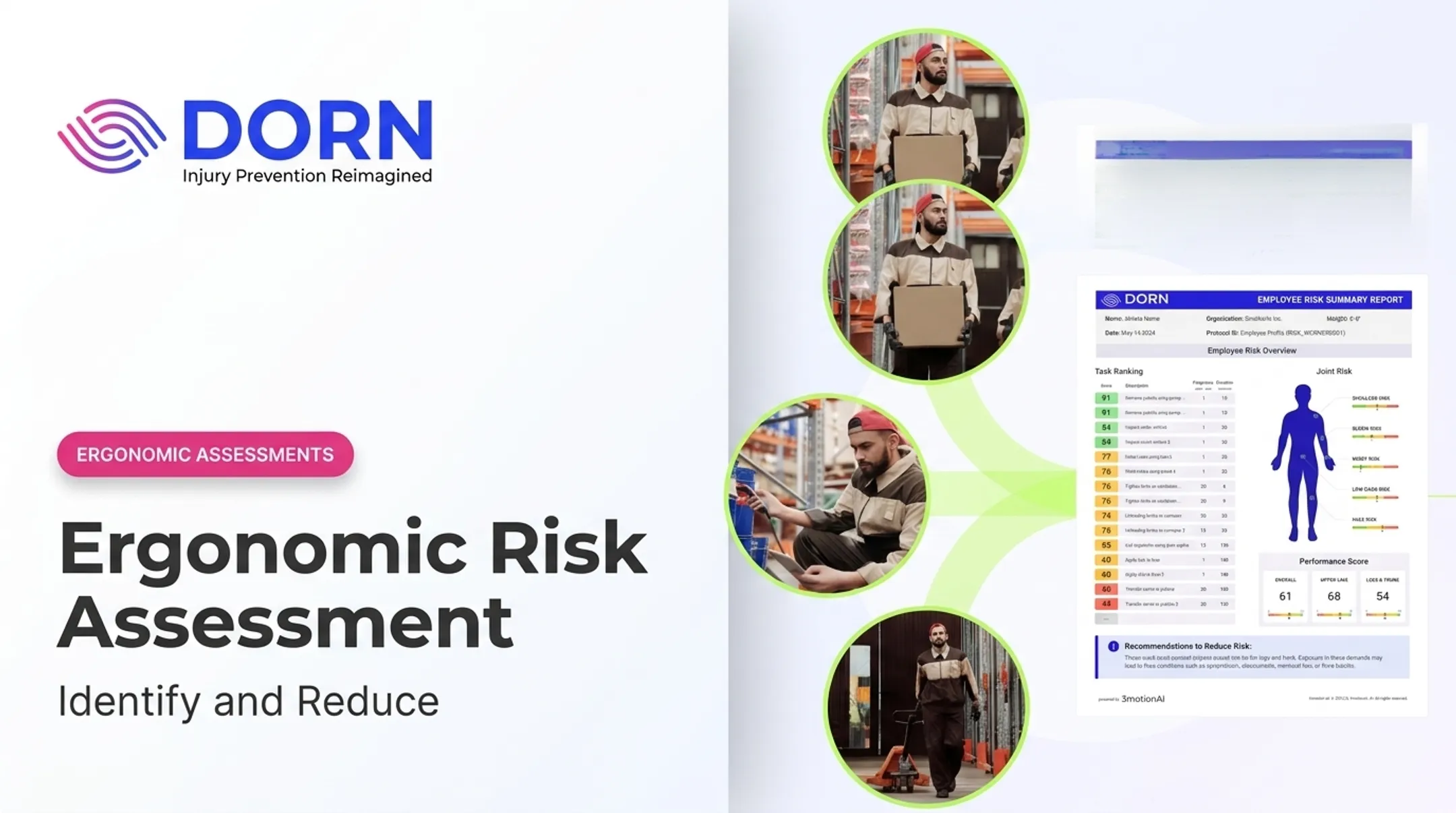
Assessments run from full-facility layout down to individual workstations, including job demand and employee physical capacity, and produce a specific improvement plan rather than a generic checklist.
Tips for Long-Term Prevention and Control
A single ergonomic assessment after an injury spike solves that injury. It doesn't solve the next one.
Routine Monitoring or Checks
Track both leading and lagging indicators, since they tell different stories:
| Leading Indicators | Lagging Indicators |
|---|---|
| Employee pain/discomfort reports | Recordable injuries |
| Fatigue and sleep quality | Workers' comp costs |
| Employee morale, turnover | Missed workdays |
| Ergonomic observations | Historical injury trends |
Reassess high-risk tasks any time equipment, staffing, or production volume changes. A workstation that was fine at 200 units per shift may not be fine at 300.
Training and Operator Standards
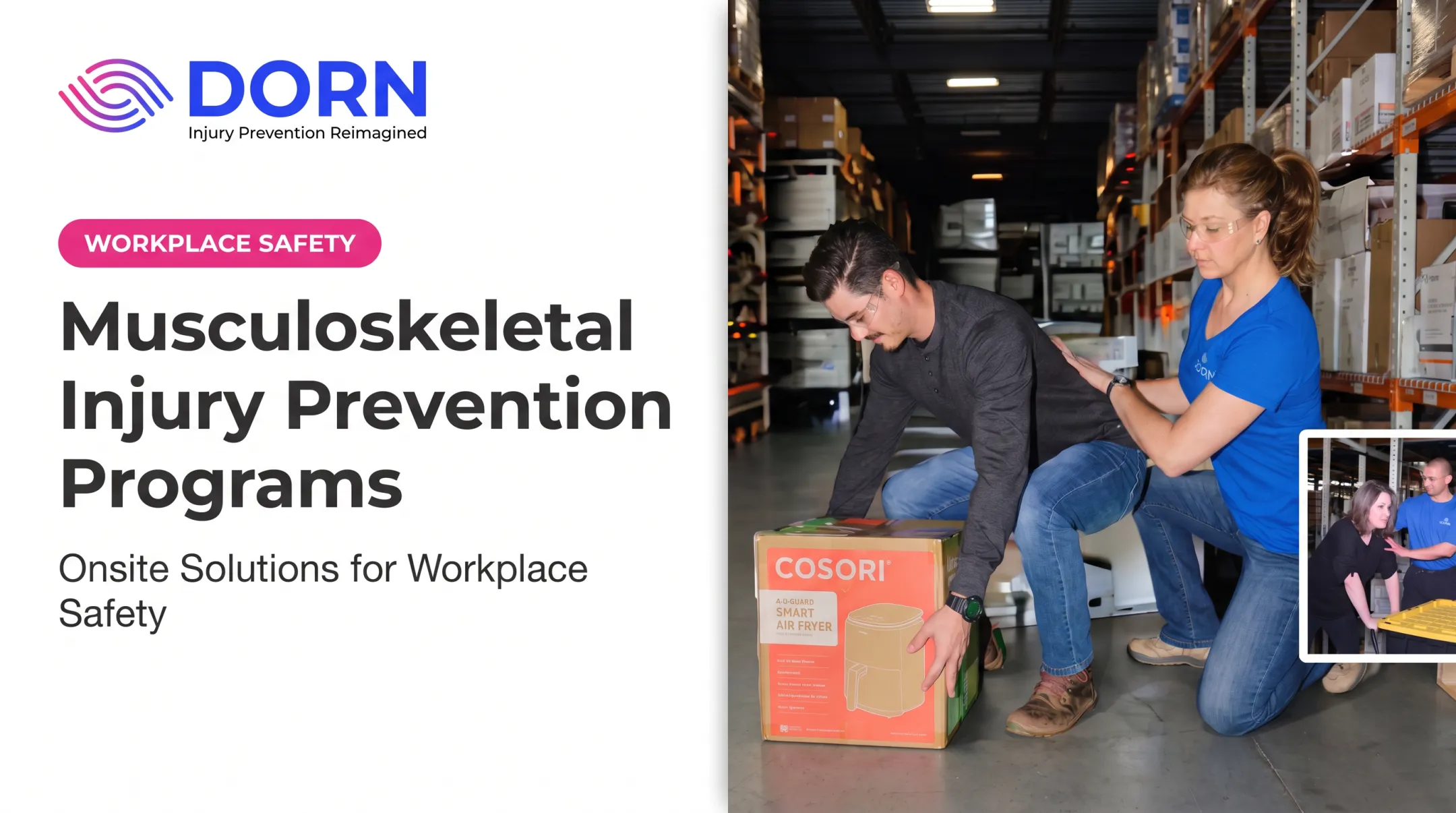
Refresh training whenever tasks or hazards shift, not just at annual review time. Coach at the point of work, and compare written procedures against how the job actually gets done on the floor. Workers who help build the standard are far more likely to follow it consistently.
Systematic Documentation
Keep records of hazard assessments, employee feedback, corrective actions, training completion, and equipment inspections. Document why a control was chosen, whether it introduced any new risk, and how you'll measure whether it's working.
Using Technology or Sensors Where Applicable
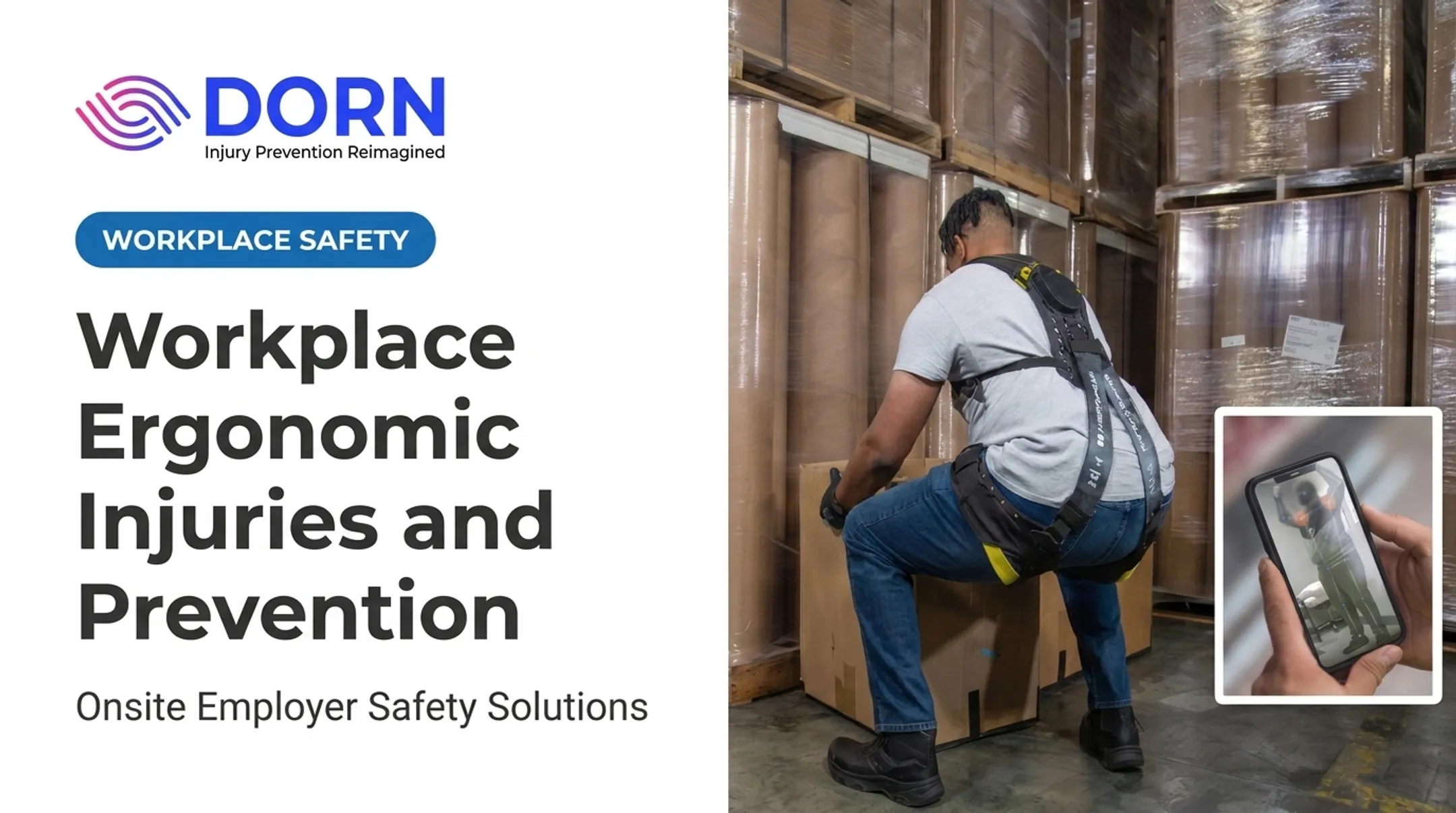
Motion capture, wearables, and fatigue-identification tools can flag exposure patterns humans might miss. DORN's Body, Behavior, and Environment model pairs manual therapy and education with ergonomic assessment and technology like AI motion analysis and wearable sensors.
Some BBE program partners have documented measurable reductions in injury rates and claims costs over multi-year engagements. Technology supports human judgment, though; it doesn't replace employee input or the need for real engineering fixes.
Conclusion
Workplace MSDs have identifiable, addressable contributors: force, posture, repetition, exposure time, environment, equipment, and how work gets organized. None of these operate in isolation.
Proactive hazard assessment, real employee participation, engineering controls that come before administrative fixes, early symptom reporting, and continuous review together reduce preventable disruption. The result is fewer claims and a workplace where people can do physically demanding work without paying for it later.
Frequently Asked Questions
What are the common symptoms of musculoskeletal disorders?
Common symptoms include pain, stiffness, swelling, tenderness, weakness, numbness or tingling, limited range of motion, and fatigue. Report symptoms that persist or worsen, and seek medical guidance rather than self-treating.
What are some common causes of musculoskeletal pain?
Forceful exertion, lifting, pushing, pulling, and repetitive motions are leading causes, along with awkward or static postures and vibration exposure. Insufficient recovery time, poor workstation design, and psychosocial or organizational stress also contribute.
What are the four basic types of musculoskeletal injuries?
Common categories include sprains, strains, tendinitis or other tendon disorders, and nerve-compression or repetitive-motion injuries like carpal tunnel syndrome. Classifications vary, so a qualified healthcare professional should confirm any diagnosis.