
An ergonomics intervention is the action taken once that risk is identified. It's not a one-time chair adjustment or a single training session. It's a deliberate change to remove, reduce, or control an exposure until the risk actually goes down.
This article walks through a practical framework: identify and prioritize risks, choose the right controls, involve workers in the process, implement changes properly, and measure whether the improvement actually holds up over time.
Key Takeaways
- Interventions work best when they change the environment, the process, and worker behavior at the same time.
- Engineering and process changes tend to outlast training alone.
- Worker feedback, clear ownership, and baseline data separate lasting fixes from short-term patches.
- Strong ergonomics programs cut injury risk while lifting productivity and supporting wider safety goals.
What Is an Ergonomics Intervention?
An ergonomics intervention is a deliberate change to a workstation, tool, task, workflow, policy, or work practice, designed to reduce ergonomic risk and improve the fit between a person and the job they're doing.
That's different from an ergonomic assessment. An assessment identifies hazards and contributing factors. The intervention is what comes after: applying a fix and verifying it actually worked.
Interventions fall into two general categories:
- Reactive: responding to a discomfort report, an injury, or a pattern of near-misses
- Proactive: reviewing a new workstation, production line, tool, or process before problems show up
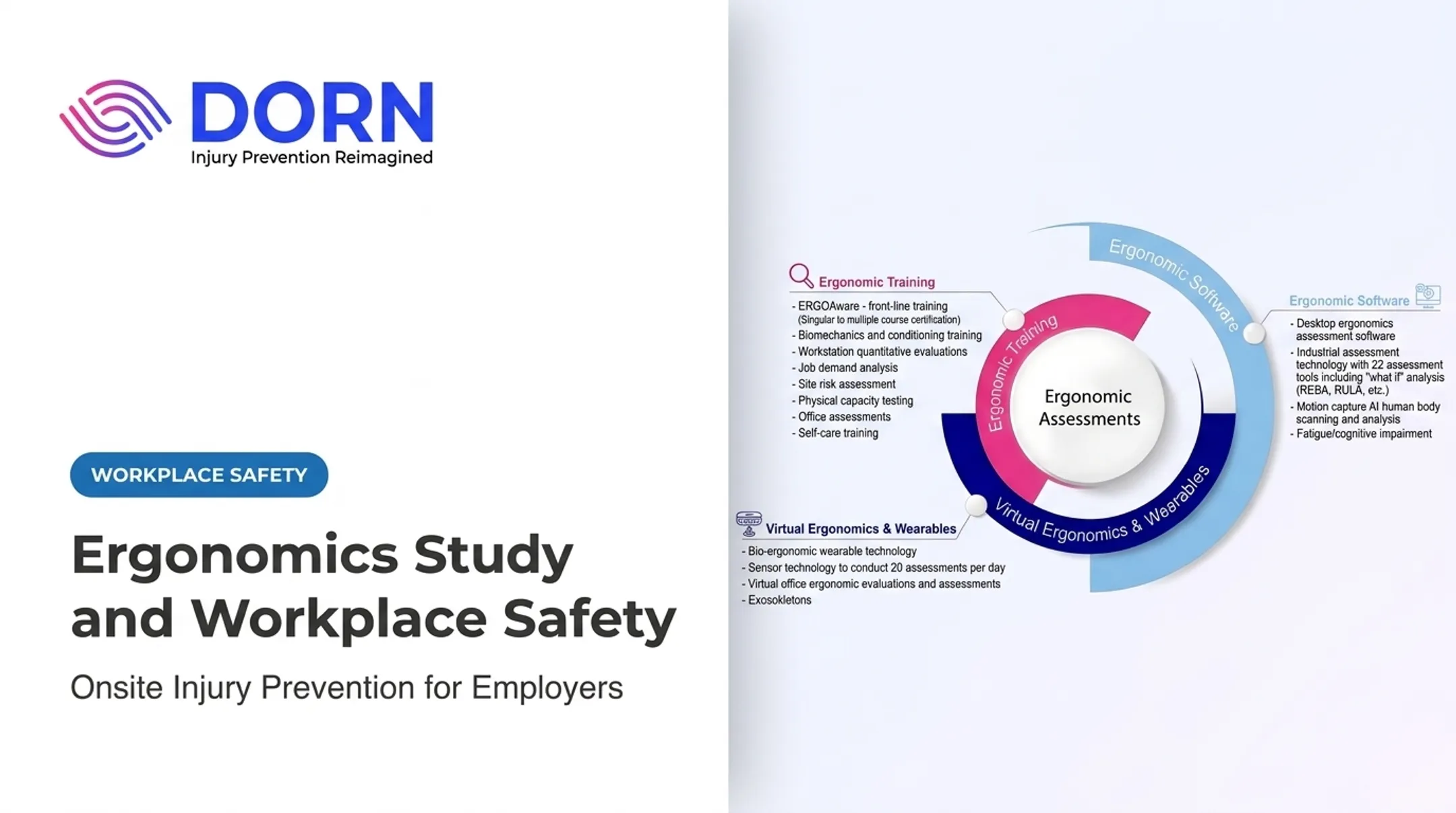
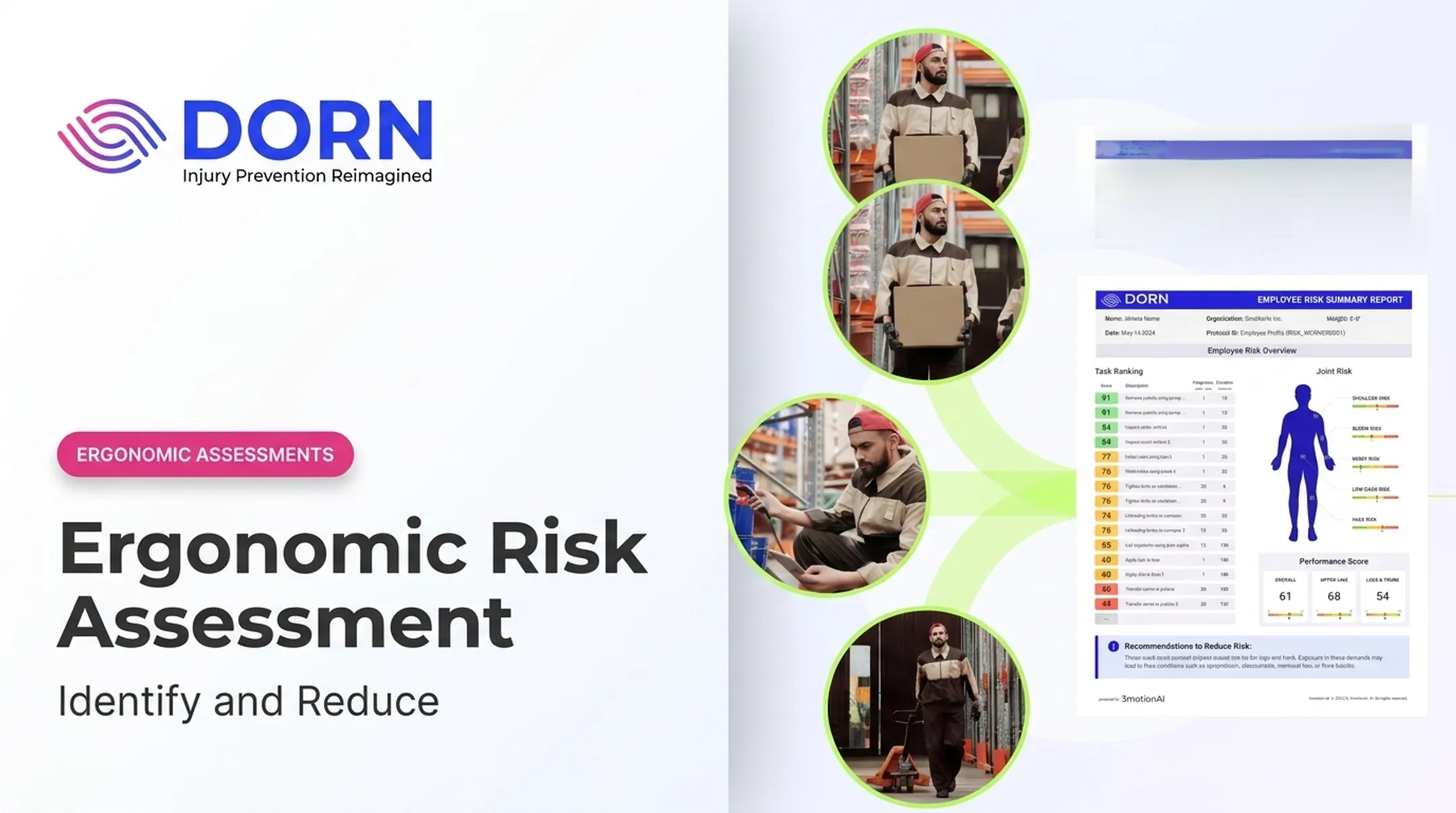
DORN's approach covers both. Assessments identify risks, rank them by risk score, and pair each one with short- and long-term mitigation options, so a facility isn't guessing what to fix first.
Why Ergonomics Interventions Matter
Unmanaged ergonomic risk doesn't stay contained to one employee or one task. It shows up across the operation as:
- Musculoskeletal discomfort and reduced work capacity
- Absenteeism and workers' compensation exposure
- Lower morale and disrupted production schedules
The scale of the issue is well documented. According to BLS data reported through NSC Injury Facts, there were 937,620 musculoskeletal disorder cases involving days away, restricted work, or job transfer in the 2023-24 reporting period.
That total included 484,620 cases involving days away from work entirely. Median time away from work in these cases was 14 days.
Early intervention matters most when symptoms or risk indicators first appear, not months later. That said, ergonomics programs are not a substitute for medical evaluation when an employee is actually injured; they work alongside clinical care, not instead of it.
The right scope for an intervention also depends heavily on setting:
- Office and remote workstations carry different risks than a production line
- Warehouses and distribution centers deal heavily with lifting, pushing, and pulling
- Food and beverage processing adds repetitive cutting motions and cold-environment exposure
Identify and Prioritize Ergonomic Risks
You can't fix what you haven't measured. Strong intervention planning pulls evidence from multiple sources—not a single report or complaint. Sources worth reviewing include:
- Ergonomic assessments and job-demand data
- Injury and near-miss records
- Employee discomfort reports
- Absence trends
- Task observations and production data
- Supervisor and worker feedback
Common Risk Factors to Examine
Look specifically for these common drivers of musculoskeletal risk:
- Repetition, force, and awkward posture
- Vibration and contact stress
- Lifting, pushing, and pulling
- Sustained positions and insufficient recovery time
- Environmental conditions such as cold exposure These risks rarely show up alone. DORN's assessment tools, including ERGOLite, evaluate worksites, tasks, and environmental factors together rather than in isolation. Objective tools help teams score exposure the same way every time. RULA, REBA, the Snook Tables, and the NIOSH Lifting Equation make hazard comparisons consistent instead of relying on gut feel.
Prioritizing What to Fix First
Once risks are identified, rank them using:
- Severity: how serious is the potential harm?
- Frequency and duration: how often and how long are workers exposed?
- Scope: how many employees are affected?
- Likelihood of recurrence
- Legal or compliance considerations
- Feasibility and expected benefit of a fix A simple risk-ranking matrix helps here. It gives an organization a consistent way to compare hazards and defend why one task gets addressed before another. Worker input belongs in this stage, not after decisions are locked. Ask employees what makes a task hard, where fatigue or discomfort shows up during a shift, and whether a proposed fix might create a new workflow or safety problem. In DORN assessments, direct employee engagement often surfaces stressors a walkthrough alone would miss.

Types of Ergonomics Interventions
No single control fixes an ergonomic problem on its own. The strongest interventions combine engineering, administrative, behavioral, and organizational approaches rather than leaning on just one.
A good illustration of this comes from Deere and Company's manufacturing operations, where ergonomics training was paired with redesigned workspaces and new hand tools. Over ten years, the combined approach was linked to an 83% reduction in back injuries and a 32% drop in related health care compensation costs.
Workers were involved from the earliest stages, generating ideas and building buy-in before rollout.
Engineering Interventions
Engineering controls physically change the task or environment. Common options include:
- Adjustable workstations and improved reach zones
- Lift assists, conveyors, and mechanical handling equipment
- Redesigned tools and workstation peripherals
- Anti-fatigue mats
How this plays out varies by role:
- Office worker: an adjustable monitor arm and keyboard tray reduce sustained awkward neck and wrist posture
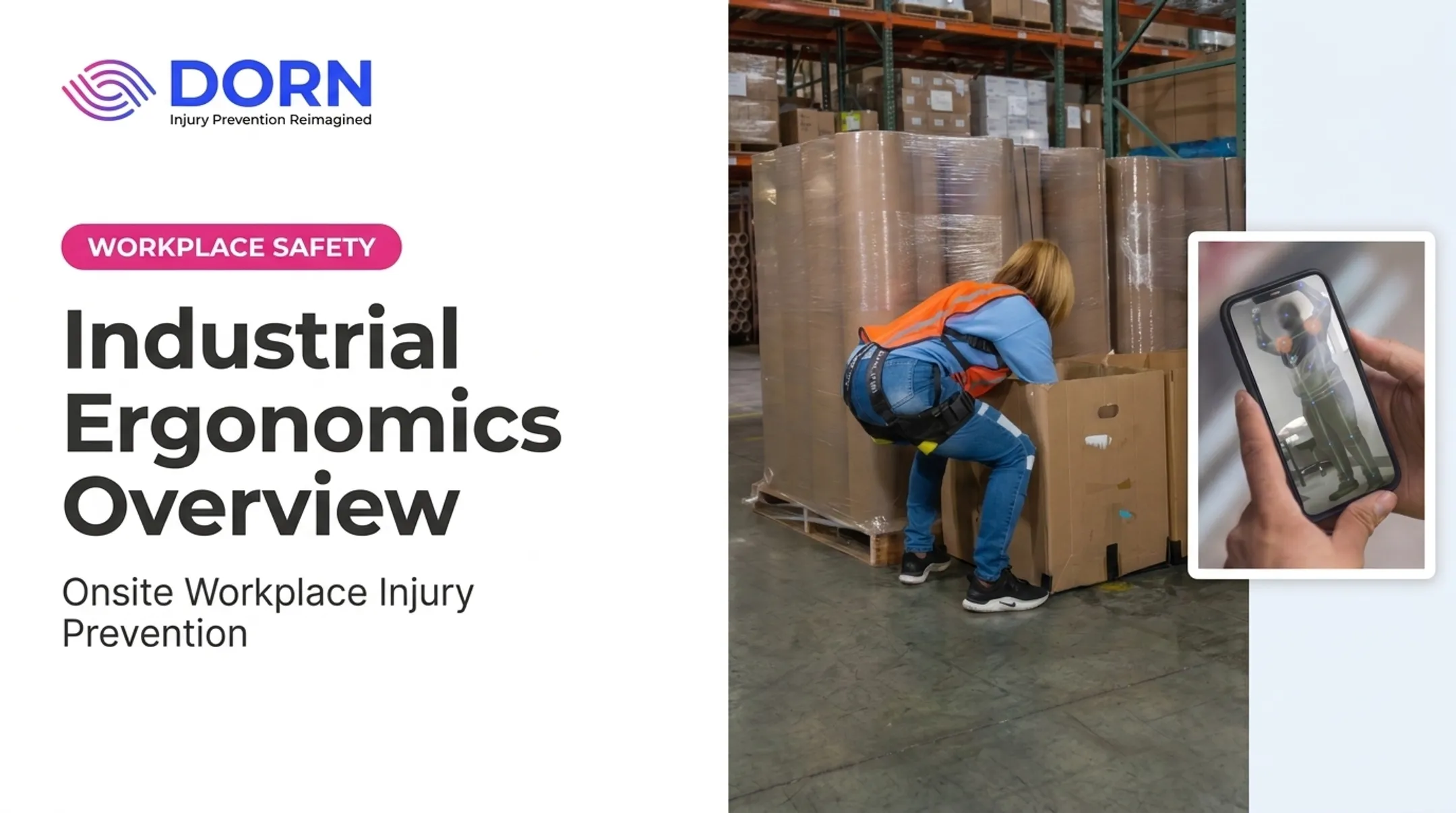
- Warehouse associate: a powered lift table reduces force exposure during repetitive material handling
- Production employee: a redesigned tool grip reduces repetitive strain on the hand and forearm
Before rolling any of these out, evaluate usability, maintainability, compatibility with production speed, and whether the fix might introduce a new hazard elsewhere.
Administrative Interventions
Administrative controls change scheduling, staffing, job rotation, rest periods, procurement standards, or procedures without physically altering the hazard itself. Job rotation, task refinement, and body-mechanics training all fall here.
These are useful when engineering fixes need time or budget to implement. But they shouldn't become a permanent substitute for a feasible engineering fix. Administrative controls manage exposure; they don't remove it.
Behavioral and Work-Practice Interventions
This category covers coaching, safe lifting and handling technique, tool-use instruction, posture awareness, early reporting, and letting employees test proposed solutions before full rollout.
Behavior-focused efforts only work when the environment actually supports the desired behavior. Coaching someone to lift with bent knees doesn't help much if the workstation still forces an awkward reach. The environment has to make the safer choice the easy choice.
Organizational and Program-Level Interventions
At the program level, ergonomics gets built into equipment purchasing decisions, new process design, supervisor responsibilities, return-to-work processes, and continuous-improvement programs.
This is where a Body, Behavior, and Environment perspective (the framework DORN uses across its programs) becomes useful. Physical demands, work practices, and workplace conditions all interact, and treating them as separate problems tends to leave gaps.
How to Plan and Implement an Ergonomics Intervention
Define Goals and Assign Ownership
Once a risk is prioritized, the intervention needs a specific goal: reducing exposure on a high-risk task, improving workstation fit, addressing a recurring discomfort report, or preventing problems in a new process before it launches.
From there, set measurable objectives with a realistic timeline (a SMART framework works well here), and assign clear ownership across employees, supervisors, operations, EHS, HR, maintenance, procurement, and management. Without assigned ownership, assessment findings become recommendations that sit in a folder rather than actions that get done.
Select and Test the Intervention
Compare possible solutions against:
- Risk reduction potential
- Employee usability
- Operational impact
- Cost and maintenance requirements
- Scalability
- Compatibility with applicable safety requirements
Pilot the change with affected employees before a full rollout. NIOSH's implementation guidance recommends running trials, evaluating results, modifying as needed, and only then moving to full-scale deployment.

Test the real task under normal production conditions, not a demo setup. A control that performs well in a quiet test room can fall apart under actual line speed.
Implement With Communication and Training
Employees need to know why the change is happening, what risk it addresses, how it affects their work, and how to report a problem afterward. Skipping this step is one of the fastest ways to get a new tool ignored or misused.
Provide task-specific instruction for any new equipment, lifting method, or revised procedure, and confirm employees can actually apply it correctly, not just that they sat through a training session.
When internal teams need more bandwidth or expertise for a rollout, outside support can fill the gap. DORN Companies works with organizations on customized ergonomic assessments, onsite or virtual support, and injury-prevention guidance delivered by Certified Industrial Ergonomic Evaluators.
Address Remote, Mobile, and Multi-Site Work
Extending an intervention across home workstations, hybrid employees, traveling staff, and multiple facilities requires standardized criteria paired with site-specific assessment. What works at one plant may not translate to another with a different layout or task mix.
Document approved controls, training materials, escalation paths, and follow-up requirements so the program stays consistent across sites while still reflecting local task differences.
Example: A repetitive office task, like data entry, might call for a monitor riser, keyboard tray, and scheduled micro-breaks. A manual material-handling task in a warehouse needs an entirely different plan: a mechanical lift aid, a revised lifting procedure, and job rotation to limit sustained exposure. Same framework, different execution.
Evaluate and Sustain the Intervention
An intervention that isn't measured is just a guess with good intentions. Start with a baseline before implementation, using measures that match the goal:
- Reported discomfort
- Ergonomic risk scores and exposure time
- Injury and near-miss records
- Absenteeism and restricted-duty cases
- Productivity metrics
Combine two types of indicators:
- Leading indicators: completed assessments, employee participation, training completion, corrective-action closure, and observed control use
- Lagging indicators: injury trends and workers' compensation data
A 2020 quasi-experimental study in Applied Ergonomics tracked material-handling interventions—powered hand trucks and lift tables—across 33 employers and 535 employees over two years. Workers who routinely used the controls reported lower upper-extremity pain frequency and severity than those relying on body strength alone.

Survey participation dropped over time, a real limitation when interpreting long-term ergonomics data.
Gather employee feedback through interviews, surveys, and observation to check whether the intervention is comfortable, practical, and used consistently. Then schedule follow-up reassessments — after implementation, after any process or equipment change, and whenever new symptoms or incidents suggest the control isn't holding up.
Continuous Improvement
Revise, expand, or replace an intervention when the risk remains, work conditions shift, employees develop workarounds, or the fix creates an unintended hazard elsewhere. Workarounds are often the clearest signal that a control doesn't fit the actual workflow.
Ongoing monitoring increasingly relies on tools such as motion capture, wearables, safety apps, and fatigue-identification software to flag emerging risk before it becomes an injury. DORN's AI Risk Detect, for example, categorizes musculoskeletal risk levels so teams can prioritize where to act first. Long-term outcome evidence for technology-led monitoring is still developing across the industry, so pair these signals with on-the-floor feedback and reassessment.
DORN Companies' Role in Workplace Ergonomics
DORN Companies is a US-based workplace wellness and injury-prevention company. Its programs combine ergonomics, early intervention, education, coaching, and technology under a Total Worker Health approach.
At the center of that approach is a Body, Behavior, and Environment framework, which looks at employee physical needs, work practices, and workplace conditions together rather than treating any one of them as the whole answer.
DORN's customized solutions are built for organizations with high physical job demands:
- Manufacturing plants
- Warehouses and distribution centers
- Food and beverage processing facilities
- Multi-site enterprises standardizing a program across locations
- Employers who need a one-off, project-based ergonomic assessment rather than an ongoing program
Service options include:
- Onsite and virtual workplace ergonomic assessments
- Injury-prevention specialists
- Technology-supported monitoring
Programs are delivered through a nationwide network of Certified Industrial Ergonomic Evaluators.
If your organization is dealing with a recurring discomfort trend, planning a new workstation layout, or needs help locating the highest ergonomic risk, DORN Companies can help scope an assessment or injury-prevention program suited to your operation.
Frequently Asked Questions
What is an ergonomics intervention?
An ergonomics intervention is a planned change to equipment, tasks, workflows, work practices, or policies that reduces ergonomic risk and improves how work fits the employee. It is the action taken after a risk is identified, not a one-time fix.
What are the main types of ergonomic interventions?
The four main categories are engineering, administrative, behavioral or work-practice, and organizational interventions. Effective programs typically combine more than one type rather than relying on just one.
When should a workplace conduct an ergonomics intervention?
Interventions make sense after a formal assessment, an injury trend, a discomfort report, a process change, a new equipment purchase, or as a proactive review of a known high-risk task before problems develop.
How do you measure the success of an ergonomics intervention?
Success is measured with baseline and follow-up data: employee feedback, observed control use, ergonomic risk scores, and safety, health, or operational indicators tracked over time.
Are ergonomic interventions only necessary for office workers?
No. Ergonomics applies across office, remote, manufacturing, warehouse, distribution, food-processing, laboratory, and healthcare settings. Risk factors just look different depending on the environment.
Who should be involved in an ergonomics intervention?
Affected employees, supervisors, EHS and safety leaders, operations, HR, maintenance, and procurement should all have a role, with specialist support brought in when internal expertise or bandwidth is limited.