
Many employers try to fix this with a stack of new chairs or a one-time lifting seminar. That's not a program. A real ergonomics program is a coordinated system: it identifies risk, brings workers into the process, applies the right controls, and keeps improving.
This guide breaks down the elements that make up that system, how to build one, how to measure whether it's working, and how it needs to flex across different US workplace environments.
Key Takeaways
- Build around leadership commitment, worker input, hazard controls, training, and follow-up review
- Prioritize real work tasks and exposures—not generic equipment buys or one-time desk checks
- Use leading indicators and worker feedback to stop issues before they become recordable injuries or claims
- Scale the program to workforce mix, risk profile, and number of sites
What Is an Ergonomics Program?
NIOSH describes an ergonomics program as a systematic process for identifying, analyzing, and controlling workplace risk factors tied to musculoskeletal disorders. It's an ongoing management effort that adapts tasks, tools, and environments to fit the people doing the work, rather than the other way around.
That's different from a single ergonomic assessment. An assessment evaluates one task, workstation, or job at a point in time. A program is the structure underneath it: policies, assigned responsibilities, control procedures, training, data practices, and a review cycle that keeps the work going after the initial evaluation ends.
Ergonomics covers more than posture. Risk factors include:
- Force and repetition
- Awkward or static postures
- Task duration and recovery time
- Contact stress and vibration
- Workstation and tool design
- Work organization and scheduling
DORN's internal data points to three factors behind most MSD injuries: awkward posture, high force, and exposure time, including prolonged exertion and frequent repetition. Roughly 20% of missed workdays trace back to poor workplace design, from factory layouts to uncomfortable office chairs.
Those design problems are what a structured program is built to fix. A well-run ergonomics program delivers:
- Fewer preventable MSD exposures
- Earlier identification of developing concerns
- Better alignment with existing safety processes
- Clearer decisions about where to spend limited safety budget
What Are the Essential Elements of an Ergonomics Program?
Programs vary by industry, but the core building blocks are consistent. Here's what each one actually requires.
Management Commitment and Program Ownership
Leadership commitment isn't a signature on a policy document that sits in a drawer. It looks like:
- Approving a written ergonomics policy with defined objectives
- Assigning clear ownership (not "everyone's job," which usually means no one's job)
- Funding controls when they're identified, not just discussing them
- Reviewing ergonomic risk data on a regular cadence
- Holding leaders accountable for closing out corrective actions
Ergonomics shouldn't live only inside EHS. Operations, HR, supervisors, purchasing, facilities, and maintenance all touch decisions that affect exposure, from equipment purchases to shift scheduling. Frontline workers need a seat too.
Worker Participation and Communication
Workers know things about their tasks that no observation checklist will catch. Bring them in through:
- Structured interviews and task demonstrations
- Discomfort reporting before symptoms become injuries
- Ergonomic committees with rotating frontline representation
- Pilot testing of proposed controls before full rollout
Reporting only works if it's easy and free of blowback. Make the process accessible, keep it non-punitive, and protect health information appropriately when discomfort reports involve medical details.
Hazard Identification and Risk Assessment
Start with the known risk factors:
- High force
- Repetition
- Awkward or static postures
- Heavy or unstable loads
- Vibration
- Contact stress
- Insufficient recovery time between tasks
Then combine multiple data sources:
- Direct job observations
- Worker feedback and near-miss reports
- Injury and discomfort trends
- Task inventories and equipment changes
Prioritize using exposure frequency, duration, force, number of employees affected, and whether existing controls are actually holding up. A task with high force but low frequency might rank differently than one with moderate force repeated hundreds of times per shift.
Risk Controls Using the Hierarchy of Controls
NIOSH and OSHA both point to the same hierarchy of controls: elimination, substitution, engineering controls, administrative controls, and PPE, in that order. PPE is a backstop, not a substitute for a feasible engineering fix.

Industrial examples:
- Mechanical lifting aids and height-adjustable fixtures
- Improved material flow to reduce carry distances
- Tool redesign and reduced package weights
- Vibration-dampening equipment
Office and remote-work examples:
- Adjustable monitors, keyboards, and input devices
- Improved seating with lumbar support
- Scheduled task variation and movement breaks
- Appropriate technology for the actual job, not a generic kit
Training, Early Reporting, and Response
Training should cover:
- Recognizing risk factors
- Using controls correctly
- Adjusting workstations
- Reporting early symptoms
Supervisors need an added layer: how to respond to a report without defaulting to blame, and when to escalate for a formal assessment.
Education has a limit. Workers with persistent or concerning symptoms need a path to an appropriate healthcare professional or established occupational health process, not just a training module.
Documentation, Evaluation, and Continuous Improvement
Keep records that make the program traceable:
- Policies
- Assessment findings
- Corrective actions
- Training completions
- Worker reports
- Follow-up reviews
Every intervention needs an owner, a target date, a status, and a way to confirm it actually happened.
Review the program after incidents, process changes, new equipment installs, and worker feedback, in addition to scheduled periodic reviews.
How to Build and Implement an Ergonomics Program
Building a program from scratch (or fixing a stalled one) follows a logical sequence. Skipping steps usually shows up later as controls nobody uses. Start with evidence, then structure, then action.
Establish the Baseline and Define the Scope
Review what you already have: injury records, discomfort reports, workers' comp data, absenteeism trends, and prior job hazard analyses. This tells you where the real exposure is, not where you assume it is.
Don't try to fix everything at once. Pick one high-risk task, department, or pilot site as your starting point, then expand based on what you learn.
Create the Program Structure
Document the core program pieces in writing:
- Policy and objectives
- Roles and responsibilities
- Reporting channels
- Assessment process and control approval workflow
- Training requirements
Build a coordination path across EHS, operations, engineering, procurement, and facilities. Most meaningful controls touch more than one department.
Assess Priority Jobs and Select Controls
A workable sequence looks like this:
- Observe the task directly—don't rely on job descriptions alone
- Talk to the workers doing it
- Document the actual exposures (force, repetition, posture, duration)
- Assess risk level and prioritize
- Identify options across the hierarchy of controls
- Select feasible interventions and document the rationale

Test controls with affected employees before a full rollout. A fix that looks good on paper can introduce a new problem, slow down production, or create an accessibility issue nobody anticipated.
Train, Launch, and Communicate
Combine role-specific onboarding, task-specific instruction, and supervisor coaching. Explain why a change is happening, not just what workers need to do differently. Short toolbox talks work well for industrial teams; practical self-assessment guidance tends to land better with office and remote staff.
Build in Professional Support When Internal Resources Are Limited
Some situations call for outside expertise: complex industrial tasks, recurring musculoskeletal concerns that internal teams can't resolve, multi-site standardization, or a new facility design where there's no internal ergonomics background.
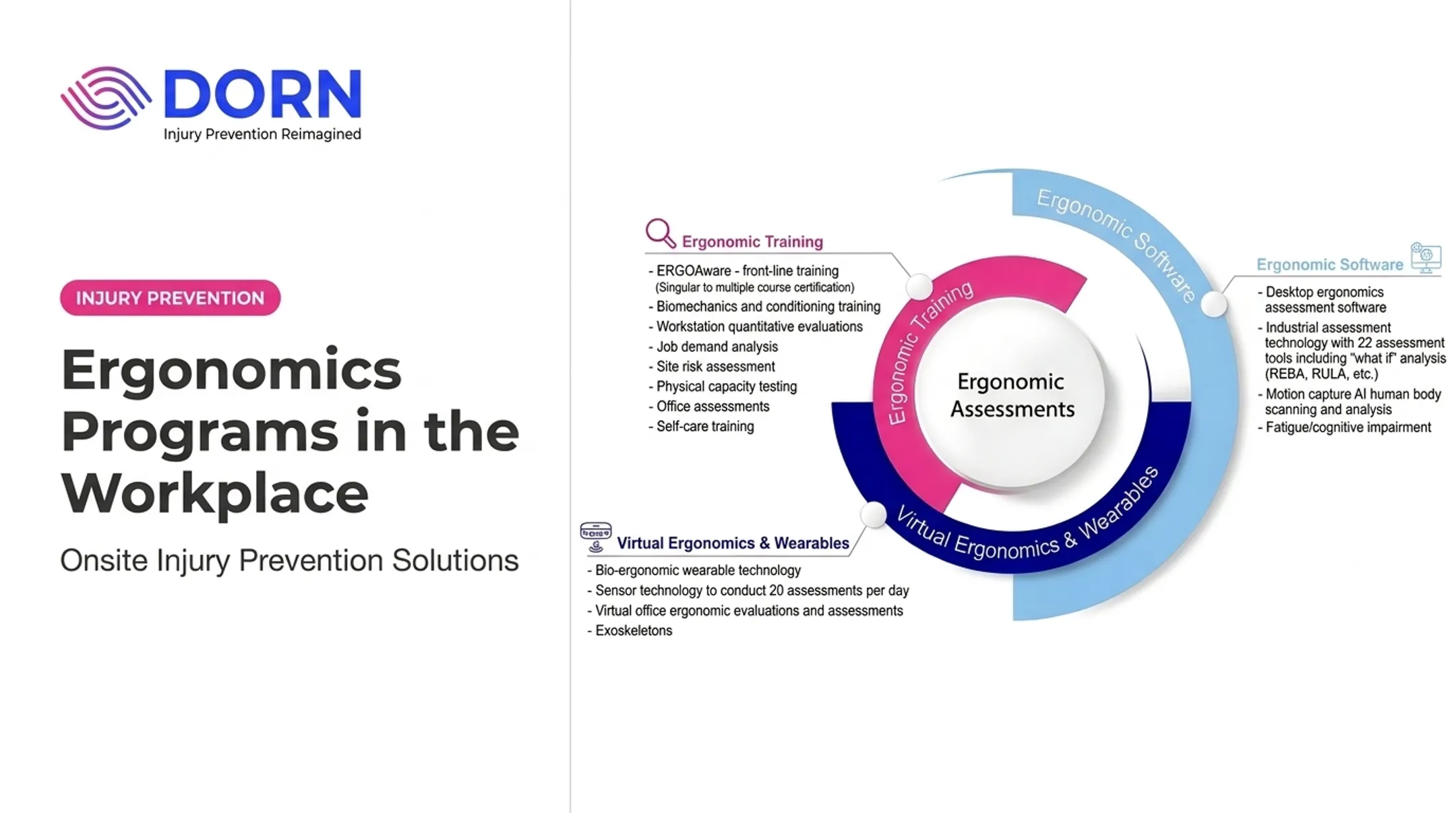
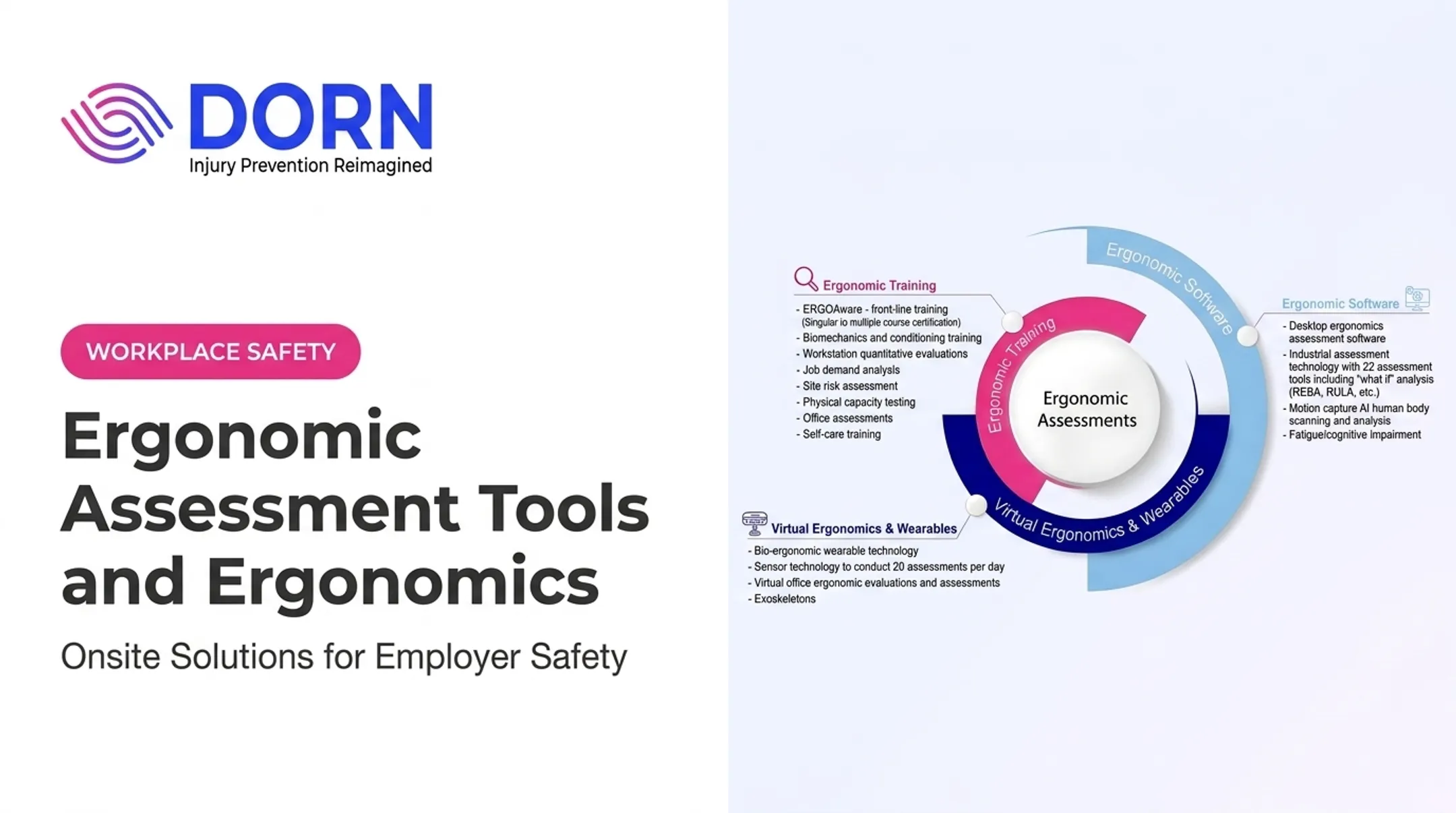
DORN Companies supports these gaps with customized ergonomics assessments and injury-prevention programs through Certified Industrial Ergonomic Evaluators. Delivery can mix onsite work, virtual support, education, and monitoring based on what each site needs.
Use a Phased Rollout for Multi-Site Organizations
Standardize the shared core: definitions, assessment forms, reporting categories, training expectations, and metrics. Let individual sites handle their own tasks and layouts.
Run a pilot, document what worked and what didn't, then build a repeatable implementation kit for the next location.
How to Measure and Improve the Program
A program that isn't measured tends to drift. These are the checkpoints that keep it accountable.
Select Leading and Lagging Indicators
Leading indicators show whether the program is functioning day to day:
- Completed assessments and follow-up reviews
- Worker participation rates
- Hazard and discomfort reports
- Training completion
- Corrective-action closure rate
Lagging indicators show outcomes and need careful reading against your baseline:
- MSD injury reports and workers' comp claims
- Restricted work and lost-time days
- Recurring symptom trends
BLS data for 2024 puts the total recordable case rate at 2.3 per 100 full-time workers in private industry, with meaningful variation by sector. Hospitals and nursing/residential care facilities run well above that average. Tracking your own site-specific numbers against your baseline matters more than chasing a national figure.
Evaluate Whether Controls Are Working
A completed purchase order or a finished training session doesn't prove exposure changed. Compare conditions before and after the intervention with task observations, worker feedback, and discomfort surveys.
DORN's own motion-capture work at four sites (two manufacturing plants and two field operations) found that engineering changes alone produced only a partial benefit. Risk scores on several tasks even ticked up slightly right after the environmental change. Full improvement showed up only once engineering fixes were paired with body-mechanics coaching and posture training.
Build the Business Case Responsibly
Connect improvements to operational realities: fewer disruptions, better task usability, and fewer restricted-duty events. One frequently cited case involves Deere and Company, which reported an 83% reduction in back injuries and a 32% drop in related health care compensation over ten years after involving workers early in its ergonomics process.

Resist the urge to invent a universal ROI number. Cost figures should come from your own baseline and follow-up data, or from credible published case studies, not assumptions.
Review, Communicate, and Revise
Schedule regular program reviews, and add trigger-based reviews after incidents, process changes, or new equipment installs. Share progress with workers and leadership through simple dashboards and action registers instead of long reports that sit unused.
If you lack in-house measurement tools, partners like DORN can supply motion capture, monitoring, and coaching data so reviews rest on observed risk change—not activity counts alone.
How Should the Program Adapt to Different Workplaces?
A program built for a distribution center won't fit an accounting office. The framework stays consistent; the details need to flex.
Manufacturing, Warehouses, and Distribution
Focus on the physical demands that drive most MSDs in these settings:
- Lifting, pushing, and pulling
- Repetitive assembly or picking
- Workstation height and reach zones
OSHA guidance suggests manually moved carts on smooth floors should generally be limited to 500 pounds, with power assistance for heavier loads.
Shift schedules, seasonal production spikes, and temporary workers all affect exposure levels and training needs. A worker on their first week deserves the same hazard awareness as a five-year veteran, often more.
Food and Beverage Processing
Repetitive cutting, packing, and sorting tasks, often in cold or wet conditions, create a distinct risk profile.
OSHA's poultry processing guidance found that MSDs accounted for roughly a third of days-away-from-work cases in that sector. Tasks like packaging one bird every five seconds or knife cuts repeated 6-10 times per minute drive that exposure.
Coordinate ergonomic changes with food safety, sanitation, and production teams. A fix in one area can create friction in another.
Office, Hybrid, and Remote Work
There's no single correct desk setup. A 2022 University of Cincinnati survey of over 1,100 faculty and staff found moderate-to-severe pain reported in 49% of respondents' necks, 45% in the low back, and 62% in the upper back and shoulders. Much of that pain tied to laptop use without an external keyboard or monitor.

Self-assessments, virtual consultations, and equipment standards work better than a rigid one-size-fits-all posture rule, especially given how different remote setups actually look.
Multi-Site and Changing Operations
Keep a common framework, but let local teams handle their specific jobs, equipment, and regulations. Build ergonomic review into change management. Assess exposure impact before rollout—not after complaints start—when you introduce:
- New equipment
- Packaging changes
- Facility redesigns
Frequently Asked Questions
What are ergonomic elements?
The main elements are management commitment, worker participation, hazard identification and assessment, risk controls, training, reporting, documentation, and continuous improvement. Together they form an ongoing system rather than a single fix.
What is the purpose of an ergonomics program?
It systematically identifies and reduces ergonomic risks while supporting worker well-being and safer operations. It also helps organizations make informed decisions about where to invest safety resources.
What is the difference between an ergonomic assessment and an ergonomics program?
An assessment evaluates one task or workstation at a single point in time. A program is the broader ongoing system of policies, controls, training, and review that sustains improvements over time.
What are the main ergonomic risk factors in the workplace?
Force, repetition, awkward or static postures, duration, contact stress, vibration, poor workstation design, and insufficient recovery time. These show up in both industrial settings and office environments.
How do you start an ergonomics program?
Secure leadership sponsorship, review baseline injury and discomfort data, gather worker input, and identify priority tasks. From there, document assessments, select feasible controls, train staff, and build in a follow-up process.
How do you measure whether an ergonomics program is successful?
Combine leading indicators like completed assessments and worker participation with lagging injury data and direct worker feedback. Verify that controls actually changed the underlying exposure, not just that a purchase or training session happened.