
Because “Just Lift With Your Legs” Is Not an Ergonomics Strategy
Choosing the right ergonomics company can mean the difference between preventing workplace injuries and paying someone to tell your employees to “lift with your legs” or “sit up straight.”
Let's face it. Ergonomics isn't always the most exciting topic at the management meeting. Mention “ergonomic risk assessment,” and suddenly everyone remembers an urgent email they need to answer.
But mention rising workers' compensation costs, lost productivity, employee injuries, and expensive equipment collecting dust in the corner? Now you've got everyone's attention.
The truth is, workplace ergonomics is about much more than comfortable chairs, anti-fatigue mats, and motivational posters reminding employees to “lift with their legs.”
A qualified ergonomics company should help you identify injury risks, implement practical solutions, improve employee performance, and demonstrate measurable results.
Unfortunately, not all ergonomics providers are created equal.
Some bring decades of experience, scientific assessment tools, and innovative solutions. Others arrive with a clipboard, recommend stretching, and disappear faster than the good donuts in the breakroom.
So, how do you separate the true ergonomics experts from the professional clipboard carriers?
Here are 10 essential questions to ask before hiring an ergonomics company, along with red flags that should have you reaching for the emergency exit handle.
1. What Qualifications and Experience Do Your Ergonomists Have?
Because watching three YouTube videos about posture does not make someone an ergonomist.
Ergonomics is a multidisciplinary science involving biomechanics, human factors, physiology, workplace design, and injury prevention.
Your ergonomics provider should employ professionals with relevant education, recognized certifications, and hands-on industry experience.
Look for credentials such as Certified Professional Ergonomist (CPE), Certified Ergonomics Assessment Specialist (CEAS), Certified Ergonomic Evaluation Specialist (CEES), or relevant qualifications in occupational therapy, physical therapy, engineering, or human factors.
But credentials alone aren't enough.
An ergonomist who has spent 20 years evaluating office workstations may be excellent at office ergonomics but less familiar with the physical demands of manufacturing, construction, or warehouse operations (that is a completely different animal).
🧐 Ask: What experience do your ergonomists have in our specific industry?
🚩 Red Flag: Their primary qualification is that they once purchased a standing desk and absolutely love it.
What to look for: Professionals who combine technical knowledge with real-world experience identifying and solving workplace ergonomic hazards. Ask which industries they have worked in and request examples of solutions they have recommended.
2. Do You Conduct Comprehensive Ergonomic Risk Assessments?
Or are we just walking around pointing at people who bend over with bad mechanics?
A legitimate ergonomic assessment involves much more than observing employees and making educated guesses.
Qualified ergonomists evaluate risk factors such as forceful exertions and manual material handling; repetitive movements and sustained muscle loading; awkward and static postures; extended reaching and excessive shoulder elevation; contact stress, vibration, and environmental conditions; and task frequency, duration, and recovery opportunities.
They should also consider actual work demands, equipment, workstation design, and employee variability.
🧐 Ask: What assessment methods do you use to identify and quantify ergonomic risk?
🚩 Red Flag: Their assessment methodology consists of saying, “Ouch, that looks uncomfortable.”
What to look for: Structured, evidence-based evaluations using appropriate tools such as the NIOSH Lifting Equation, RULA, REBA, ART, or other validated assessment methods.
3. Can You Quantify Ergonomic Risk and Measure Improvement?
Because “Things Look Better” Is Not a KPI.
Imagine telling your leadership team: “Great news! We implemented ergonomic improvements, and everyone seems happier.”
Wonderful. But did the risk actually decrease?
An effective ergonomics company should establish baseline measurements, identify priority risks, and evaluate changes following interventions.
Depending on the task, useful measurements might include lifting forces, postural exposure, repetition rates, reach distances, or validated risk scores.
🧐 Ask: How do you demonstrate that your interventions actually reduce ergonomic risk?
🚩 Red Flag: Their success metric is the number of employees who smiled during training.
What to look for: Before-and-after measurements, clearly defined metrics, and transparent reporting that distinguishes measured risk reductions from estimated financial benefits. Bonus points if they can explain their findings without requiring everyone in the room to have a doctorate in biomechanics.
4. Do You Recommend Engineering Controls or Just Employee Training?
Spoiler alert: A Stretch Break Won’t Make a 75-Pound Box Weigh Less.
Employee education is valuable. Teaching proper body mechanics, neutral postures, and effective movement strategies can help reduce unnecessary physical stress.
But training alone cannot eliminate poorly designed workstations, excessive forces, or repetitive high-risk tasks.
Engineering and administrative controls should be a major component of a comprehensive ergonomics program.
Examples include height-adjustable workstations, lift-assist devices, improved material-handling systems, redesigned tools, job rotation, and automated processes.
🧐 Ask: How do you determine when engineering controls are necessary instead of relying on employee training?
🚩 Red Flag: Every recommendation involves stretching, better posture, or telling employees to “be more careful.”
What to look for: A provider who understands the hierarchy of controls and prioritizes eliminating or reducing hazards at their source. Remember: You cannot train gravity to cooperate.
5. Will Your Recommendations Be Practical for Our Operations?
Because Recommending a $250,000 Robot to Move a 15 lb. Box Might Raise Some Questions.
An ergonomics solution must work in the real world.
That means considering production requirements, facility space, employee workflows, equipment compatibility, implementation costs, and operational constraints.
The most technically impressive solution isn't necessarily the best.
Sometimes a simple workstation adjustment produces meaningful improvement. Other times, a lift-assist device or automated material-handling system may be justified.
🧐 Ask: How do you balance ergonomic risk reduction with productivity, operational needs, and implementation costs?
🚩 Red Flag: Their recommendations require rebuilding half your facility, hiring six additional employees, and purchasing equipment that won’t fit into the facility.
What to look for: Customized, scalable solutions with practical short-term improvements and longer-term engineering recommendations. Good ergonomics should improve how work gets done—not make getting work done impossible.
6. Do You Involve Employees in the Assessment and Solution Process?
Because the Person Doing the Job Probably Knows a Thing or Two About the Job.
Employees are often the best source of information about workflow challenges, physical demands, and why certain tasks are difficult.

They also know which equipment works, which equipment doesn't, and which expensive ergonomic gadget has been sitting untouched since 2019.
A qualified ergonomics company should actively engage employees, supervisors, and safety professionals throughout the assessment process.
🧐 Ask: How do you incorporate employee feedback into your assessments and recommendations?
🚩 Red Flag: The ergonomist never speaks to the employees performing the work.
What to look for: Collaborative assessments, employee interviews, task observations, and opportunities to test proposed solutions before full implementation. After all, an ergonomic solution that nobody uses is just an expensive decoration.
7. What Technology Do You Use, and How Reliable Is It?
AI Is Impressive. But It Still Needs Someone Who Knows What They’re Looking At.
Technology is transforming workplace ergonomics.
Video-based assessments, motion analysis, artificial intelligence, and digital reporting tools can help ergonomists evaluate workplace exposures more efficiently.
However, technology should support professional judgment—not replace it.
An AI-generated risk score is only as useful as the quality of the data, the appropriateness of the analysis, and the expertise used to interpret the findings.
🧐 Ask: How do you validate your technology and ensure the accuracy of your ergonomic assessments?
🚩 Red Flag: “Our AI handles everything. We don’t really need an ergonomist anymore.”
What to look for: Providers who combine innovative technology with experienced professionals, transparent methodologies, appropriate data privacy protections, and human review. Technology is a tool. Expertise is what makes the tool valuable. Even the smartest software can’t fix a poorly designed workstation by giving it a motivational speech.
8. What Will We Receive After the Assessment?
Because a 90-Page Report That Nobody Reads Is Not an Ergonomic Intervention.
A professional ergonomic assessment should result in actionable information, not just a beautifully formatted document that lives forever in a shared drive.
Ask to see a sample report before signing a contract.
A strong report should clearly identify observed hazards, explain associated risks, prioritize concerns, and recommend realistic corrective actions (both short-term and long-term).
Ideally, recommendations should distinguish between immediate improvements, behavioral controls, administrative controls, and longer-term engineering solutions.
🧐 Ask: What deliverables will we receive, and how will they help us prioritize corrective actions?
🚩 Red Flag: The final report contains 47 photographs, 12 pages of generic definitions, and one recommendation: “Employees should use proper body mechanics.”
What to look for: Clear executive summaries, prioritized risk rankings, supporting photographs or data, actionable recommendations, and implementation guidance. The goal isn’t to impress people with the thickness of the report. The goal is to reduce risk.
9. Do You Provide Implementation Support and Follow-Up?
Or Do You Disappear Immediately After Sending the Invoice?
Identifying ergonomic hazards is only the beginning.
The real value comes from implementing corrective actions, helping employees adapt to changes, and verifying whether interventions actually work.
Without follow-up, even excellent recommendations can remain permanently trapped in the “We’ll Get to That Next Quarter” folder.
🧐 Ask: What support do you provide after the assessment to help implement and evaluate solutions?
🚩 Red Flag: Their follow-up program consists of sending a satisfaction survey and wishing you the best.
What to look for: Assistance with equipment selection, employee coaching, implementation planning, reassessments, and measurable progress tracking. A strong ergonomics partner should help move recommendations from paper to production. Preferably before the next fiscal year.
10. Can You Demonstrate Results and Provide Relevant References?
Because “We’ve Helped Lots of Companies” Is Not Exactly a Case Study.
Before selecting an ergonomics provider, ask for examples of previous projects involving similar workplace challenges.
A credible company should be able to explain the hazards identified, interventions implemented, and results achieved.
Look for documented improvements in ergonomic risk exposure, task efficiency, employee participation, or other relevant performance measures.
Be cautious about promises of guaranteed injury reductions or financial savings. Injury outcomes depend on multiple factors, and meaningful results require appropriate measurement and time.
🧐 Ask: Can you share case studies, measurable outcomes, and references from organizations similar to ours?
🚩 Red Flag: Their biggest success story is that nobody complained about the new office chairs.
What to look for: Relevant industry experience, transparent outcomes, credible references, and realistic expectations. Great ergonomics providers don’t just tell you they’re effective. They can explain how they know.
Bonus: Five Red Flags That Deserve Immediate Attention
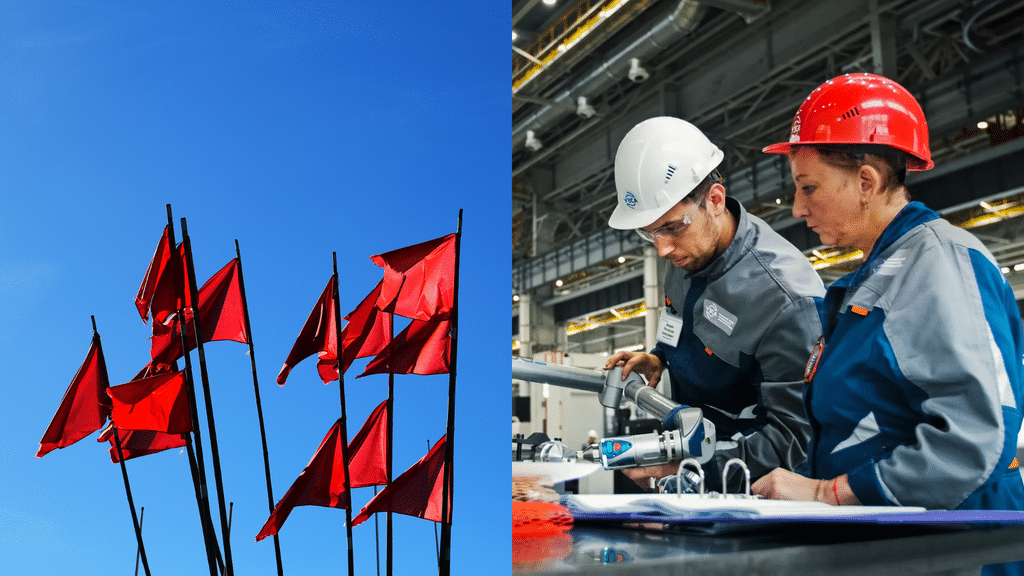
Still having trouble deciding? Watch for these warning signs:
- One-size-fits-all solutions. Every workplace receives the same recommendations, regardless of its operations or hazards.
- Training is always the answer. Even when employees are repeatedly lifting excessive loads or working in awkward postures.
- No measurable results. The provider cannot explain how risks are assessed or how improvements will be verified.
- Technology without expertise. Impressive dashboards replace sound ergonomic analysis and professional judgment.
- No implementation strategy. You receive a list of problems but little guidance on how to solve them.
If you encounter several of these warning signs, you may want to keep shopping. Your employees and your budget will thank you.
The Bottom Line: Choose a Partner, Not Just a Provider
Choosing an ergonomics company shouldn't be about finding someone who can conduct the fastest assessment, deliver the longest report, or recommend the most recent automation equipment.
It should be about finding a knowledgeable partner who understands your operations, identifies meaningful risks, develops practical solutions, and helps you measure improvements.
The right ergonomics company brings together scientific expertise, industry experience, innovative technology, employee engagement, and a commitment to results.
When ergonomics is done well, organizations can reduce exposure to injury risks, improve work processes, support employee well-being, and potentially lower injury-related costs.
And perhaps most importantly, employees can finish their shifts without feeling like they've just completed an obstacle course designed by someone who has never actually performed their job.
Before hiring your next ergonomics company, ask the tough questions. Look beyond the sales presentation. Demand practical solutions and measurable outcomes.
Because great ergonomics isn't about teaching employees how to survive poorly designed work.
It's about designing work, so employees don't have to.
And that, unlike the office chair with 37 adjustment levers, is something everyone can appreciate.
I’ll be glad to answer any questions that come up that I haven’t covered above. Just reach out anytime.
Frequently Asked Questions About Hiring an Ergonomics Company
What should I look for when hiring an ergonomics company?
Look for qualified ergonomists with experience in your industry, evidence-based ergonomic risk assessment methods, practical recommendations, and a clear process for measuring improvement. Request sample reports, relevant client references, and examples of solutions the company has helped implement.
What does an ergonomic risk assessment include?
A workplace ergonomic risk assessment examines factors such as forceful exertion, repetitive movement, awkward or static postures, manual material handling, vibration, and task duration. It should also consider workstation design, equipment, actual job demands, and employee input. The assessment methods should match the tasks being evaluated.
How can an ergonomics company demonstrate results?
An ergonomics company should document baseline conditions and reassess the work after changes are made. Depending on the task, useful measures may include posture, repetition, reach distances, lifting demands, and established ergonomic risk scores. Ask the provider to distinguish measured reductions in risk exposure from projected cost savings or injury reductions.
Is ergonomic training enough to reduce workplace injury risks?
Ergonomic training can help employees understand work practices, but training alone cannot eliminate hazards caused by poorly designed tasks, excessive forces, or unsuitable equipment. A comprehensive ergonomics program should also evaluate engineering controls, equipment changes, and practical adjustments to how work is performed.
What should an ergonomics assessment report include?
An ergonomic assessment report should clearly identify workplace hazards, explain and prioritize risks, document supporting observations or measurements, and recommend feasible corrective actions. It should also outline implementation priorities and explain how the organization can evaluate whether the changes reduced ergonomic risk.