

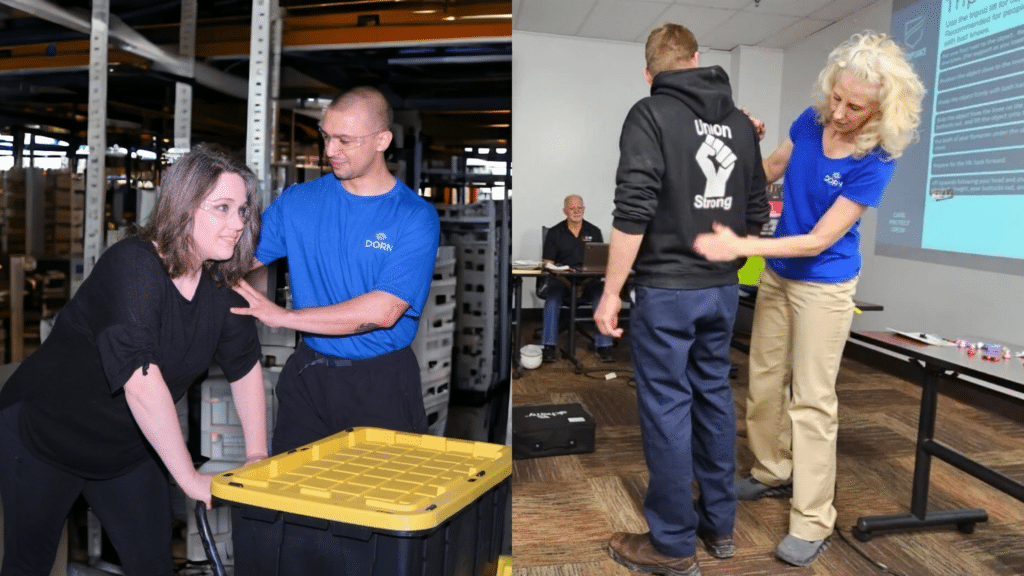
Watch a toddler pick something up from the floor, and you may see something many adults have forgotten: a deep squat, the object held close to the body, and a full-body pivot instead of a twist through the spine.
No ergonomics class. No safety poster. No annual refresher.
Yet those movements closely resemble the mechanics safety teams try to reinforce every day.
That observation was the starting point for DORN’s recent webinar on natural movement, workplace behavior, and injury prevention. It also highlights a persistent challenge in industrial ergonomics: employees can know the “right” way to move and still default to movement patterns that increase physical strain.
For employers, the solution is not another reminder to “lift with your legs.” Sustainable change requires understanding how movement habits develop, how the work environment reinforces them, and how ergonomic assessments, engineering controls, and behavioral coaching can work together.
Why Traditional Ergonomics Training Often Falls Short
Most employees do not intentionally choose poor body mechanics. Repeated movement becomes automatic.
Toddlers develop movement through exploration and thousands of small repetitions. Over time, their nervous systems settle on strategies that help them manage force, balance, and the demands of the environment.
Adults also rely on learned movement patterns, but they often favor energy efficiency over mechanical efficiency. Bending at the waist can feel easier than squatting. Reaching may feel faster than stepping closer. Twisting while carrying a load may save a few seconds.
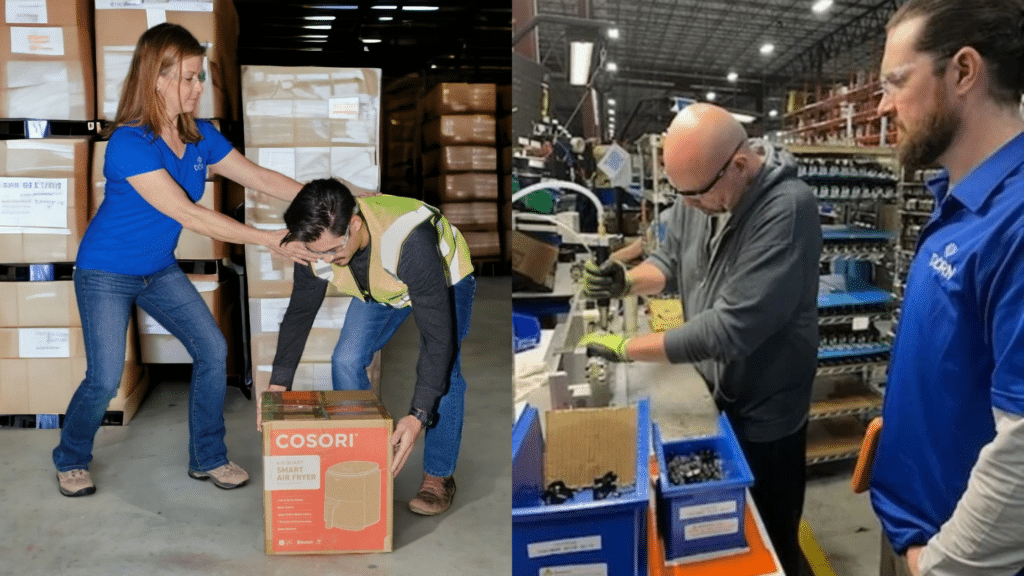
The problem is that the movement that feels easiest in the moment may place more strain on joints and tissues over time.
That is why effective ergonomic programs must move beyond one-time education. Awareness is important, but awareness alone does not automatically rewrite a deeply practiced movement pattern.
Ergonomic Assessments Should Identify Why Risk Exists
A strong ergonomic assessment should answer more than, “What is the employee doing?”
It should also ask, “What is the job causing the employee to do?”
DORN describes poorly designed work environments as creating “environmental casts.” A workstation that is too low can repeatedly force bending. Limited space may make workers twist instead of repositioning their feet. Poor lighting may encourage forward leaning. A fixed-height work surface may place employees of different sizes into awkward postures.
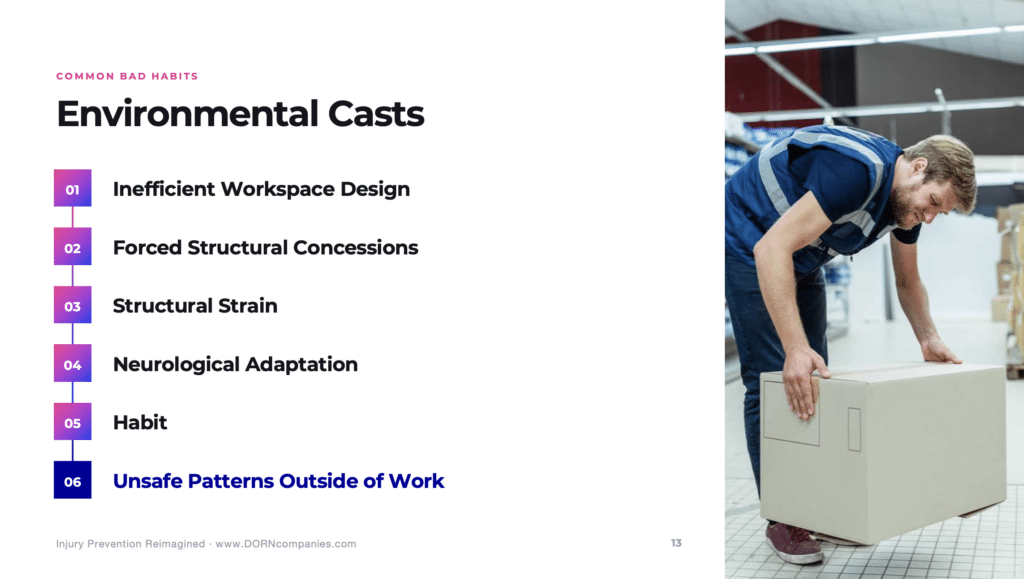
The sequence is important: inefficient workspace design can create structural concessions; repeated concessions create strain; repeated strain can reinforce neurological adaptation and, eventually, habit.
An experienced ergonomic consultant can help organizations separate behavioral risk from environmental risk and determine whether the best response involves workstation changes, engineering controls, training, coaching, or a combination of approaches.
Engineering Controls Work Best When Employees Know How to Use Them
In industrial ergonomics, engineering controls are often a powerful path because they can reduce exposure by changing the work itself. Automation, lift assists, workstation redesign, and process changes can all play an important role.
But DORN’s pilot study with an industrial door manufacturer showed why implementation matters.
The pilot covered four sites: two manufacturing locations and two field installation and maintenance operations, and compared baseline risk with engineering and behavioral interventions.
Most tasks improved after engineering controls were introduced. However, some initially showed increased risk when employees had not received adequate training on how to interact with the modified environment.
After task-specific body mechanics coaching, risk levels dropped dramatically.
For tasks where the pilot timeline did not allow engineering controls to be implemented, behavioral controls alone produced notable results, including a 51% reduction in low-back compression, 37% improvement in upper-extremity risk score, 44% improvement in lower-extremity risk score, 300% improvement in time spent within the safe reach-distance zone, and 154% improvement in safe reach height.
The takeaway is not that behavioral controls should replace engineering. It is that equipment, environment, and human movement have to work together.
Three Pillars of Sustainable Ergonomic Programs
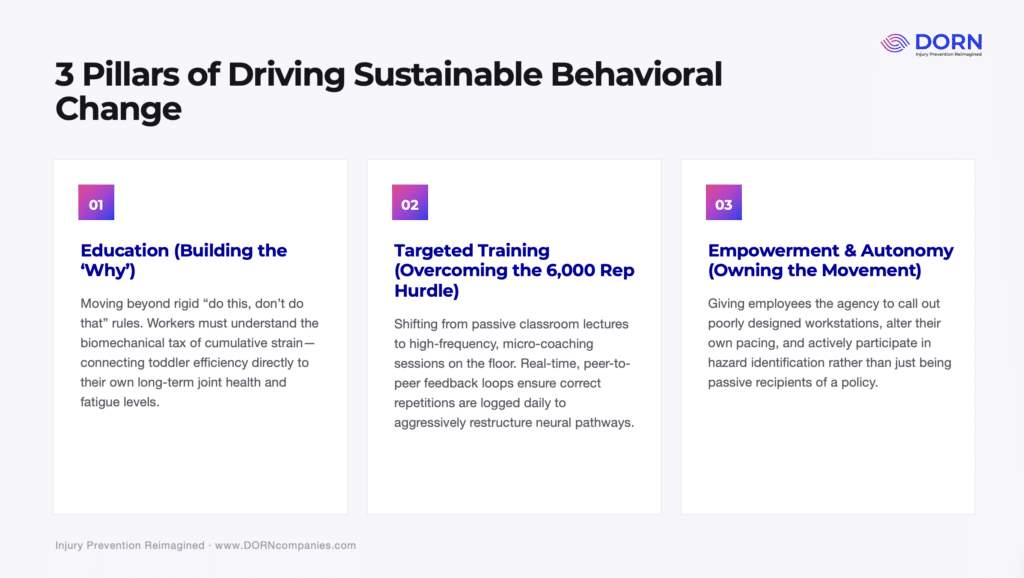
DORN identifies three pillars for changing workplace movement behavior.
1. Education: Build the “why.” Employees need to understand the physical cost of cumulative strain. Rules are easier to apply when workers understand what the rule is protecting.
2. Targeted training: Practice where work happens. Classroom instruction should be reinforced with frequent, task-specific coaching on the floor. Real-time feedback helps employees practice safer movement in the context where the habit actually occurs.
3. Empowerment and autonomy: Give employees ownership. Workers should be able to identify poorly designed workstations, participate in hazard identification, and have a voice in how work is performed.
Together, these elements turn ergonomics from a compliance event into an active injury prevention program for employees.
What an Ergonomic Consultant Can Add to Your Injury Prevention Strategy
An ergonomic consultant can help safety and operations leaders connect pieces that are often managed separately: task design, physical exposure, employee behavior, training, engineering changes, and measurement.
For organizations dealing with recurring strains, sprains, overexertion concerns, or demanding material-handling tasks, a critical first step is developing a clearer picture of where ergonomic risk is actually coming from.
That may include onsite ergonomic assessments, observation of employee movement, objective risk measurement, workstation evaluation, and recommendations for engineering and behavioral controls.
The goal is not to teach employees one “perfect” movement. It is to create working conditions in which safer movement is realistic, repeatable, and reinforced.
Build an Injury Prevention Program Before the Next Injury
The best opportunity to address ergonomic risk is before discomfort becomes an injury.
A stronger injury prevention program for employees looks upstream: at fatigue, awkward postures, repeated reaching, twisting, inefficient workstation design, and the movement habits employees may perform hundreds of times during a shift.
DORN helps organizations build practical industrial ergonomics and injury prevention strategies that address both the work environment and the people performing the work.
Schedule a free consultation with DORN to discuss your workplace risks, ergonomic priorities, and opportunities to strengthen your program.
Then watch the webinar on-demand recording to explore the science behind natural movement, learned behavior, engineering controls, and how employees can relearn more mechanically efficient movement patterns.
Frequently Asked Questions About Ergonomic Assessments and Programs
What does an ergonomic consultant do?
An ergonomic consultant evaluates how employees interact with their tasks, tools, workstations, and environment. The goal is to identify sources of physical risk and recommend practical engineering, administrative, or behavioral controls.
What is included in an ergonomic assessment?
Depending on the task, ergonomic assessments may examine posture, force, repetition, reach, lifting, workstation geometry, movement patterns, and environmental constraints. The assessment should help explain not only where risk exists, but why.
What is industrial ergonomics?
Industrial ergonomics focuses on reducing physical strain and ergonomic risk in environments such as manufacturing, warehousing, distribution, installation, maintenance, and other physically demanding operations.
How can ergonomic programs help prevent employee injuries?
Effective ergonomic programs combine risk identification, engineering improvements, education, task-specific coaching, employee participation, and ongoing reinforcement. The objective is to reduce exposure while making safer work practices easier to sustain.
Should ergonomic programs use engineering controls or behavioral training?
They can work together. DORN’s pilot found that engineering changes generally reduced risk, but task-specific behavioral training helped employees adapt to environmental modifications and further reduce measured risk.