


by Jill Braunstein, National Academy of Social Insurance | August 12, 2015
Workers’ compensation benefits as a share of payroll for injured workers continue to decline even as employment grows and overall employer costs increase, according to a new report from the National Academy of Social Insurance (the Academy).
Workers’ Compensation Benefits* and Costs** Per $100 of Covered Wages, 1980-2013
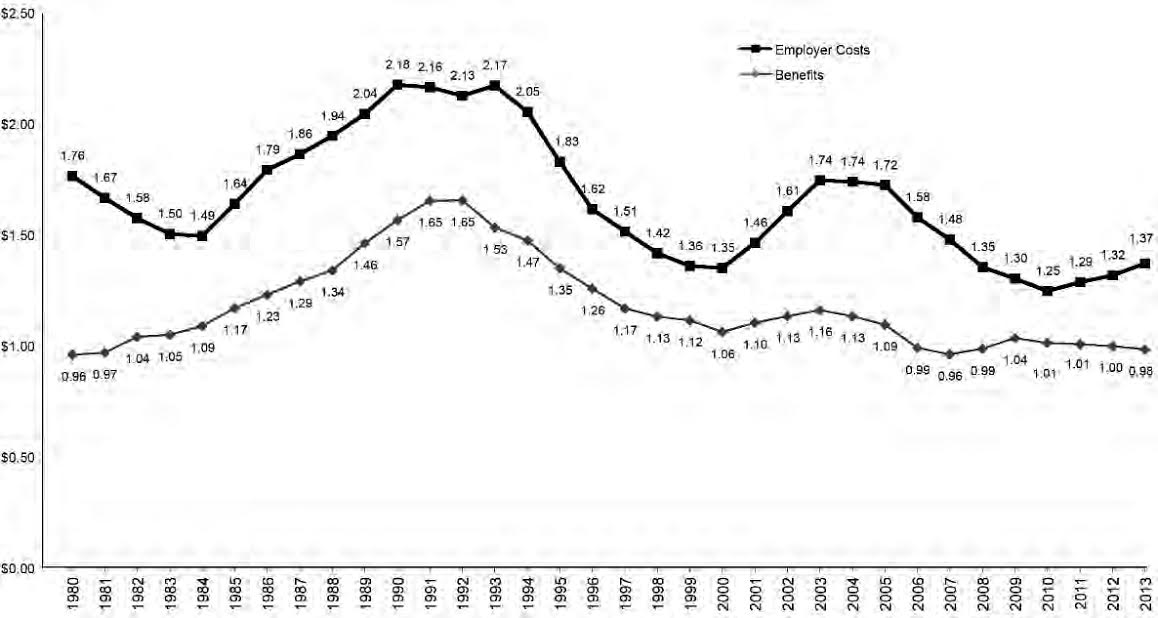
* Benefits are calendar-year payments to injured workers and to providers of their medical care.
** Costs for employers that purchase workers' compensation insurance include calendar-year insurance premiums paid plus benefits paid by the employer to meet the annual deducible, if any. Costs for self-insuring employers are calendar-year benefits paid plus the administrative costs associated with providing those benefits.
Source: National Academy of Social Insurance estimates.
Despite the growth in employment following the Great Recession – and the significant uptick in employees eligible to receive workers’ compensation – benefits per $100 of covered payroll dropped to $0.98 in 2013, a 5 percent decrease from 2009. At the same time, the growing workforce has translated into rising workers’ compensation costs for employers – now $1.37 per $100 of covered payroll, a 5 percent increase from 2009.
Workers’ compensation benefits as a share of payroll were lower in 2013 than during almost any period in the last three decades, according to the report, Workers’ Compensation: Benefits, Coverage, and Costs, 2013. Total workers’ compensation benefits in 2013 were $63.6 billion, while employer costs were $88.5 billion.
Benefits as a percent of payroll declined in 39 states between 2009 and 2013, continuing a national trend in lower benefits relative to payroll that began in the 1990s. “The decline is due to a drop in workplace injuries as well as changes in many state laws that made it more difficult for workers' to qualify for benefits,” said John F. Burton, Professor Emeritus, Rutgers and Cornell University. “These state laws include more stringent compensation rules, the reduction of coverage for certain medical diagnoses, and new legal requirements that make it more difficult for workers to succeed in their claims for benefits.”
Workers’ compensation, which was the first social insurance program in the United States, provides medical benefits paid to the providers of healthcare for injured workers, and cash benefits paid to workers whose injuries prevent them from working. Due to rising healthcare costs during the last 30 years, medical benefits now account for an increasing share of total workers’ compensation benefits, from 29 percent in 1980 to more than 50 percent in 2013. About 33 states currently spend more than half of their workers’ compensation spending on medical care for injured workers.
Marjorie Baldwin, chair of the Academy’s Study Panel on Workers’ Compensation Data, noted that “state trends vary from national trends due to their industrial mix, workers’ compensation policies, and the extent to which their economy is struggling to recover from the Great Recession.”
The Academy report details state-by-state changes in coverage, benefits, and employer costs over the last five years. The state-level results show that between 2009 and 2013:
- The number of covered workers and the amount of covered wages increased in every state except Arkansas and New Mexico;
- Benefits per $100 of covered wages decreased in 39 states;
- In 2013, the jurisdictions with the lowest workers’ compensation benefits as a share of payroll were the District of Columbia ($0.26 per $100 of covered payroll), Texas ($0.40 per $100 of covered payroll), and Arkansas ($0.49 per $100 of covered payroll);
- Employer costs per $100 of covered wages increased in 27 states; and
- In 2013, the states with the highest employer costs for workers’ compensation were Alaska ($2.58 per $100 of covered payroll), Montana ($2.24 per $100 of covered payroll), and Oklahoma ($2.24 per $100 of covered payroll).
Workers’ Compensation: Benefits, Coverage, and Costs, 2013, is the 18th in an annual series. The report provides the only comprehensive data on workers’ compensation benefits, coverage, and employer costs for the nation, the states, the District of Columbia, and federal programs. This data informs state and federal policy and provides critical information for business, labor, insurers, academics, and others working in the field.
This article was originally published by National Academy of Social Insurance. You can see the original article here: https://www.nasi.org/