

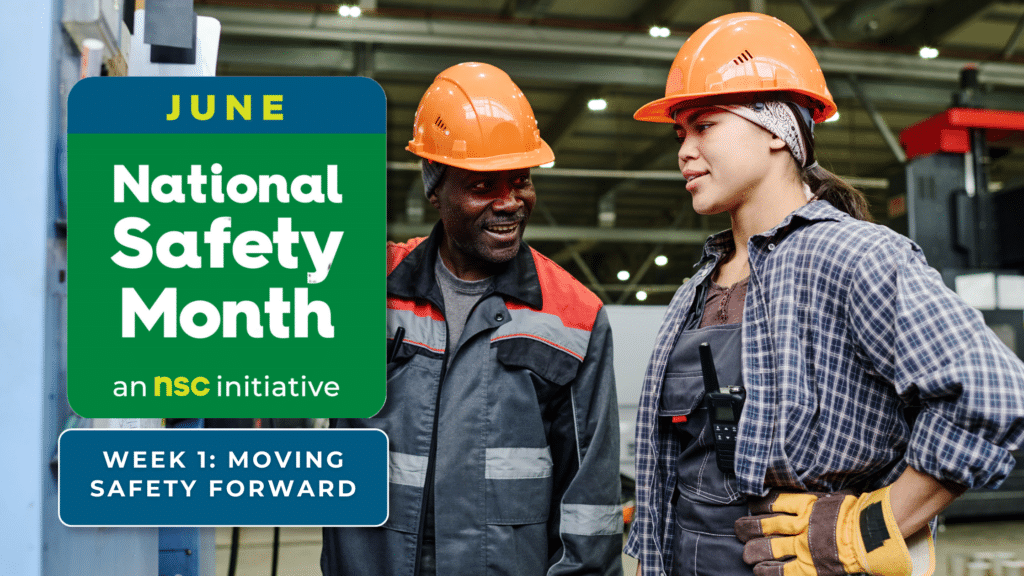
June marks National Safety Month, and at DORN, we're proud to stand with the National Safety Council and safety leaders across the country to spotlight the work being done to keep employees safe, healthy, and thriving.
Week 1's theme, Moving Safety Forward, highlights the importance of taking a proactive approach to workplace safety. At DORN, we believe that the journey begins with a strong safety culture, one that goes beyond compliance and creates an environment where safety is part of the conversation every day.
The most effective injury prevention strategies aren't built on policies alone. They're embedded in an organization's values, championed by leadership, and brought to life by engaged and empowered employees. Continuous improvement requires listening to your workforce, learning from both near misses and successes, and adapting your approach to better protect your team.
One of the most powerful ways organizations can move safety forward is by understanding and leveraging leading indicators.
What Are Leading Indicators in Workplace Safety?
If you've ever driven a car, you're familiar with the feeling that comes when a warning light appears on your dashboard. Whether it's a check engine light, a low-fuel warning, or an oil change reminder, those alerts exist for a reason: to warn you of a potential problem before it becomes a major and costly issue.
Paying for an oil change may be inconvenient, but it's far better than paying thousands of dollars for a new engine. Stopping for gas is always preferable to being stranded on the side of the road.
In workplace safety and injury prevention, these early warning signs are known as leading indicators - signals that help organizations identify and address risks before injuries occur.
Leading indicators are one side of the equation that helps employers understand, identify, and mitigate risk. The other side consists of lagging indicators, which measure events that have already occurred.
Understanding how to evaluate both provides a clearer picture of organizational risk and enables safety leaders to develop interventions that prevent injuries before they happen, reduce costs, and support a healthy, engaged, and productive workforce.
Leading Indicators vs. Lagging Indicators
Every organization relies on data to guide safety decisions, but it's important to distinguish between leading and lagging indicators.
Common Lagging Indicators
Lagging indicators measure past performance and outcomes, including:
- Number of incidents and injuries
- Workers' compensation costs
- Missed workdays
- Days without an incident
- Historical injury trends
- Productivity metrics
- Production goals
- Sales performance
While these metrics are important, they are inherently reactive. They tell us what happened yesterday, not what may happen tomorrow.
Common Leading Indicators
Leading indicators focus on present conditions and behaviors that can help predict future risk, including:
- Employee pain and discomfort levels
- Sleep quality and fatigue
- Medication usage
- Employee morale
- Absenteeism
- Workforce demographics
- Turnover rates
- Employee engagement
These indicators provide organizations with valuable insight into emerging risks and opportunities for intervention before an injury occurs.
Looking Beyond the Data: Emotional Ergonomics and Hidden Risk Factors
Safety programs thrive on measurable data. Ergonomic assessments, AI-powered motion capture technology, wearable sensors, exertion monitoring, and on-site observations are all critical components of a comprehensive injury prevention strategy.
However, even the most sophisticated data collection tools don't always tell the whole story.
That's why leading organizations are increasingly embracing the concept of Emotional Ergonomics - a framework that recognizes the impact workplace conditions, psychosocial hazards, and emotional well-being have on employee safety and performance.
Emotional Ergonomics acknowledges that workers are more than physical bodies performing tasks. Their stress levels, morale, mental health, and overall workplace experience directly influence decision-making, attention, fatigue, and injury risk.
The Connection Between Mental Health and Workplace Safety
Research continues to demonstrate a strong connection between mental health and physical safety outcomes.
Consider the following:
- Up to 80% of American workers report experiencing work-related stress.
- Stress and anxiety-related cases account for 52% of workplace injuries.
- Mental health injuries are 10 times more common than chemical exposure injuries and 8.6 times more common than head injuries.
- Workplace stress contributes approximately $190 billion in annual U.S. healthcare costs.
The evidence is clear: mental health challenges significantly impact workplace safety.
Severe depression has been linked to nearly a 35% reduction in cognitive function and a 20% decrease in job task efficiency. Excessive workloads, poor communication, toxic workplace cultures, low autonomy, job insecurity, and other psychosocial hazards can create emotional strain that increases injury risk.
Many of these workplace challenges fall under what researchers describe as a VUCA environment:
- Volatility
- Uncertainty
- Complexity
- Ambiguity
Organizations operating in VUCA environments must proactively identify hidden risks that traditional safety metrics may overlook.
Using Employee Feedback to Identify Leading Indicators
Many of the most valuable leading indicators never appear in incident reports or observational assessments.
Instead, they emerge through meaningful conversations with employees.
DORN's experience evaluating psychosocial hazards and workplace risk has shown that the following tools are critical for identifying hidden safety concerns:
Employee Surveys
Regular employee surveys provide insight into:
- Pain and discomfort levels
- Morale and engagement
- Job satisfaction
- Perceived workplace challenges
- Equipment and workstation concerns
- Organizational culture
Consistently gathering this feedback helps organizations identify both operational and wellness-related risks before they escalate.
Employee Focus Groups
Focus groups create opportunities for workers to openly discuss their experiences and concerns.
When employees share challenges in a collaborative setting, additional issues often surface, creating a more complete understanding of workplace risks and how they affect individuals and teams.
Why Organizations Still Rely on Lagging Indicators
Although both leading and lagging indicators are essential, many organizations continue to focus primarily on lagging indicators because they are easier to track and historically have been the foundation of most safety programs.
Unfortunately, relying solely on lagging indicators can create blind spots.
Low injury rates may mask underlying risks that are steadily increasing beneath the surface. By the time those risks appear in injury statistics, the opportunity for prevention may have already passed.
Fortunately, today's employers have access to more tools than ever to identify and monitor leading indicators.
These include:
- Ergonomic assessments
- Employee engagement tracking
- Safety culture surveys
- Fatigue monitoring technologies
- Alertness testing programs
- AI motion capture systems
- Wearable sensor technologies
- Behavioral observation programs
Low participation or engagement in existing safety initiatives may itself serve as a leading indicator, signaling that employees lack confidence in current programs or feel disconnected from safety efforts.
Fatigue monitoring tools can provide valuable insight into worker alertness and sleep quality. Research from the National Safety Council shows that employees with sleep problems are significantly more likely to experience workplace injuries.
Likewise, motion capture technology and wearable sensors can identify high-risk movements, poor posture, repetitive strain exposures, and unsafe work patterns before they result in costly musculoskeletal injuries.
The most successful organizations don't simply collect this data; they integrate it into a larger injury prevention strategy that drives action.
The Role of Safety Culture in Leading Indicator Success
Even the best safety tools and technologies depend on one critical factor: culture.
Leading indicators often rely on employee feedback, and obtaining honest, accurate feedback requires a workplace environment built on trust, accountability, transparency, and communication.
Employees are far more likely to report concerns, discomfort, fatigue, morale issues, and safety risks when they know their feedback will be taken seriously and acted upon.
Organizations with strong safety cultures create environments where employees feel comfortable speaking up without fear of retaliation.
They also measure the effectiveness of their safety and injury prevention programs by regularly gathering employee feedback and evaluating outcomes.
Through more than 15,000 employee surveys conducted annually, DORN has seen firsthand what successful safety cultures look like and how they consistently outperform reactive approaches to injury prevention.
Moving Safety Forward

As we recognize National Safety Month, organizations have an opportunity to move beyond simply tracking injuries and begin identifying the factors that contribute to them.
Leading indicators provide a powerful way to understand risk before incidents occur. When combined with a strong safety culture, ergonomic expertise, employee engagement, and proactive injury prevention strategies, these elements help organizations create safer, healthier, and more productive workplaces.
Moving safety forward means looking beyond what has already happened and focusing on what can be prevented.
That's where meaningful, lasting safety improvements begin.
How to Build Momentum This Week
- Open a safety conversation with your team, and ask what could be improved
- Recognize small wins and safe behaviors
- Encourage peer-to-peer safety feedback
- Revisit past incidents and turn them into learning opportunities
Safety is a living process. Continuous improvement means we never stop asking: “How can we do better—for our people, for their families, and for the future of work?”
Stay tuned each week in June as we dive into other vital themes:
Week 2: Safety is more than checking boxes
Week 3: AI and Ergonomics
Week 4: Build systems that prevent injuries
If you're looking to strengthen your workplace safety program, reduce injuries, or explore how ergonomic assessments can support your 2026-2027 safety goals, we're here to help.
Let’s talk about your safety goals, injury prevention strategy, or budget planning. Contact DORN today to learn more or schedule a consultation.