
Hybrid workers report back pain at a higher rate than employees who work in the office every day. In Cardinus Risk Management's internal dataset of 55,733 desk-based workers, 14.4% of hybrid employees reported back pain, compared with 11.9% of full-time office workers and 13.9% of fully home-based workers.
That should change your 2027 ergonomics budget. The workstation you control and inspect is the lowest-risk one your people use.
The data comes from the Cardinus Data Project, an internal dataset of office-type workers in office, home, and hybrid settings. Jon Abbott, Director at Cardinus Risk Management, presented it in a DORN webinar hosted by Kevin Lombardo, CEO and President of DORN. Below are the newest U.S. back injury numbers, what the hybrid data shows, what it costs, and how to build a workplace injury prevention program that reduces it.
Workplace back pain statistics at a glance
- Low back pain is the leading cause of disability worldwide. It affected 619 million people in 2020 and is projected to reach 843 million by 2050 (WHO).
- U.S. employers reported 2.4 million workplace injuries and illnesses in 2025, a rate of 2.3 per 100 full-time workers (BLS, released November 2026).
- Overexertion causes more serious workplace injuries than anything else. It accounted for 946,290 cases with days away, restricted duty, or job transfer in 2023–2024, about 1 in 3, with a median of 14 days away from work (BLS).
- Work injuries cost the U.S. $181.4 billion in 2024 (National Safety Council).
- 13.7% of desk-based workers in the Cardinus dataset reported back pain. Hybrid workers were highest at 14.4%.
- Workstation setup predicts back pain better than location. Home workers at a desk and office chair: 11%. At a kitchen counter: 27%. On a bed or floor: 32%.
- Estimated U.S. cost of back pain among home and hybrid workers: $129.8 billion a year, from about 1.37 billion lost productive hours.
- 47% of employers believe discomfort is not under-reported among home and hybrid staff. The prevalence data suggests otherwise.
How common are back injuries at work in 2026?
Overexertion injuries, which include most back injuries, still make up the largest category of serious workplace injury in the U.S. Overall injury rates are falling slowly, but the injuries that keep people off the job longest have not moved much.
| Measure | Latest figure | Source |
| Recordable injuries and illnesses, private industry | 2,414,200 cases (2.3 per 100 FTE workers), down 3.0% from 2024 | BLS, 2025 data |
| Cases with days away from work | 842,500 (0.8 per 100 FTE workers) | BLS, 2025 data |
| Overexertion, repetitive motion and bodily conditions | 946,290 days away, restricted, or transfer (DART) cases - the largest event category, 32% of all DART cases | BLS, 2023–2024 |
| Median days away for overexertion cases | 14 days, vs 8 for all injuries | BLS, 2023–2024 |
| Median days restricted or transferred for overexertion | 21 days | BLS, 2023–2024 |
| Cases involving the back | 248,180 | BLS latest numbers |
| Total cost of U.S. work injuries | $181.4 billion; $48,000 per medically consulted injury | NSC Injury Facts, 2024 |
| Workdays lost to work injuries | 102 million in 2024, plus 54 million expected in future years | NSC Injury Facts, 2024 |
| People with low back pain worldwide | 619 million (2020), projected 843 million by 2050 | WHO |
Two things stand out for EHS leaders. First, an overexertion case keeps a worker away almost twice as long as the typical injury (14 days vs 8). Second, these figures count only injuries employers record. Most back pain at a laptop never becomes a recordable injury, which is where the hybrid data comes in.
Do hybrid workers have more back pain than office workers?
Yes. In the Cardinus study, 14.4% of hybrid workers reported back pain, vs. 11.9% of full-time office workers and 13.9% of home-based workers. Across all 55,733 desk-based workers in the dataset, 13.7% reported back pain.
The reflex response is to bring everyone back to the office. The data says that misses the point. The risk follows the workstation, not the postcode.
Workstation setup predicts back pain better than location
Workers at a kitchen counter reported back pain at about 2.5 times the rate of those at a proper desk. On a bed or floor, it was nearly 3 times the desk rate. The kitchen-counter group is small (1% of home workers), so treat that figure as directional.
The seating data shows how little employers can see. Only 17% of home workers and 11% of hybrid workers confirmed they use an office chair. Another 58% of home workers and 62% of hybrid workers didn't state their seating at all. You can't manage a risk your reporting system never sees.
The webinar's policy conclusion: occupational health strategy should assess workstation setup and worker behavior, not just work location. Return-to-office mandates based on presence alone "may overlook modifiable ergonomic and behavioral factors present across all work environments."
For your next leadership meeting: a compliant office doesn't help the employee who spends four hours a day hunched over a laptop on a hotel bed.
Is the pain in the upper or lower back?
Mostly both. Among workers reporting back pain:
- 56% reported both upper and lower back pain
- 33% reported upper back pain only
- 11% reported lower back pain only
Most corporate ergonomics programs are built around lifting and lower-back risk. In this population, upper back pain dominates. That points to screen height, monitor position, laptop use, and long periods of static sitting. If your training for desk-based staff is still 90% "lift with your legs," it's built for the 11%.
How much does back pain cost employers?
An average medically consulted work injury costs about $48,000, according to the National Safety Council (2024). Overexertion injuries, the category most back injuries fall into, keep workers off the job a median of 14 days, almost twice the 8-day median for all injuries (BLS).
Here's what that means for a 10,000-person employer, using only published figures:
| Step | Figure | Source |
| Recordable injury and illness rate | 2.3 per 100 FTE workers | BLS, 2025 |
| Expected recordable cases | 230 | 10,000 × 2.3% |
| Share that are overexertion | ~32% | BLS, 2023–2024 |
| Expected overexertion cases | ~74 | 230 × 32% |
| Median days away per case | 14 | BLS, 2023–2024 |
| Estimated lost workdays | ~1,036 | 74 × 14 |
| Cost per medically consulted injury | $48,000 | NSC, 2024 |
| Estimated annual cost | ~$3.5 million | 74 × $48,000 |
Treat this as an order-of-magnitude estimate. NSC's per-injury cost covers wages, lost productivity, medical and administrative costs across all medically consulted injuries, and BLS measures the overexertion share on serious (days-away, restricted or transfer) cases. Your actual cost depends on industry, claims history, and job mix. It still leaves out presenteeism.
What does it cost the U.S. economy?
About $130 billion a year, for home and hybrid workers alone. The webinar combined BLS 2023 telework figures (22.2 million fully home-based workers, 19.2 million hybrid) with the Cardinus prevalence rates. That gives about 5.85 million workers with back pain, about 1.37 billion lost productive hours, and a cost of $129.8 billion a year.
Why the highest cost never shows up on your OSHA log
Recordables are the visible part. The cost that moves your P&L is presenteeism: the employee who shows up and works at 70%. The webinar split it into three areas:
- Reduced physical function. Slower movement, less dexterity, avoiding tasks like lifting, typing or driving, and compensatory movements that raise the risk of the next injury.
- Reduced cognitive performance. Pain competes for attention and working memory. Expect more errors, slower decisions, and mental fatigue. In safety-critical roles, that's a leading indicator, not a comfort complaint.
- Altered work patterns. Frequent breaks driven by discomfort, less engagement in meetings, and leaving work exhausted, which hurts overnight recovery and compounds the problem.
Nationally, U.S. work injuries cost 102 million lost workdays in 2024, with another 54 million expected in future years from those same injuries (NSC). Presenteeism isn't in that count either.
How do you reduce back injuries at work?
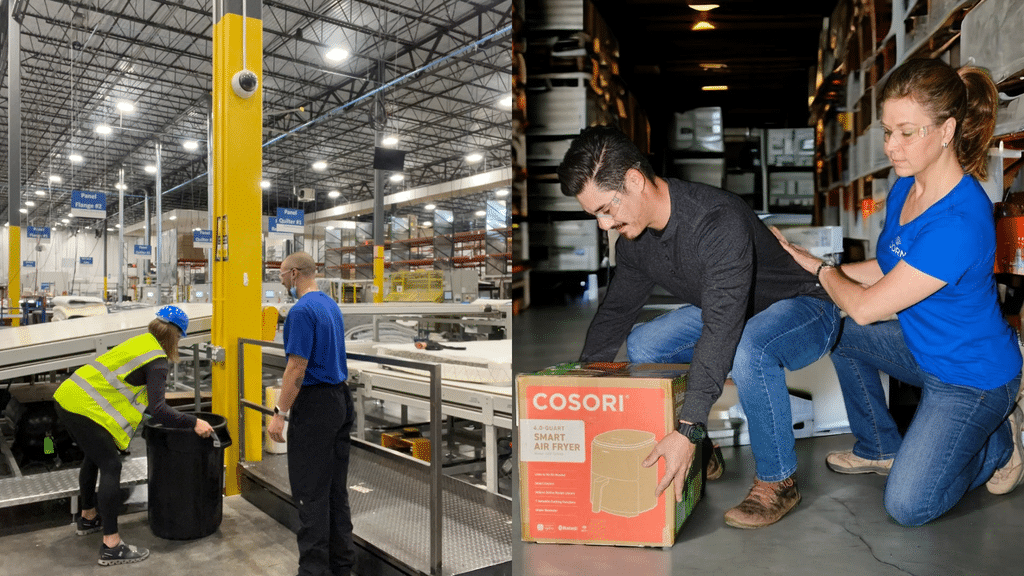
Measure where the risk is, train behavior, then target equipment at the highest-risk workers. The webinar summed it up in three principles:
- Be pragmatic. Measure the risk before you spend. Self-assessments across a distributed workforce find the kitchen-counter and bed-based setups that no site walkthrough will.
- Accept management constraints. You won't buy 20,000 sit-stand desks. Prioritize by risk exposure, not headcount.
- Educate. Behavior is the one variable you can change at scale, at low cost, in every location — office, home, hotel, or vehicle.
What should a workplace injury prevention program for back pain include?
Five parts, in this order:
- Assessment. Map where risk sits across every environment your people work in — plant floor, office, home, and hybrid. Use on-site reviews for physical jobs and self-assessments for remote staff.
- Biomechanics and behavior training. Teach how the spine loads and unloads during real work: lifting and carrying, but also sitting, screen use, and static posture. This is what travels with the worker.
- Targeted equipment and job design. Spend on the groups the assessment flags. For physical jobs, redesign the task first — lift assists, lower shelf heights, smaller loads — before relying on training alone.
- Early intervention. Give workers a fast, low-friction way to report discomfort and get help, such as hands-on therapy, before it becomes a recordable or a claim.
- Measure and repeat. Track discomfort reports, recordables, days away, and claims costs. Reassess at least yearly and after major changes like a move to hybrid work.
This structure fits recognized frameworks, including OSHA's Recommended Practices for Safety and Health Programs, ANSI/ASSP Z10.0 and ISO 45001. OSHA has no specific ergonomics standard, but it can cite serious ergonomic hazards under the General Duty Clause.
Ergonomics for back pain: desk and laptop setup
These changes target the upper and combined back pain that dominates the hybrid data:
- Screen: top of the screen at or slightly below eye level, about an arm's length away.
- Laptop: don't use it on its own all day. Raise it on a stand and add an external keyboard and mouse.
- Chair: feet flat on the floor or a footrest, lower back supported, elbows close to the body at roughly 90 degrees.
- No couch, bed, or counter as a daily workstation. These setups carry two to three times the back pain rate of a desk.
- Movement: change position often. Static posture, not one "bad" posture, drives much of the strain.
Ergonomics for back pain: lifting and manual handling
- Use the NIOSH Revised Lifting Equation to rate lifting tasks. Its maximum recommended load is 51 pounds, and only under ideal conditions.
- Keep loads close to the body and between knee and shoulder height.
- Cut twisting by moving the feet, not the spine.
- Use mechanical aids or team lifts for heavy, awkward, or frequent lifts.
- Rotate tasks to limit repetitive loading on the same tissues.
How DORN helps reduce back injuries
DORN is a global injury prevention and ergonomics partner working in 50+ countries with organizations including Intel, McKesson, DHL, United Airlines, Starbucks, Macy's, and Dana-Farber Cancer Institute. Back injury prevention now has to reach past the four walls you control — the exact problem this research describes.
- Ergonomic assessments. On-site and remote reviews of real workstations, not the ones described in the policy document. This is how you find the 27% and 32% risk groups hiding inside "working from home."
- Biomechanics training. How the body loads and unloads under real work demands. It's the piece most programs skip, and the piece that travels: a worker who understands spinal loading makes better decisions at a pallet and at a dining table. Because 56% of reported pain involves both the upper and lower back, DORN's training covers screen height, static posture, and sustained positions alongside lifting mechanics.
- DORN Hands-On Therapy. Targeted hands-on sessions for employees already living with back pain. DORN-reported results show pain reduced by up to 75% after four sessions — relief that keeps people working at full capacity instead of working through it.
- Back injury prevention and pain reduction programs. Behavior-first programs that follow the worker across every environment — office, home, vehicle, and plant floor.
| DORN client-reported outcome | Result |
| Injury-free employees | 750,000 |
| Client savings | $250M |
| Average annual client ROI | 600% |
| Pain level reduction | 75% |
| Reduction in workers' comp costs | 60% |
| Employees reporting improved morale | 97% |
DORN also offers a free HealthyWorking risk assessment covering 5% of your workforce. That's enough to see whether you have a distributed ergonomics problem before you commit budget to it.
Frequently asked questions
What percentage of office workers have back pain?
In Cardinus' internal dataset of 55,733 desk-based workers, 13.7% reported back pain: 14.4% of hybrid workers, 13.9% of home-based workers, and 11.9% of those in the office full time. In the general population, low back pain affected 619 million people worldwide in 2020 and is the leading cause of disability, according to the WHO.
What is the most common cause of workplace back injuries?
Overexertion. BLS counted 946,290 overexertion, repetitive motion, and bodily condition cases with days away, restricted duty, or job transfer in 2023–2024. That's the largest injury category, about 32% of all such cases, with a median of 14 days away from work.
Do hybrid workers really have more back pain than office workers?
In this study, yes: 14.4% vs 11.9%. The likely cause is inconsistent workstations. Hybrid employees move between an assessed office setup and an unassessed home setup, often using a laptop without a stand, external monitor or proper chair.
Is back pain from working at home OSHA recordable?
It can be. Under 29 CFR 1904.5(b)(7), an injury at home is work-related if it happens while the employee is doing paid work and is directly tied to that work, not the general home environment. But the higher cost is presenteeism, which never reaches the log. Check recordability questions with your compliance counsel.
How much does back pain cost an employer?
An average medically consulted work injury costs about $48,000 (National Safety Council, 2024). For a 10,000-person employer at the 2025 BLS injury rate, roughly 74 overexertion cases a year would cost an estimated $3.5 million. That excludes presenteeism, which is usually larger.
What should a back injury prevention program include in 2026?
Five parts, in order: assessment across every work environment, biomechanics and behavior training, targeted equipment and job design, early intervention for discomfort, and ongoing measurement. Programs built only on equipment and lifting training miss the seated, screen-based risk that now drives much of the problem.
What are the best ergonomics fixes for back pain at a desk?
Raise the screen so its top is at or just below eye level. Put laptops on a stand with an external keyboard and mouse. Use a chair that supports the lower back with feet flat. Change position often, and don't use a couch, bed, or counter as a daily workstation.
What's the highest-impact first step for remote and hybrid workers?
Assessment. About 60% of home and hybrid workers in the study didn't state their seating type, so most employers can't see where the risk is. A workforce-wide self-assessment finds the couch, dining-table, counter, and bed groups (19% to 32% back pain), so budget goes where it's needed.
Our employees haven't complained. Doesn't that mean we're fine?
Not necessarily. 47% of employers in this study believe discomfort is not under-reported among home and hybrid staff — a confidence the prevalence data doesn't support. Remote workers have no safety walkthrough and no supervisor nearby to notice. A lack of complaints is weak evidence of a lack of pain.
We already run manual handling training. Isn't that enough?
It covers part of the problem. Among desk-based workers in the study, only 11% of those with back pain reported lower back pain alone; 56% reported upper and lower back pain together. That points to seated posture, screen position, and static loading, which lifting training doesn't address.
Next steps
- Watch the webinar. Jon Abbott (Cardinus) walks through the full dataset and live Q&A in a session hosted by Kevin Lombardo (DORN). Watch now.
- Download the white paper. Uncovering the Hidden Cost of Back Pain in Modern Workplaces has the full findings from more than 55,000 home, hybrid, and office workers. Read it now.
- Talk to DORN. Building or rebuilding your back injury prevention program? Email info@DORNcompanies.com to discuss an ergonomic assessment, biomechanics training, or a workforce risk baseline.
Sources
- Cardinus Data Project (internal dataset, n = 55,733 desk-based workers), presented by Jon Abbott in a DORN webinar hosted by Kevin Lombardo
- U.S. Bureau of Labor Statistics, Employer-Reported Workplace Injuries and Illnesses, 2025 (released November 18, 2026)
- U.S. Bureau of Labor Statistics, Cases With Days Away From Work and Job Transfer or Restriction, 2023–2024
- U.S. Bureau of Labor Statistics, Injuries, Illnesses and Fatalities: latest numbers
- National Safety Council, Injury Facts: Work Injury Costs
- World Health Organization, Low back pain fact sheet
- National Safety Council, cost per medically consulted injury (2024), used in the employer cost estimate
- U.S. Bureau of Labor Statistics, 2023 telework data (as cited in the webinar)