


October is National Ergonomics Month - a time to recognize the importance of creating safer, healthier work environments for the people who keep our organizations moving.
It’s also budget season.
As safety and operations leaders begin planning for 2027, now is the time to ask an important question:
Is ergonomics an intentional part of your strategy or something you address only after an injury occurs?
At DORN, we believe the greatest opportunity is to get ahead of injuries by identifying risk earlier, understanding what’s driving it, and taking meaningful action to protect your people.
This October, let’s turn ergonomics awareness into action.
Your People Are Your Most Important Investment
In manufacturing, distribution, food processing, utilities, and other physically demanding environments, employees put their bodies to work every day.
We think of these employees as industrial athletes.
They lift, carry, push, pull, reach, bend, climb, and perform repetitive tasks...often for hours at a time.
A strong industrial ergonomics strategy starts by understanding those physical demands and how they interact with the work environment.
Through an ergonomic assessment, organizations can evaluate how work is actually being performed, identify areas of elevated risk, and determine where changes may have the greatest impact. But identifying risk is only the first step.
A Strong Ergonomics Program Goes Beyond the Assessment
Effective ergonomics isn't about completing an assessment, checking a box, and moving on. It's an ongoing process.
The strongest ergonomics programs bring together employees, safety teams, engineering, leadership, technology, and experienced ergonomic consultants to understand risk and develop practical solutions.
- Sometimes that means changing equipment or workstation design.
- Sometimes it means changing the way a task is performed.
- Sometimes it requires hands-on coaching.
- Often, the best solution is a combination of all three.
And increasingly, technology is helping organizations understand which interventions are actually producing results.
Using AI to See Ergonomic Risk Differently
AI motion capture is becoming a powerful addition to the ergonomics toolbox.
Using video of an employee performing a normal task, the technology can help quantify movement, posture, reach, lifting demands, and other ergonomic risk factors.
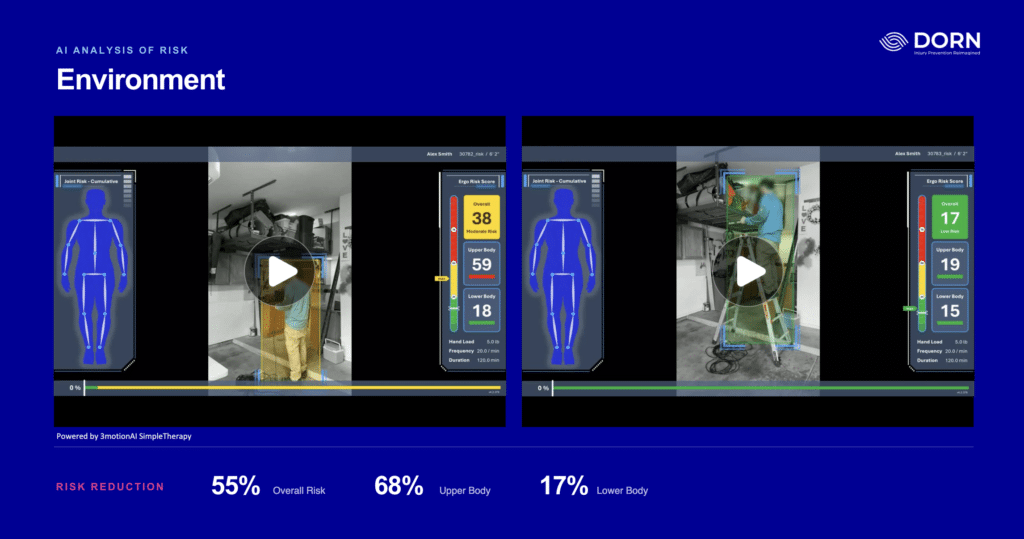
That gives ergonomics teams something extremely valuable: the ability to compare conditions before and after an intervention.
In a four-site DORN pilot highlighted by Director of Program and Service Development Alex Smith, every task with complete data showed a measurable reduction in ergonomic risk. Those reductions ranged from approximately 21% to 90%, averaging roughly 49%.
But the story behind those numbers is even more important.
In one task, a new lifting fixture reduced overall risk by 81%. When behavioral coaching was added, the total reduction reached approximately 90%.
Another task demonstrated why measurement matters even more clearly.
An equipment change intended to reduce risk during elevated ladder work initially increased overall risk by approximately 23% because the new equipment changed the worker’s posture. Once hands-on coaching was added, the task ultimately finished approximately 24% below its original baseline.
The lesson? Don't assume a change reduced risk. Measure it.
Technology can help ergonomic consultants see and quantify risk more quickly, but it doesn't replace professional experience. An experienced ergonomist still plays a critical role in interpreting the data, understanding the work environment, engaging employees, and determining which solution is practical and cost-effective.
What Happens When Prevention Becomes a Priority?
This National Ergonomics Month, DORN CEO Kevin Lombardo is sharing a quick video highlighting results DORN clients reported from their 2026 ergonomics and injury prevention initiatives.
Those results include:
- 67% reduction in risk in just three months
- 87% reduction in incidents
- 95% success rate with an on-site injury prevention program
Every workplace is different, and results will vary. But these examples demonstrate what's possible when organizations move from reacting to injuries to intentionally investing in prevention.
That's the real value of a proactive ergonomic program.
It's not simply about identifying what's wrong.
It's about understanding where risk exists, determining what can be changed, implementing the right solution, and measuring whether that solution actually worked.
National Ergonomics Month Is the Perfect Time to Plan for 2027
October gives us a reason to talk about ergonomics. Budget season allows us to act. As you build your 2027 plan, consider what is happening across your organization today.
- Where are employees experiencing discomfort?
- Which jobs or tasks continue to produce injuries or elevated risk?
- When were your highest-risk jobs last evaluated through a professional ergonomic assessment?
- Are previous engineering changes delivering the results you expected?
- Could on-site injury prevention better support your industrial athletes?
- And most importantly: What could you prevent in 2027 by investing today?
You don't need to have all the answers. You just need to know where to start.
Watch the Video: See What’s Possible in 2027
Take a few minutes to watch this video from DORN CEO Kevin Lombardo and hear about results DORN clients reported in 2026. Then let's talk about your organization.
Whether you need an ergonomic assessment, experienced ergonomic consultants, a comprehensive industrial ergonomics program, or on-site injury prevention support for your industrial athletes, DORN can help you identify risk, prioritize opportunities, and develop a strategy around the needs of your workforce.
Schedule your 2027 budget planning meeting with DORN today.
National Ergonomics Month may last one month. The impact of a stronger ergonomics strategy can last all year.
Frequently Asked Questions About Ergonomics Programs
What is an ergonomic assessment?
An ergonomic assessment evaluates the physical demands of a job or task to identify potential ergonomic risks. Depending on the work, an assessment may examine posture, lifting, reaching, force, repetition, task frequency, equipment, workstation design, and how employees perform the task.
What does an ergonomic consultant do?
An ergonomic consultant helps organizations identify workplace ergonomic risks and develop practical strategies for addressing them. This can include ergonomic assessments, job and task analysis, recommendations for engineering or administrative controls, employee coaching, and evaluating whether implemented changes are producing the intended results.
What is industrial ergonomics?
Industrial ergonomics focuses on fitting physically demanding work to the capabilities of the people performing it. It can address risks associated with lifting, pushing, pulling, carrying, repetitive motion, awkward posture, reaching, workstation design, equipment, and other physical demands commonly found in manufacturing and industrial environments.
What is an industrial athlete?
The term industrial athlete describes employees whose jobs require significant physical activity and repetitive or demanding movements. Like traditional athletes, industrial athletes benefit from strategies designed to support movement, physical readiness, recovery, and injury prevention.
How can an ergonomics program help prevent workplace injuries?
A proactive ergonomics program can help organizations identify risk before an injury occurs. Ergonomic assessments, engineering improvements, employee coaching, technology, and on-site injury prevention can work together to address physical demands and support safer ways of working.
Can AI replace an ergonomic consultant?
AI motion capture can provide valuable objective data about movement and ergonomic risk, but it does not replace an experienced ergonomist. AI can help identify and quantify potential risks, while trained professionals are still needed to interpret the results, understand the context of the work, and determine appropriate and cost-effective interventions.