

Annual body mechanics training rarely changes how people move. Employees leave the session understanding the correct technique, return to the same workstation, and within a shift their bodies revert to the pattern they have repeated ten thousand times. The instruction was never the problem. The environment that taught the habit is still there, and one hour of demonstration cannot outweigh months of repetition.
That is the uncomfortable finding behind most ergonomics programs that plateau. It is also fixable, and the fix is cheaper than most safety leaders expect.
Key takeaways
- One-time training creates awareness, not automaticity. Movement habits form through repetition and only change through repetition.
- The workplace itself teaches movement. A workstation angled the wrong way trains twisting more effectively than any instructor can untrain it.
- Engineering controls can temporarily increase measured risk if workers are not coached on how to use the new setup.
- In a six-month DORN pilot, behavioral coaching alone reduced low-back risk by 51% on tasks where engineering changes were not yet possible.
- Sustainable change needs three things together: personal buy-in, ongoing reinforcement from frontline supervisors, and a trusted way for employees to flag environmental barriers.
Watch a toddler pick something up
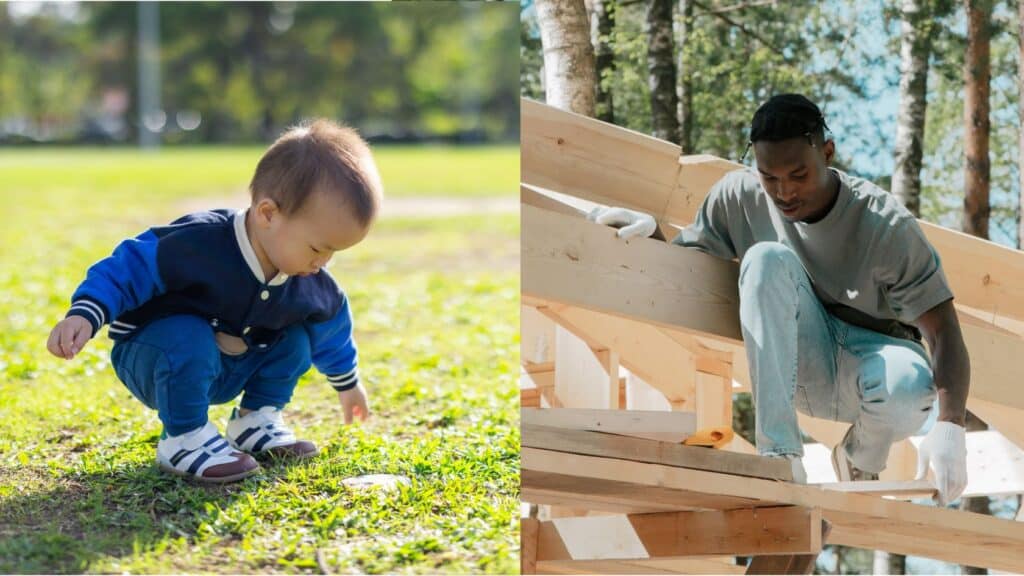
A toddler lowers their hips, keeps the object close, and pushes back up through the legs. Nobody taught them that. Their coordination and strength are still developing, so their body defaults to the position that keeps them stable.
Now watch an adult pick up a pen. Most of us bend at the waist, reach, grab, and stand, no thought required. The pen weighs nothing, so the movement feels free.
It isn't free. It is just cheap enough that we never notice the charge.
Adults have the strength, balance, and core control to override good mechanics. We can twist instead of stepping. We can reach outside the power zone instead of repositioning. We can work overhead instead of adjusting the height first. Each shortcut buys a second or two and costs the body a small tax.
One tax is nothing. Several thousand a week, over fifteen years, is a debt.
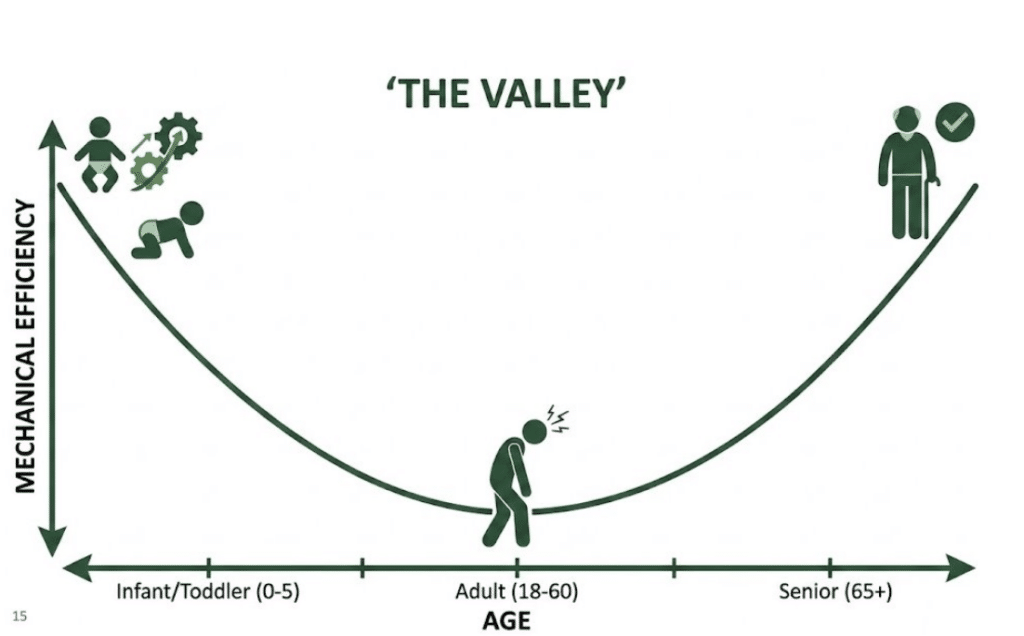
Alex Smith, DORN's Director of Program and Service Development and Senior Ergonomist, calls this the valley of mechanical efficiency. We start life moving well because we have no choice. We spend our working years strong enough to cut corners. Then reduced mobility, joint changes, or an old injury forces us back into deliberate movement, often after the damage is done.
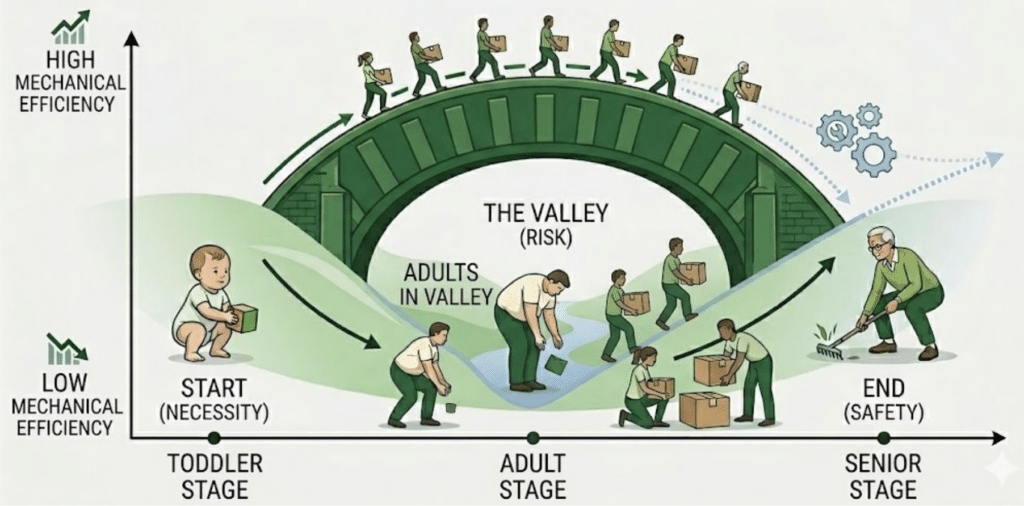
The goal of a good ergonomics program is not to eliminate the valley. It is to keep people from falling so far into it.
Your workstation is a training program
Movement never happens in isolation. Tool design, work height, material placement, lighting, floor space, production pace, fatigue, and previous injuries all shape how a person completes a task.
When the environment restricts natural movement, the body adapts, and the adaptation outlives its cause.
Someone recovering from an ankle fracture changes how they walk, stand, and shift weight. The fracture heals. The limp fades. Elements of the compensation stay because by then the pattern is a habit rather than a response to pain.
The same thing happens on a production floor.
Picture an employee transferring boxes between two surfaces set at an angle to each other, several hundred times a shift. Planting the feet and rotating through the torso feels faster than pivoting the whole body. Within weeks, the twist is automatic. Within months it follows them home, and they twist to move a box in their own garage where nothing is forcing them to.
The workstation trained that. No amount of "remember to lift properly" competes with a geometry that rewards the shortcut every single time.
This is why injury prevention that focuses only on worker instruction stalls. You have to look at what the job is teaching.
Mechanical efficiency versus energy efficiency
These two goals pull against each other, and most workplaces quietly reward the wrong one.
Mechanical efficiency distributes force well: stable base, load close to the body, work inside the power zone, strong muscle groups doing the work.
Energy efficiency finishes the immediate task with the least effort right now.
Toddlers pick mechanical efficiency because they lack the strength to do anything else. Older adults often return to it to protect a joint or preserve balance. The working-age adult in between is strong enough to choose speed and production targets make that choice for them every hour.
Small changes, repeated, do the heavy lifting
Better mechanics rarely require dramatic intervention.
In that box-transfer task, pivoting with the feet instead of rotating through the spine adds perhaps two seconds. Repeated across a shift, it removes hundreds of rotational loads from the lumbar spine, which is the plane where the back is least able to tolerate them.
Work height behaves the same way. Materials stored too low pull workers into a deep, unsupported reach. Raising the surface, or simply teaching the worker to step in closer first, moves the load toward the body's center of gravity and lets the legs and hips carry it.
Overhead work is the third common offender. Sustained arm elevation loads the shoulder, neck, and upper back, and forces the head into extension. Bringing the work down does more than reduce reach, it restores the worker's ability to generate force efficiently.
In a demonstration, these look trivial. Across a 50-hour week with real materials, repeated for years, they are the difference between a workforce that ages well and one that doesn't.
Why one-time training doesn't stick
The standard model is familiar. An instructor shows the wrong way, shows the right way, and asks everyone to use the new method starting Monday.
The information is correct. Employees understand it. Many agree with it. And almost nothing changes.
Understanding a movement is not the same as owning it. The brain builds efficient neural pathways through repetition, the same process that turns riding a bicycle from a concentration exercise into something you do while holding a conversation.
Relearning is harder than learning, because the old pathway is still there competing. An employee can fully believe pivoting beats twisting and still twist during a fast shift, because that is the pattern their nervous system reaches for under time pressure.
Then they return to the same workstation, the same pace, the same colleagues using the old method, and the same production numbers. The habit wins.
Treat training as the start of behavior change, not the whole of it.
The three pillars of durable behavior change
1. Education that connects to their life, not just your TRIR
Employees need to know why the change matters to them.
Fear-based messaging produces compliance while a supervisor is watching and stops the moment the perceived threat leaves. Connecting safer movement to life outside work produces something more durable — having the physical capacity at 55 to garden, coach a team, work on a car, or keep up with grandchildren.
The organization wants fewer claims and less disruption. Say so honestly. Then give the employee a reason that belongs to them.
2. Reinforcement from the people on the floor
New patterns need practice, and practice needs prompting.
Frontline supervisors matter more here than any external expert, because they are present all day. Recognition works: noticing out loud that someone stepped in closer before lifting, or repositioned their feet before a transfer, keeps the standard alive between safety meetings.
Onsite ergonomists and injury prevention specialists extend this with task-specific coaching, but they supplement supervisor reinforcement rather than replacing it.
3. Empowerment to name the barrier
Workers spot ergonomic problems before anyone else. They know which workstation is too low, which tool is hard to grip, which material location forces a reach.
Most say nothing, because they have concluded nothing will change.
Give them a clear, trusted route to report barriers, recommend fixes, and close the loop visibly when something gets fixed. Empowerment also means acknowledging the limit: no amount of good technique overcomes a workstation that makes safe movement impossible.
Engineering controls need coaching to deliver
This is the finding most safety teams don't expect.
DORN recently ran a motion-capture pilot with a manufacturer of industrial doors, hardware, hinges, and handles, covering four sites, two manufacturing plants and two field installation and maintenance operations, across the United States and France.
The team assessed high-risk areas, then used motion capture to establish objective baselines on specific tasks. Over roughly six months, DORN and the client implemented engineering, administrative, and behavioral changes, then re-measured.
Most engineering controls reduced risk as predicted. But on several tasks, risk scores went up slightly after the environmental change.
The equipment wasn't wrong. The workers hadn't yet learned how to position themselves within the new setup. Some didn't know the best way to hold a redesigned tool; others stood where the old layout had taught them to stand.
Once the engineering change was paired with body mechanics coaching, posture awareness, and physical-tolerance training, the full benefit appeared.
Buying the fix is half the intervention. Teaching people to work inside it is the other half.
What behavioral coaching achieved on its own
Not every improvement can be engineered immediately. Budgets, lead times, production schedules, and facilities constraints all delay physical changes.
During the pilot, some tasks had to be addressed primarily through coaching and repetition. Measured against motion-capture baselines:
| Measure | Result |
|---|---|
| Low-back-related risk | 51% reduction |
| Upper-shoulder risk score | 37% improvement |
| Time spent within a safer reach distance | 300% improvement |
| Time spent within a safer vertical power zone | 154% improvement |
These figures do not argue for coaching instead of engineering controls. They show that education, repetition, and reinforcement measurably reduce exposure while larger changes are being planned or where an engineering solution isn't available at all.
The strongest programs run both together.
Where technology genuinely helps
Wearable sensors deliver feedback at the moment of the movement. A vibration when a worker enters a high-risk posture interrupts the automatic pattern precisely when interruption is useful, the same principle as a smartwatch nudging you to stand.
AI-powered motion capture solves a specific coaching problem: people cannot see themselves move. An ergonomist demonstrates, the employee copies, and the employee genuinely believes they have matched it. Video with color-coded posture indicators settles the argument without anyone needing a biomechanics background. Green is fine, red needs attention, and now there is a shared reference point for measurement.
Exoskeletons support alignment and offload specific regions in the right applications. They require careful evaluation of worker, task, fit, and, critically, whether the device transfers risk somewhere else.
Virtual and augmented reality allow task-specific repetition in a controlled setting, giving workers practice before they face the full physical demands of the real job.
None of this replaces expertise. Technology shows how someone is moving. A practitioner works out why — what the environment is contributing, what the person's history is doing, and which change is actually practical.
Questions worth asking before an injury happens
Reactive programs start after the pain report. Proactive programs ask:
- What movement habits is this job teaching?
- Which tasks are repeated often enough to accumulate exposure?
- Are employees compensating for fatigue, discomfort, or an old injury?
- Do workers understand why mechanics matter to their own lives?
- Are supervisors reinforcing this between training sessions?
- Can employees report an ergonomic barrier without friction?
- Are improvements measured objectively, or assumed?
- Does every engineering change include training on how to use it?
Reclaiming the movement blueprint
Moving like a toddler doesn't mean copying a child. It means recovering the principles their bodies default to:
- Build a stable base
- Move the feet instead of twisting the spine
- Keep the load close
- Drive with the hips and legs
- Work inside strong reach zones
- Change the environment where you can
- Choose mechanical efficiency over the fastest shortcut
- Practice until the safer pattern is the automatic one
Adults can ignore all of this for years, which is exactly what makes it dangerous. Strength doesn't cancel cumulative stress. It postpones the bill.
Sustainable injury prevention isn't asking people to overcome bad design through willpower. It's building an environment where the safer movement is also the easier one, then reinforcing it until nobody has to think about it.
At DORN, we combine ergonomics, injury prevention, movement coaching, on-site support, and motion-capture measurements to help organizations move beyond one-time training and reactive injury management. The point isn't only preventing an incident on shift. It's people going home with enough left to enjoy the rest of their lives. Schedule your free consultation today.
FAQ for EHS and safety professionals
Why do employees continue to use poor body mechanics after training? They aren't ignoring the training. Their movement habits were built through thousands of repetitions, usually in an environment that makes the safer option slower or harder. Once a pattern is automatic, changing it takes practice and reinforcement, not more information.
Why isn't one-time lifting training enough? One-time training builds awareness but rarely changes behavior. Employees return to the same workstation, pace, tools, and targets, and the established pattern reasserts itself within a shift. Durable change requires repetition, supervisor reinforcement, and coaching in the actual work environment.
Should employers prioritize engineering controls or behavior change? Both, together. Engineering controls remove or reduce the source of risk. Coaching teaches workers how to interact safely with the task and the equipment. DORN's motion-capture pilot found that engineering changes sometimes raised measured risk until workers were coached on the new setup.
How much can coaching alone achieve? On tasks where engineering changes weren't yet feasible, DORN's six-month pilot measured a 51% reduction in low-back-related risk and a 37% improvement in upper-shoulder risk score through behavioral intervention alone.
How can an EHS team start this week? Look at the tasks employees repeat most. Ask whether the environment supports safe movement or forces bending, twisting, reaching, or overhead work. Then find the smallest change that makes the safer movement the easier one.